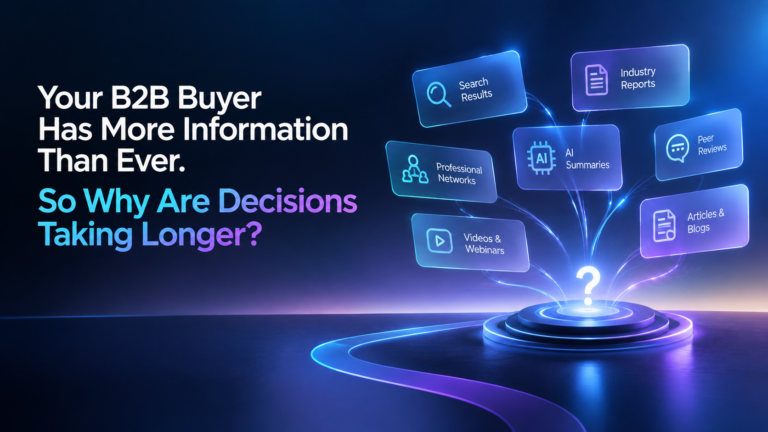
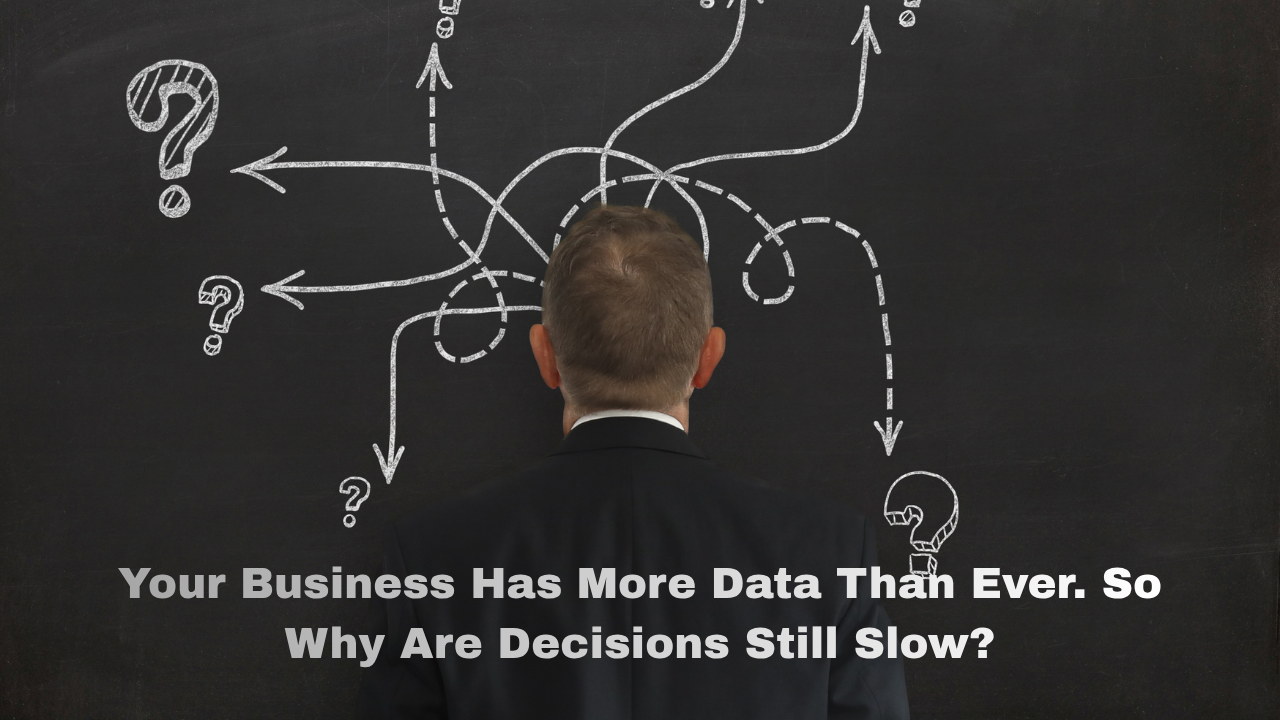
Businesses have access to more information than ever before. Sales teams have CRM data, marketing teams have campaign and customer behaviour data, finance has financial reporting, HR has workforce analytics, operations has performance dashboards, and IT has system and usage data. On top of this, AI can increasingly generate insights, forecasts and recommendations from these information sources. Yet data-driven decision making is not necessarily becoming easier. In many organisations, decisions are still slowed by conflicting numbers, disconnected systems, approval layers and requests for more information.
Data-driven decision making has become a critical capability for modern businesses, but having access to large volumes of information does not automatically lead to better outcomes. Effective data-driven decision making requires organisations to identify the most relevant signals, understand their business context and connect those insights to clear actions. As companies collect more data across sales, marketing, finance, operations and customer experience, the ability to turn that information into timely decisions is becoming just as important as the ability to collect it.
The challenge for many enterprises is no longer a lack of information but ineffective data-driven decision making. Business leaders may have access to multiple dashboards, reports, analytics platforms and AI-generated insights, yet still struggle to determine which information should influence a decision. Strong data-driven decision making depends on separating actionable information from background noise and ensuring that decision-makers receive the right information when it matters most.
Why More Business Data Does Not Always Mean Better Decisions –
For years, data maturity was often associated with how much information an organisation could collect, store, analyse and visualise. Modern businesses have invested heavily in data warehouses, analytics platforms, dashboards and reporting systems to make information more accessible.
However, accessibility does not automatically create clarity.
Different departments can have their own definitions, reporting systems and priorities. Marketing might see strong lead volume while sales sees weak-quality opportunities. Finance might see healthy revenue while operations sees rising delivery costs. Customer success might report strong engagement while product teams see declining usage.
None of these teams necessarily has incorrect data. The challenge is that the organisation lacks sufficient context to understand how those signals fit together.
When data is fragmented, decision-makers often have to spend valuable time reconciling information before they can even start deciding what to do.
This can lead to:
- Multiple versions of the same business metric
- Conflicting departmental reports
- Delayed executive decisions
- Repeated requests for additional analysis
- Unclear ownership of business outcomes
- Excessive dependence on meetings to interpret data
The result is an organisation that may be highly informed but not necessarily highly aligned.
The Real Problem Is Not Data Volume. It Is Decision Speed.
Business environments are moving faster. Customer expectations change, competitors adjust their strategies, operating models evolve and technology continues to reshape how products and services are delivered.
In that environment, information can lose value when it arrives too late.
A forecast that was useful at the beginning of a month may not provide enough context several weeks later. Yet many businesses still operate through reporting cycles in which information is collected, cleaned, analysed, presented, discussed and eventually converted into action.
By the time the decision is made, the original business signal may have changed.
PwC’s 2026 Digital Trends in Operations research illustrates the challenge. The research found that only 51% of respondents said their organisations establish a clean, structured data foundation before scaling digital initiatives, while 60% said poor data quality had affected their ability to achieve value from those initiatives. It also found that 89% considered actionable data more important than comprehensive data, while 84% were comfortable making decisions when data was not perfect.
The implication is important: businesses do not always need more information before making a decision. They need the right information at the moment the decision needs to be made.
Focus on Actionable Data, Not Just More Data –
One of the most important shifts in data-driven decision making is moving from data collection to data prioritisation.
Not every metric deserves executive attention. Not every fluctuation requires intervention. Not every report needs to exist.
Organisations need to distinguish between information that is interesting and information that is actionable.
Actionable data helps decision-makers understand:
- What has changed?
- Why does the change matter?
- Who needs to know?
- What decision needs to be made?
- What action should follow?
- How will the outcome be measured?
This changes the role of analytics. Instead of producing increasingly large volumes of information, analytics teams can focus on identifying the signals that genuinely influence business outcomes.
For example, an enterprise may monitor hundreds of customer metrics but only a smaller number may be directly relevant to decisions about retention, expansion or customer experience.
The objective is not to eliminate information. It is to make the most important information easier to recognise.
Treat Data Quality as a Strategic Business Capability –
Data quality is often treated as a technical responsibility. Data teams clean databases, IT teams maintain infrastructure and analysts validate reports.
But poor data quality can affect decisions across the entire organisation.
A data point can be technically accurate and still be insufficient for a decision because it is:
- Outdated
- Too narrow
- Missing relevant context
- Isolated from other business signals
- Based on inconsistent definitions
Consider a customer record in a CRM. The classification might be completely accurate, but it may tell decision-makers very little about the customer’s current situation if recent support interactions, purchasing behaviour, product usage or changing requirements are stored elsewhere.
This is why data quality needs to be considered alongside data context and usability.
Gartner’s 2026 research similarly emphasises data quality as a strategic capability and connects stronger data and analytics foundations with better outcomes from AI initiatives.
For enterprises investing in AI, this becomes particularly important. AI can process poor-quality or inconsistent information at scale. It does not automatically correct weaknesses in the underlying business data.
Break Down Data Silos Across Business Functions –
Data silos remain a major obstacle to effective data-driven decision making.
Businesses can invest in modern platforms and still struggle with disconnected information because the underlying issue is not always technical. It can also be organisational.
Marketing, sales, finance, operations, product and customer success may each have different definitions, incentives and priorities.
A business might have a central data warehouse and still have several interpretations of:
- What constitutes a qualified lead
- What defines an active customer
- What makes an account profitable
- What counts as a successful project
- Which revenue numbers should drive planning
Technology can improve the movement of information. It cannot automatically create agreement about what that information means.
This distinction becomes even more important as organisations introduce AI into workflows. AI can scale useful information, but it can also scale inconsistent definitions and assumptions.
The goal should therefore be more than integration. Enterprises need shared business definitions and a common understanding of how data connects to organisational outcomes.
Build a Clear Decision Architecture –
The next evolution of data maturity may be less about collecting information and more about creating a decision architecture.
A decision architecture connects:
Business objective → Relevant signal → Decision-maker → Action → Outcome
This creates a direct relationship between what an organisation measures and what it actually does.
For every important business metric, leaders should be able to answer four fundamental questions:
- What does this metric tell us?
- Why does it matter?
- Who needs to act on it?
- What should happen next?
Without these connections, organisations can become very good at measurement without becoming better at management.
They may know what happened but disagree about why it happened. They may know what is changing but not who should respond. They may see an important metric move but struggle to connect it to business priorities.
A decision architecture helps turn analytics from a reporting function into an operating capability.
Connect Data Ownership With Decision Ownership –
Another common problem is confusing data ownership with decision ownership.
IT may own the infrastructure. Data teams may manage pipelines. Finance may own financial reporting. Marketing may own acquisition data. Sales may own pipeline information. Operations may own operational metrics.
But who owns the decision when those datasets point in different directions?
This question becomes increasingly important as business decisions become more cross-functional.
For example, customer acquisition affects sales. Sales affects revenue forecasting. Revenue affects planning. Planning affects operations. Operations affects customer experience. Customer experience affects retention and future revenue.
A decision made within one department can therefore create consequences across several others.
Organisations should establish clear decision ownership for critical business outcomes rather than assuming that the team owning the underlying data automatically owns the decision.
This can help prevent a situation in which every department optimises its own dashboard while the broader organisation becomes slower.
Use AI to Improve Decisions, Not Just Productivity –
AI is changing the economics of business analysis.
Instead of waiting for an analyst to prepare a report, leaders can increasingly use AI systems to analyse trends, compare scenarios, identify anomalies, summarise performance and generate recommendations.
But more recommendations do not automatically produce better decisions.
An AI system might identify ten potential problems in seconds. The business still needs to determine:
- Which problem matters most
- Whether the signal is reliable
- What context is missing
- What the potential consequences are
- Who should act
- How the result should be evaluated
This is why AI investment should not be measured solely by how much manual work it eliminates.
The more strategic question is whether AI helps an organisation make decisions that are faster, better informed, more consistent and more closely connected to business outcomes.
Gartner reported in July 2026 that only 20% of finance AI projects were primarily focused on improving decision quality, compared with 45% that were more heavily focused on productivity.
The distinction matters.
Automating a task can save time. But saving time does not automatically improve the decision that follows.
The next phase of enterprise AI will therefore require a stronger connection between AI capabilities and decision processes.
Give Leaders Enough Information to Act With Confidence –
When information was scarce, access to information itself could create competitive advantage.
Today, information is everywhere.
The differentiator is increasingly the ability to interpret information correctly and act on it quickly.
This changes the role of leadership in a data-rich organisation. Leaders should spend less time asking whether another report can be produced and more time asking whether the organisation already has enough reliable information to make the decision.
That requires clarity around:
- Which metrics matter
- How those metrics connect to strategic priorities
- Who has decision authority
- What controls are necessary
- When escalation is required
- How outcomes will be measured
Speed does not mean eliminating governance.
In fact, good governance can enable speed when decision rights, definitions and escalation paths are clear. People spend less time rediscovering how decisions should be made because the organisation has already established the framework.
Data-Driven Decision Making Requires More Than Better Technology –
It is tempting to treat every data problem as a technology problem.
A new dashboard can be purchased. A data platform can be implemented. An AI assistant can be deployed. A reporting process can be automated.
But technology alone does not create organisational intelligence.
A business can have sophisticated systems and still experience slow decisions if:
- Teams disagree about definitions
- Decision ownership is unclear
- Data lacks context
- Governance is complicated
- Leaders receive too many competing signals
- Employees do not know which information should drive action
The real challenge is connecting technology with operating processes.
This means businesses need to think about data, analytics, AI, governance and decision-making as parts of the same system rather than isolated technology initiatives.
Conclusion –
The challenge facing modern businesses is no longer simply a shortage of data. It is the growing complexity of turning abundant information into timely, confident decisions.
Data-driven decision making requires more than dashboards, analytics platforms or AI tools. It depends on reliable data, shared definitions, clear decision ownership, strong governance and a direct connection between business signals and business outcomes.
The companies that build this capability effectively will not necessarily have more data than their competitors. They will be better at identifying what matters, understanding the context behind it and acting before the opportunity or problem changes.
As AI makes analysis faster and information more abundant, the competitive advantage may increasingly belong to organisations that can create the shortest reliable path between a signal and a decision.
Frequently Asked Questions
Data-driven decision making is the practice of using reliable, relevant business data and analysis to inform organisational decisions. It connects business signals with context, decision ownership and measurable outcomes rather than relying solely on intuition or isolated reports.
Businesses can struggle because of fragmented systems, data silos, inconsistent definitions, poor data quality, unclear decision ownership and excessive reporting. Having more data does not automatically resolve these challenges.
Data quality affects whether decision-makers can trust and correctly interpret the information available to them. Even technically accurate data may be less useful when it is outdated, incomplete, isolated or missing important business context.
Actionable data is information that can meaningfully influence a decision or action. It helps an organisation understand what is changing, why it matters, who should respond and what should happen next.
AI can help analyse large amounts of information, identify patterns and anomalies, compare scenarios, summarise performance and generate recommendations. However, organisations still need appropriate governance, context and decision ownership to turn AI-generated insights into effective action.