The Future of CRM Is No Longer About Managing Relationships—It’s About Building Them
For decades, AI-powered CRM was little more than a digital record keeper. Traditional CRM platforms stored contacts, tracked emails, monitored sales pipelines, and generated reports. While valuable, they were largely reactive—sales teams updated information after customer interactions instead of using CRM to shape future engagement.
Today, artificial intelligence is transforming CRM into something far more powerful. Instead of simply recording customer data, AI-powered CRM can predict buyer intent, personalize outreach, automate engagement, and strengthen relationships long before a salesperson joins the conversation.
This shift marks one of the biggest transformations in enterprise sales. The future of CRM isn’t about managing relationships—it’s about helping create them.
Why Traditional CRM Is No Longer Enough
The modern B2B buying journey has changed dramatically.
Enterprise buyers research products through AI assistants, LinkedIn, webinars, analyst reports, online communities, and review platforms before ever speaking to a sales representative. By the time a lead reaches the sales team, much of the buying decision has already been influenced.
Traditional CRM systems struggle in this environment because they only capture historical interactions. Modern organizations need CRM platforms that understand customer behavior in real time and respond proactively.
How AI-Powered CRM Understands Customer Intent
Every customer interaction leaves behind valuable signals, including:
- Website visits
- Content downloads
- Webinar attendance
- Pricing page visits
- Product comparisons
- Social media engagement
- Support conversations
Individually these actions reveal little, but together they tell a complete story.
AI analyzes these behavioral signals to determine where buyers are in their purchasing journey. Instead of relying on static lead scoring, intelligent CRM continuously updates customer profiles, predicts buying intent, and recommends the best next action.
AI analyzes behavior, predicts needs, and delivers personalized experiences—before the first sales call.
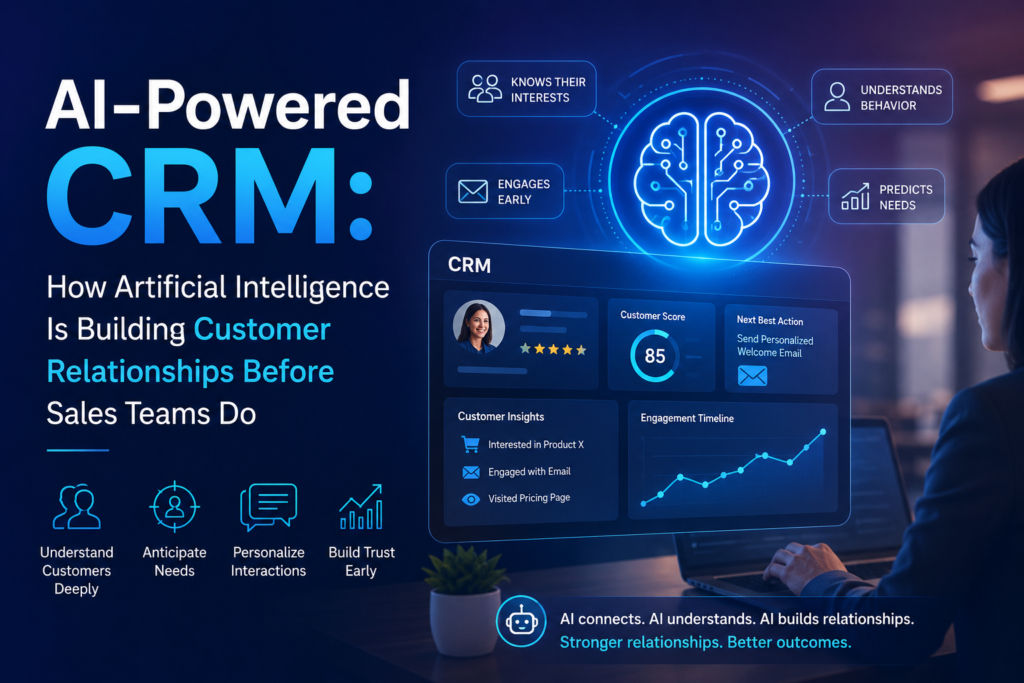
Building Customer Relationships Before Your Sales Team Even Reaches Out
AI is transforming CRM by analyzing customer behavior, predicting intent, and delivering personalized experiences before your sales team makes the first contact. Build stronger relationships, increase engagement, and accelerate growth with intelligent automation.
Personalization at Enterprise Scale
Personalization has always been essential in B2B marketing, but delivering it across thousands of accounts has been difficult.
AI changes this completely.
An AI-powered CRM can automatically create personalized communication based on:
- Industry trends
- Company news
- Executive priorities
- Previous conversations
- Customer behavior
- Competitive insights
Instead of sending the same follow-up email to every prospect, AI delivers tailored messages for different stakeholders. Technical leaders receive architecture documentation, finance teams receive ROI information, while executives receive strategic business insights—all without manual effort.
Traditional CRM vs AI-Powered CRM
| Feature | Traditional CRM | AI-Powered CRM |
|---|---|---|
| Data Management | Manual updates | Automated capture |
| Customer Insights | Historical data | Predictive intelligence |
| Sales Process | Reactive | Proactive |
| Personalization | Limited | AI-driven |
| Forecasting | Basic reports | Predictive analytics |
Key Insight : AI-powered CRM uses artificial intelligence to predict customer intent, automate engagement, personalize experiences, and help businesses build relationships proactively.
Predictive CRM Is Replacing Reactive Sales
Traditional CRM systems help organizations understand what has already happened. AI-powered CRM helps businesses prepare for what is likely to happen next.
Using machine learning and predictive analytics, AI evaluates customer behavior alongside external business signals to forecast future opportunities. It considers factors such as company growth, executive hiring, funding announcements, technology adoption, competitive activity, and historical purchasing patterns to identify accounts that are most likely to convert, expand, renew, or churn.
This predictive intelligence allows businesses to move from reactive selling to proactive relationship building.
Instead of waiting for a customer to request information, AI may recommend sharing a relevant case study after detecting increased engagement with a specific product category. If buying intent appears to decline, the system can suggest delaying outreach or introducing additional stakeholders before momentum is lost.
Together, these insights create a living profile of every customer relationship.
Instead of simply recording interactions, CRM begins understanding the health, strength, and future potential of every account. This allows organizations to engage customers with greater relevance, anticipate challenges earlier, and build stronger long-term partnerships.
Autonomous CRM: When AI Starts Taking Action
The evolution of CRM becomes even more powerful when artificial intelligence moves beyond analysis and begins taking action. Early AI tools focused on recommending next steps, but the next generation of AI-powered CRM is becoming increasingly autonomous. Instead of simply identifying opportunities, these systems can initiate routine interactions, prepare sales teams for meetings, and manage administrative tasks without constant human input.
Imagine a sales representative beginning the day with a complete briefing already prepared. Meeting summaries, customer sentiment, recent company news, competitive insights, and recommended talking points are generated automatically before the first call. Follow-up emails are drafted, proposals are personalized, and action items are assigned without requiring manual effort.
Modern AI-powered CRM platforms are already capable of automating tasks such as:
- Summarizing customer meetings and conversations
- Drafting personalized follow-up emails
- Scheduling meetings based on customer availability
- Preparing executive account briefings
AI Agents Are Reshaping Customer Relationship Management
The future of CRM will not rely on a single AI assistant. Instead, it will operate through a network of specialized AI agents working together behind the scenes.
Each agent will focus on a specific responsibility while continuously sharing intelligence with the rest of the CRM ecosystem. One agent may monitor customer sentiment, another may analyze competitor activity, while others track renewal opportunities, optimize pricing recommendations, or identify potential cross-sell opportunities.
Together, these intelligent agents can:
- Monitor buying intent across multiple channels
- Detect changes in customer priorities
- Track competitor movements
- Recommend expansion opportunities
AI Enhances Human Relationships Instead of Replacing Them
Whenever artificial intelligence enters the conversation, one question inevitably follows: Will AI replace sales professionals?
The evidence suggests otherwise.
Enterprise sales has always been built on trust, credibility, and strategic thinking—qualities that technology cannot fully replicate. While AI excels at analyzing data, identifying patterns, and automating repetitive tasks, customers still value authentic conversations, industry expertise, empathy, and confident decision-making.
The relationship between AI and sales is therefore complementary rather than competitive.
Artificial intelligence is best suited to handling:
- Data analysis and forecasting
- Administrative tasks
- Routine customer communication
- Lead qualification
- Meeting preparation
Conclusion
The silent CRM revolution is no longer a future possibility—it is already reshaping how enterprises build and manage customer relationships. As artificial intelligence becomes deeply integrated into CRM platforms, businesses are moving beyond simply tracking interactions to understanding customer intent, predicting needs, and delivering personalized experiences at scale.
However, the future of AI-powered CRM is not about replacing human relationships. Trust, empathy, strategic thinking, and meaningful conversations will remain the foundation of successful B2B sales. AI’s real value lies in removing administrative complexity, uncovering actionable insights, and enabling sales teams to focus on the moments where human expertise creates the greatest impact.
Organizations that embrace this transformation today will be better equipped to anticipate customer needs, strengthen long-term relationships, and make faster, data-driven decisions. Those that continue relying on traditional, reactive CRM workflows risk falling behind in an increasingly intelligent and competitive marketplace.
Frequently Asked Questions (FAQs)
An AI-powered CRM is a customer relationship management system that uses artificial intelligence to automate routine tasks, analyze customer behavior, predict buying intent, and deliver personalized recommendations. Unlike traditional CRM platforms that primarily store customer data, AI-powered CRM actively helps businesses strengthen customer relationships through real-time insights and intelligent automation.
Artificial intelligence is transforming CRM from a reactive database into a proactive relationship management platform. It can analyze customer interactions across multiple channels, predict future buying behavior, automate follow-ups, personalize communication, and provide sales teams with actionable insights before they engage with prospects.
No. AI is designed to support—not replace—sales professionals. While AI can automate administrative tasks such as meeting summaries, lead qualification, and follow-up emails, human expertise remains essential for strategic consulting, complex negotiations, and building trust-based customer relationships.
AI-powered CRM helps businesses improve productivity, increase sales efficiency, and deliver better customer experiences. Key benefits include predictive analytics, personalized customer engagement, automated workflows, improved forecasting, higher data accuracy, and better collaboration across sales, marketing, and customer success teams.
AI-powered CRM continuously analyzes customer behavior, engagement patterns, and buying signals to recommend the best next actions. This enables businesses to deliver timely, personalized interactions that build trust, improve customer satisfaction, and strengthen long-term relationships throughout the buyer journey.