Physical Address
304 North Cardinal St.
Dorchester Center, MA 02124
Physical Address
304 North Cardinal St.
Dorchester Center, MA 02124

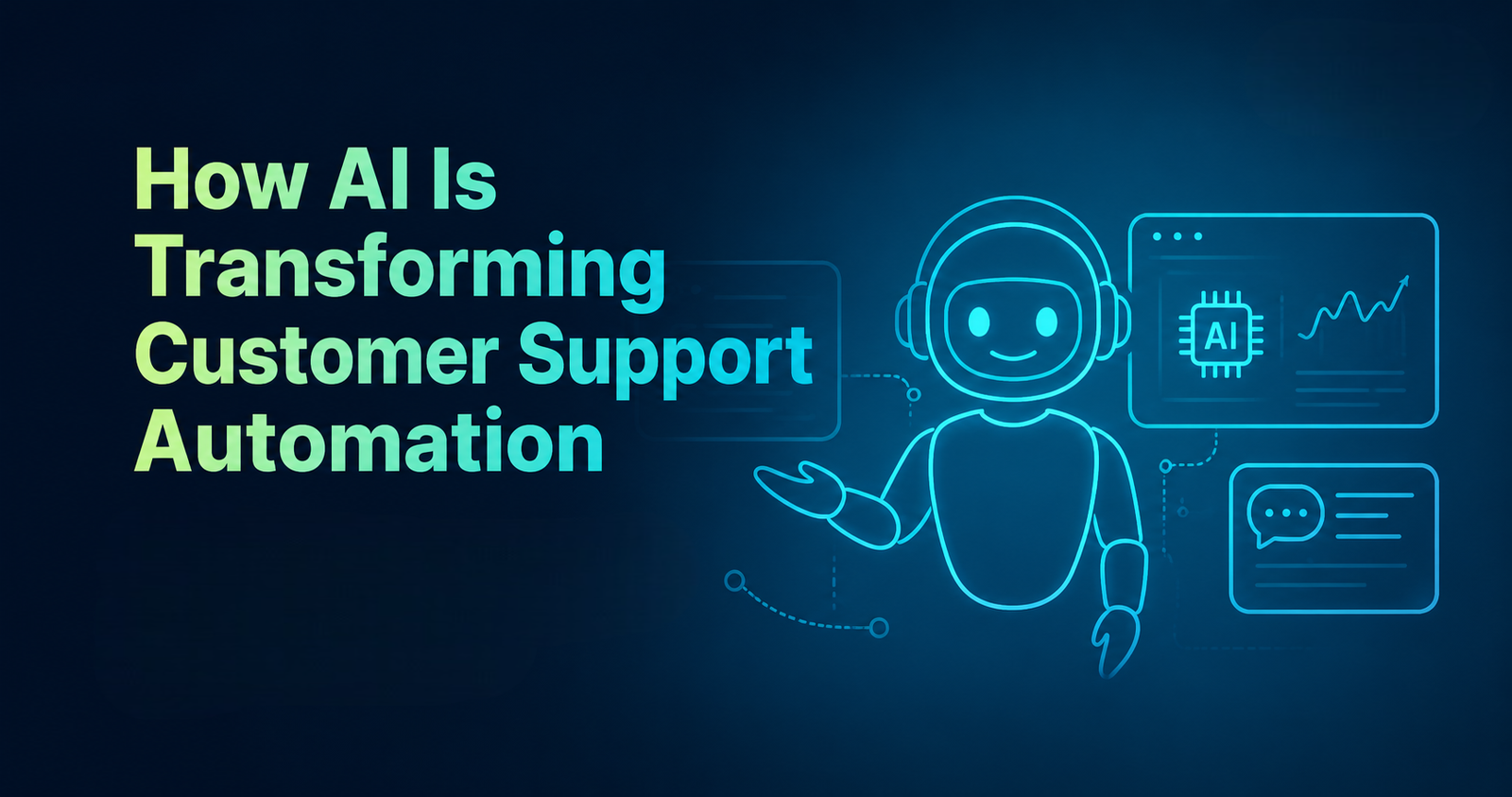
Customer support has always been one of the most important aspects of business success. Companies that provide fast, reliable, and personalized support are more likely to retain customers and build long-term relationships. However, as businesses grow and customer expectations increase, managing support operations manually becomes challenging, expensive, and time-consuming. This is where Artificial Intelligence (AI) is transforming customer support automation.
AI-powered technologies are helping businesses automate repetitive support tasks, improve response times, reduce operational costs, and deliver better customer experiences. Modern customers expect instant responses, 24/7 availability, and personalized interactions across multiple communication channels. AI enables businesses to meet these expectations efficiently without overwhelming support teams.
From intelligent chatbots and virtual assistants to predictive analytics and sentiment analysis, AI is reshaping the future of customer service across industries. Businesses are now using AI not only to automate support but also to enhance customer satisfaction and improve overall operational efficiency.
Traditional customer support systems relied heavily on human agents handling phone calls, emails, and live chat requests manually. While this approach worked in the past, it often resulted in long waiting times, inconsistent service quality, and high operational costs.
As digital transformation accelerated, businesses began adopting automation tools such as ticketing systems and scripted chatbots. However, these early systems had limited capabilities and often failed to understand customer intent properly.
Modern AI technologies have significantly changed this landscape. Advanced AI systems can now understand natural language, analyze customer behavior, recognize emotions, and provide intelligent responses in real time. This evolution has made customer support automation smarter, faster, and more effective.
One of the biggest advancements in customer support automation is the rise of AI-powered chatbots and virtual assistants. These tools can interact with customers through websites, mobile apps, messaging platforms, and social media channels.
Unlike traditional rule-based bots, AI chatbots use Natural Language Processing (NLP) and Machine Learning (ML) to understand customer queries more accurately. They can answer frequently asked questions, guide users through processes, recommend solutions, and even handle complex interactions.
For example, an eCommerce company can use AI chatbots to:
AI-powered assistants can also transfer conversations to human agents when necessary, ensuring smooth customer experiences.
Businesses using intelligent chatbots often experience higher customer satisfaction and increased support efficiency.
Modern customers expect personalized experiences rather than generic responses. AI helps businesses analyze customer data and deliver highly customized interactions based on user behavior, preferences, and previous conversations.
AI systems can collect and process information such as:
Using this information, AI can recommend personalized solutions, products, or support responses tailored to individual customers.
For instance, a SaaS company can use AI to identify customers struggling with a specific feature and proactively offer tutorials or assistance before users submit support tickets. This proactive approach improves customer satisfaction while reducing support requests.
Personalization also helps businesses build stronger relationships with customers by making interactions more relevant and meaningful.
Predictive customer support is another major innovation powered by AI. Instead of waiting for customers to report problems, AI systems can predict issues before they occur.
By analyzing historical data, usage patterns, and system behavior, AI can identify potential risks or service disruptions in advance. Businesses can then take proactive steps to resolve issues before they affect customers.
Examples of predictive customer support include:
This proactive support model reduces frustration, improves trust, and enhances overall customer experiences.
AI technologies are also improving customer interactions through sentiment analysis and emotion detection. These systems can analyze customer language, tone, and communication patterns to determine emotional states such as frustration, satisfaction, or urgency.
This capability allows businesses to prioritize sensitive conversations and respond appropriately. For example, if an AI system detects frustration in a customer message, it can automatically escalate the issue to a human support representative.
Sentiment analysis helps businesses:
This technology is particularly valuable for companies handling large volumes of customer interactions across multiple channels.
Many customers prefer solving issues independently instead of contacting support teams directly. AI-powered self-service systems help businesses meet this demand by providing instant access to relevant information and solutions.
Modern self-service platforms include:
These systems use AI to understand customer intent and deliver accurate recommendations quickly. Instead of searching through multiple articles manually, users receive targeted answers based on their specific questions.
Self-service automation improves efficiency while reducing the number of repetitive support requests handled by human agents.
Customers today interact with businesses through multiple communication channels, including email, websites, social media, messaging apps, and phone support. Managing these channels manually can be difficult and inconsistent.
AI helps businesses create seamless omnichannel support experiences by integrating customer interactions across all platforms. AI systems can track conversations, maintain context, and provide consistent support regardless of the communication channel used.
For example, a customer who starts a conversation on a website chatbot can continue the same interaction later through email or mobile messaging without repeating information.
Omnichannel AI support improves:
Businesses that provide unified support experiences often gain stronger customer loyalty and engagement.
One of the primary reasons businesses adopt AI-powered customer support is cost reduction. Handling large support volumes manually requires significant staffing, training, and infrastructure investments.
AI automation reduces these costs by handling repetitive and routine tasks efficiently. Chatbots and automated systems can resolve common issues without human intervention, allowing support agents to focus on more complex customer needs.
AI also helps optimize workforce management by:
As a result, businesses can scale support operations without proportionally increasing operational expenses.
Despite its advantages, AI-powered customer support also comes with challenges. Businesses must ensure that automation does not negatively impact customer experiences.
Some common challenges include:
Customers may become frustrated if AI systems fail to understand their issues properly or provide irrelevant responses. Therefore, businesses should maintain a balance between automation and human support.
The most successful customer support strategies combine AI efficiency with human expertise and emotional intelligence.
The future of AI in customer support looks highly promising. As AI technologies continue to evolve, businesses will gain access to even more advanced automation capabilities.
Future trends may include:
Generative AI and conversational AI models are expected to make customer interactions more natural, intelligent, and context-aware. Businesses that adopt these innovations early will gain significant competitive advantages.
AI will not completely replace human support agents but will continue to enhance their capabilities and improve overall service efficiency.
Artificial Intelligence is transforming customer support automation by helping businesses deliver faster, smarter, and more personalized customer experiences. From AI-powered chatbots and predictive support systems to sentiment analysis and omnichannel communication, AI technologies are redefining how companies interact with customers.
Modern businesses are increasingly using AI to automate repetitive tasks, reduce operational costs, improve response times, and enhance customer satisfaction. At the same time, AI provides valuable insights that help companies understand customer behavior and deliver more meaningful support experiences.
Although challenges still exist, the benefits of AI-driven customer support far outweigh the limitations. Companies that successfully combine AI automation with human expertise can create highly efficient and customer-centric support systems.
As customer expectations continue to evolve, AI will play an even bigger role in shaping the future of customer service and business communication. Organizations that embrace AI-powered support automation today will be better prepared to meet the demands of tomorrow’s digital-first customers.