Physical Address
304 North Cardinal St.
Dorchester Center, MA 02124
Physical Address
304 North Cardinal St.
Dorchester Center, MA 02124

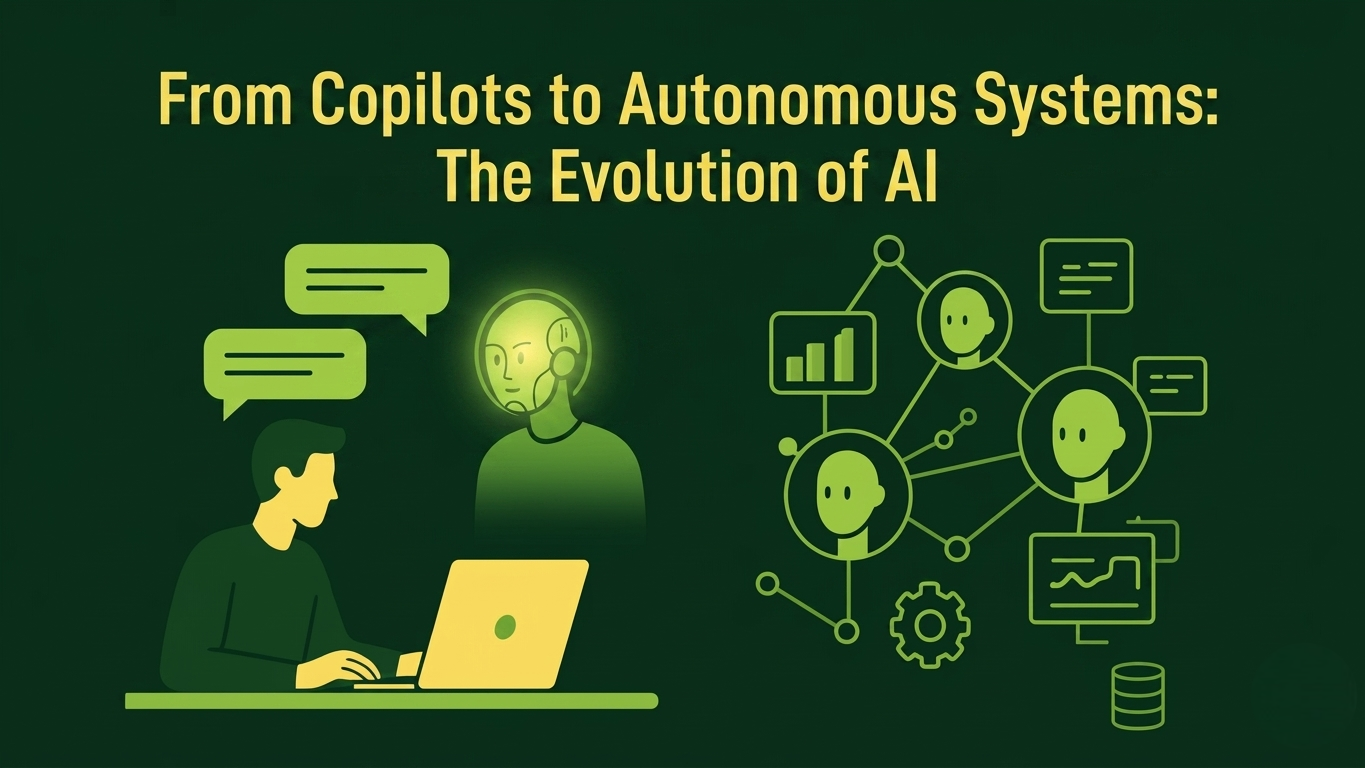
Artificial Intelligence is no longer just a supportive tool—it is rapidly becoming an independent decision-maker. Over the past few years, AI has evolved from simple assistants to intelligent copilots, and now toward fully autonomous systems capable of executing complex tasks with minimal or no human intervention.
This transformation marks a significant shift in how technology is used across industries. What began as tools that assist humans is now progressing into systems that can act on behalf of humans. Understanding this evolution is essential for businesses and IT professionals aiming to stay relevant in a rapidly changing digital landscape.
In its early stages, AI was primarily used as a tool for automation and data processing. These systems followed predefined rules and required constant human input to function effectively.
For example, traditional automation systems could perform repetitive tasks such as data entry, report generation, or simple customer interactions. However, they lacked adaptability and intelligence. Every action had to be explicitly programmed, limiting their ability to handle dynamic scenarios.
This phase laid the foundation for modern AI but was far from the intelligent systems we see today.
The next major leap in AI evolution came with the introduction of AI copilots. These systems are designed to assist humans by providing real-time suggestions, recommendations, and support during tasks.
AI copilots are now widely used in areas such as software development, content creation, customer service, and data analysis. They do not replace humans but enhance productivity by reducing effort and improving efficiency.
Key characteristics of AI copilots include:
For instance, developers use AI copilots to generate code snippets, while marketers use them to create content and analyze campaigns. This collaborative approach between humans and AI has significantly improved productivity across industries.
While AI copilots have transformed workflows, they still rely heavily on human guidance. They assist but do not act independently. This creates certain limitations, especially in scenarios that require speed, scalability, and continuous operation.
Some common limitations include:
These limitations have driven the need for more advanced AI systems capable of functioning independently.
The latest phase in AI evolution is the development of autonomous systems. Unlike copilots, these systems are designed to perform tasks from start to finish without constant human involvement.
Autonomous AI systems can analyze data, make decisions, and execute actions on their own. They are powered by advanced machine learning models, reinforcement learning, and real-time data processing.
This shift represents a move from “assistance” to “execution.”
Autonomous systems operate through a combination of perception, decision-making, and action. They continuously learn from their environment and adapt their behavior accordingly.
A typical autonomous AI workflow includes:
This loop enables AI systems to function independently while improving over time.
Autonomous AI is already making an impact across various industries, transforming how businesses operate.
Autonomous systems can monitor infrastructure, detect issues, and resolve them without human intervention. This leads to faster incident response and reduced downtime.
AI agents are now capable of handling entire customer interactions, from query resolution to follow-ups, without human involvement.
Autonomous AI systems are used for fraud detection, risk assessment, and algorithmic trading, enabling faster and more accurate decisions.
AI-driven systems assist in diagnostics, treatment recommendations, and patient monitoring, improving overall healthcare efficiency.
The transition to autonomous AI brings several advantages that go beyond traditional automation.
These benefits make autonomous systems highly valuable in environments that require speed and precision.
Despite their potential, autonomous AI systems come with significant challenges. One of the biggest concerns is trust. Allowing AI to make decisions independently raises questions about reliability and accountability.
Other challenges include:
Organizations must implement proper governance frameworks to ensure safe and responsible use of autonomous AI.
The evolution of AI does not stop at autonomous systems. The next phase could involve collaborative AI ecosystems where multiple autonomous agents work together to achieve complex goals.
Future AI systems may:
This could lead to a fully AI-driven ecosystem where human involvement becomes more strategic rather than operational.
The journey from AI tools to copilots and now to autonomous systems reflects the rapid advancement of artificial intelligence. Each phase has brought increased efficiency, intelligence, and capability.
While AI copilots have enhanced human productivity, autonomous systems are redefining how work is done by taking over execution itself. As this evolution continues, businesses must adapt to leverage these technologies effectively while addressing the associated risks.
Ultimately, the future of AI lies in creating systems that not only assist but also act—transforming industries and reshaping the way we interact with technology.