Physical Address
304 North Cardinal St.
Dorchester Center, MA 02124
Physical Address
304 North Cardinal St.
Dorchester Center, MA 02124
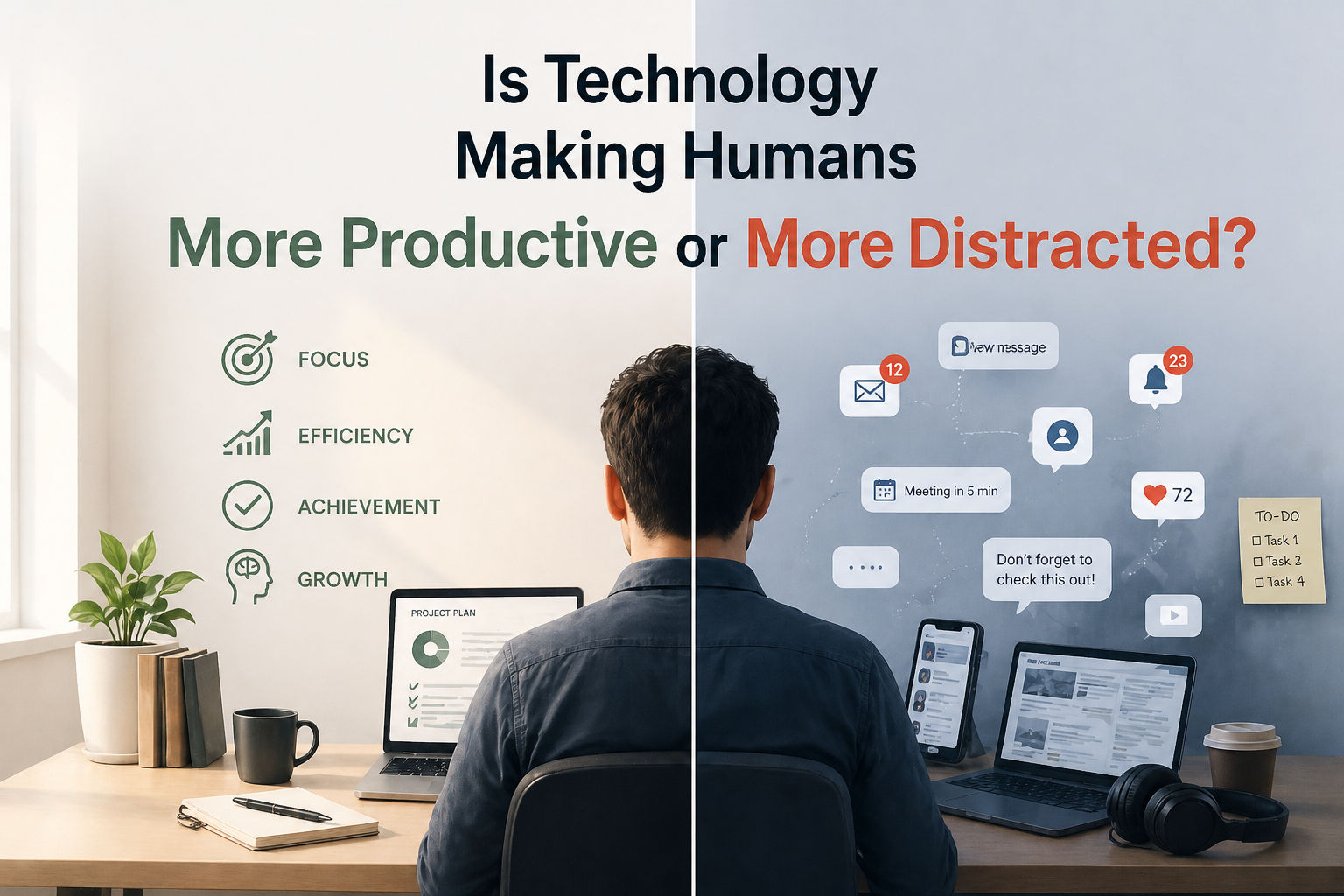
Technology was designed to make human life easier, faster, and more efficient. From automation tools to AI-powered assistants, it has significantly improved how work gets done across industries. Tasks that once took hours can now be completed in minutes, allowing individuals and organizations to scale output. Collaboration tools, cloud platforms, and digital workflows have also enabled remote and global teams to function seamlessly. Businesses are able to track performance, analyze data, and make decisions in real time. In many cases, technology has reduced manual effort and improved accuracy. However, productivity is not just about speed—it is also about focus and quality of output. While tools enhance efficiency, they also introduce new complexities. The real question is whether these gains are sustainable or overshadowed by new forms of distraction.
Key productivity benefits:
While technology improves productivity, it also introduces constant interruptions that affect focus. Notifications from apps, emails, messaging platforms, and social media create a fragmented work environment. Instead of deep work, many individuals find themselves switching between tasks frequently. This reduces attention span and increases cognitive fatigue. Studies suggest that it can take several minutes to regain focus after each interruption. Social media platforms are specifically designed to capture and retain attention, making distraction even more difficult to control. Even workplace tools meant for productivity can become sources of overload. The result is a paradox: more tools, but less uninterrupted thinking time. This raises concerns about whether technology is helping or harming cognitive performance.
Common sources of distraction:
Despite advancements in technology, productivity growth in many sectors has not always matched expectations. This phenomenon is often referred to as the “productivity paradox.” While individuals have access to powerful tools, the actual output improvements are sometimes limited. One reason is that time saved through automation is often lost to digital distractions. Another factor is the learning curve associated with new technologies, which can temporarily reduce efficiency. Additionally, over-reliance on tools can reduce critical thinking and problem-solving skills. Organizations may also struggle to integrate multiple systems effectively. This creates a gap between potential productivity and actual performance. The paradox highlights that technology alone is not enough—it must be used intentionally.
Key causes of the paradox:
Modern technology operates within what is often called the “attention economy,” where user attention is the primary resource being competed for. Platforms are designed to maximize engagement, often by encouraging continuous interaction. Algorithms analyze user behavior and deliver personalized content to keep individuals engaged longer. While this is effective for businesses, it can negatively impact users’ ability to concentrate. Work and leisure increasingly overlap on the same devices, making boundaries less clear. This constant stimulation can lead to mental fatigue and reduced productivity over time. Individuals may feel busy but not necessarily productive. Managing attention has become as important as managing time. Understanding this dynamic is crucial to navigating modern digital environments.
Attention economy effects:
The impact of technology on productivity ultimately depends on how it is used. When used intentionally, it can significantly enhance performance and efficiency. However, without boundaries, it can easily become a source of distraction. Individuals and organizations need to adopt strategies that promote focused work. This includes setting limits on notifications, scheduling deep work periods, and using tools that support rather than interrupt workflows. Digital well-being practices are becoming increasingly important in professional environments. Companies are also beginning to recognize the importance of employee focus and mental clarity. The goal is not to eliminate technology but to use it more consciously. Productivity in the digital age is about control, not constant connectivity.
Strategies for better balance:
Technology is neither purely a productivity booster nor a distraction machine—it is both. Its impact depends on how it is designed, implemented, and used by individuals and organizations. While it has dramatically improved efficiency and enabled new levels of performance, it has also created an environment of constant interruption and reduced focus. The challenge of the modern digital age is not access to technology, but control over attention. Those who learn to use technology intentionally, rather than reactively, will benefit the most. Ultimately, productivity in a tech-driven world is less about working more and more about working with focus and purpose.