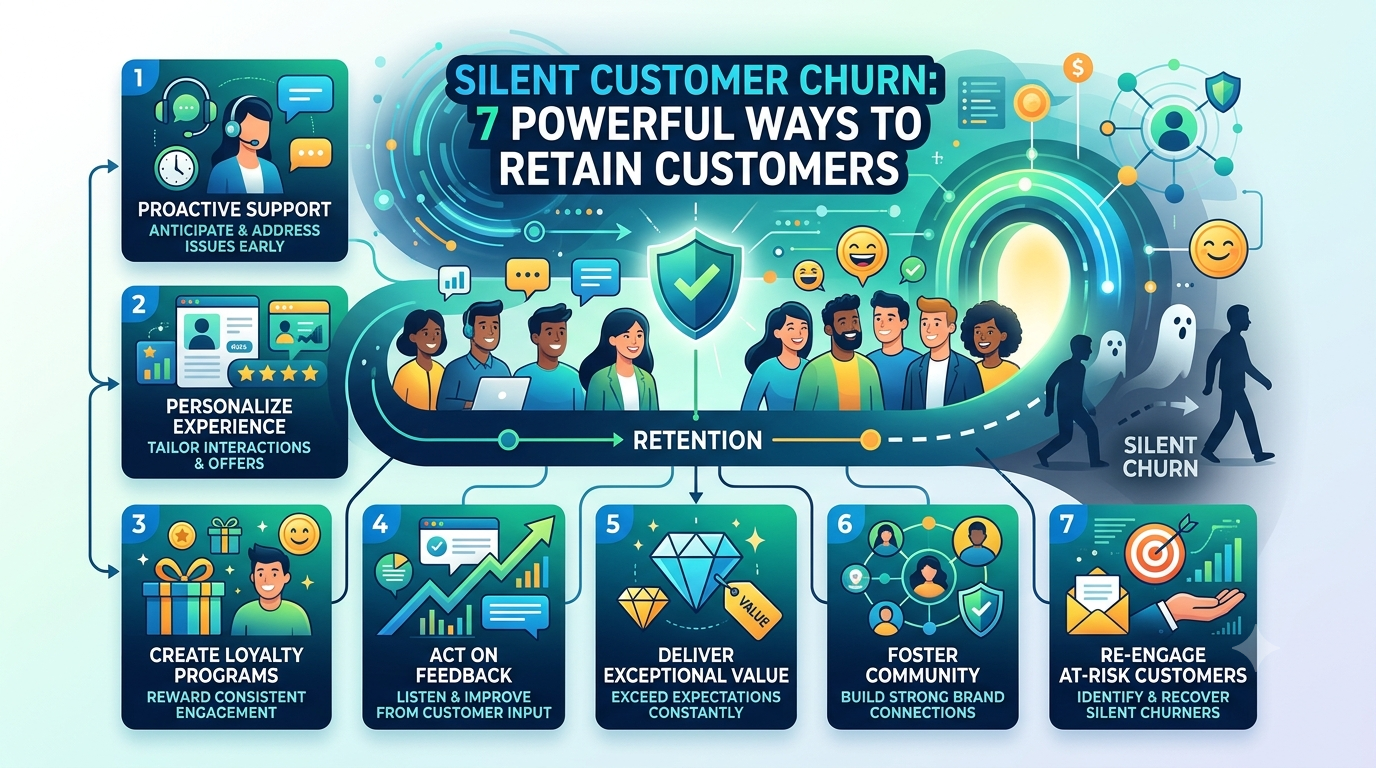
Silent Customer Churn is a growing concern for businesses that depend on long-term customer relationships. Companies often prioritise customers who complain, raise support tickets, or express dissatisfaction. However, some customers gradually disengage without explaining their concerns or announcing their intention to leave.
These customers may reduce product usage, stop attending meetings, or become less responsive to communication. Although their accounts may remain active, their confidence in the business could be declining. By the time they cancel a contract or choose a competitor, the opportunity to address their concerns may already have passed.
For B2B organisations, recognising early warning signs and using effective customer retention strategies can help protect recurring revenue, strengthen relationships, and support sustainable growth.
What Is Silent Customer Churn?
Silent customer churn occurs when customers gradually lose interest in a business without directly communicating their dissatisfaction. They may continue paying for a service while exploring alternatives or questioning whether the relationship still provides sufficient value.
For example, an enterprise customer might continue paying for a software platform while employees gradually stop using its important features. A professional services client may stop participating in account reviews because the service no longer meets its changing priorities.
Silence does not always mean dissatisfaction. However, meaningful changes in customer behaviour deserve attention before they develop into a lost business relationship.
Common Mistakes Businesses Make When Addressing Silent Churn –
Even organisations that recognise customer disengagement can make mistakes when responding to it. Poorly designed retention efforts may create unnecessary pressure, waste resources, or damage trust further.
Several common mistakes deserve attention.
Assuming silence means satisfaction: A lack of complaints does not establish that a customer is happy. Businesses should consider engagement and service context alongside direct feedback.
Treating every behavioural change as a churn warning: Reduced activity may reflect seasonality, project completion, or changing customer needs. Signals should be investigated before action is taken.
Relying entirely on automated messages: Generic follow-ups may increase communication volume without addressing the underlying issue. Relevant, human conversations are often more appropriate.
Waiting until renewal time: If a business reviews customer satisfaction only shortly before a contract expires, it may have limited time to resolve problems and rebuild confidence.
Collecting feedback without taking action: Customers may lose trust when their concerns are repeatedly acknowledged but never addressed.
Ignoring internal causes: Customer disengagement may originate in product limitations, billing processes, implementation difficulties, or inconsistent service delivery. Retention efforts should address these causes rather than focusing exclusively on communication.
Avoiding these mistakes helps businesses build a more balanced approach to customer retention that combines evidence, empathy, and accountability.
Measuring the Effectiveness of Customer Retention Efforts –
Businesses need a consistent way to understand whether their customer retention efforts are improving relationships and reducing avoidable customer losses.
The most useful measures depend on the business model, contract structure, customer lifecycle, and available data. Organisations should select metrics that support meaningful decisions rather than collecting information simply because it is available.
Relevant measures may include:
- Customer churn rate: The proportion of customers lost during a defined period.
- Customer retention rate: The proportion of existing customers retained over a defined period.
- Gross revenue retention: The recurring revenue retained from existing customers, excluding expansion revenue.
- Net revenue retention: The recurring revenue retained after accounting for expansion, contraction, and churn, according to the company’s reporting methodology.
- Product adoption: The extent to which customers use the capabilities relevant to their objectives.
- Support resolution performance: How effectively customer problems are resolved within appropriate service expectations.
- Customer engagement: Changes in meaningful interactions, review participation, and other relevant account activities.
These metrics should be interpreted together. For example, a stable retention rate may conceal declining product adoption or reduced engagement among a subset of customers. Conversely, a temporary reduction in usage may not be concerning if the customer is still achieving the intended outcome.
Businesses should establish relevant baselines, review trends over time, and investigate the reasons behind significant changes. This creates a stronger foundation for improving customer experience and prioritising retention investments.
Silent Customer Churn reminds businesses that customer relationships can weaken long before a cancellation becomes visible. A customer who stops complaining may be satisfied, distracted, or facing changing business priorities. However, silence can also indicate unresolved concerns, declining perceived value, or a loss of confidence in the relationship.
Organisations can reduce the risk of avoidable customer losses by recognising meaningful changes in customer behaviour, maintaining reliable CRM information, and using analytics to identify accounts that may need attention. AI and predictive analytics can support these efforts, but they are most effective when combined with human judgement, relevant questions, and a willingness to act on customer feedback.
Long-term customer retention also requires collaboration across the organisation. Sales, customer success, support, product, finance, and operations all influence the experience customers receive. When these teams work together to resolve problems and demonstrate value, they give customers stronger reasons to maintain the relationship.
7 Warning Signs of Silent Customer Churn –
Recognising silent customer churn requires businesses to look beyond complaints and cancellations. These seven indicators can help teams identify accounts that may need attention.
1. Declining Customer Engagement
Customers who previously attended meetings, responded promptly, and discussed future plans may gradually become less involved. Compare their current behaviour with their usual engagement patterns before drawing conclusions.
2. Reduced Product Usage
Declining usage of important software features may indicate adoption difficulties or reduced perceived value. Customer success teams should investigate whether users need additional training, technical support, or a better solution.
3. Reduced Communication
Customers who stop initiating conversations or provide only brief responses may be less engaged. Personalised communication focused on their business priorities is more useful than repeated generic follow-ups.
4. Delayed Renewals
Repeatedly postponed renewal discussions may indicate changing priorities, procurement delays, or concerns about value. Early conversations give businesses more time to understand the situation.
5. Recurring Support Issues
Unresolved technical problems, billing errors, and delayed service delivery can gradually weaken trust. Businesses should identify recurring issues and address their underlying causes.
6. Less Interest in Future Projects
Customers who previously discussed expansion opportunities but no longer show interest may have different priorities or reduced confidence in the partnership.
7. Changes in Key Stakeholders
When important customer contacts leave or change roles, relationships can weaken. Maintaining connections with relevant stakeholders helps preserve account knowledge and continuity.
How CRM and AI Help Prevent Customer Churn –
Customer relationship management (CRM) systems help businesses centralise customer interactions, support history, account activity, and renewal information. When combined with relevant product usage and service data, this information provides a clearer view of customer relationships.
For example, declining engagement alongside recurring support issues may indicate that an account needs a review, even when revenue remains stable.
AI-powered customer analytics can further help organisations identify behavioural patterns associated with previous customer losses. These insights allow teams to prioritise accounts and investigate potential concerns earlier.
Useful capabilities include:
- Customer health monitoring: Identify meaningful changes in engagement and adoption.
- Predictive analytics: Highlight patterns that may warrant a closer account review.
- Renewal tracking: Ensure important customer conversations happen before contracts expire.
- Personalised outreach: Help account managers prepare relevant conversations using customer history.
AI predictions are not guarantees. Businesses must consider customer context, data quality, and privacy requirements before acting on automated signals. Technology should support human judgement, not replace genuine communication.
6 Customer Retention Strategies That Work –
Identifying potential churn risks is only the first step. Businesses must take meaningful action to strengthen relationships and demonstrate value.
1. Conduct Regular Customer Reviews
Discuss customer objectives, outstanding concerns, product adoption, and expected outcomes. Do not wait until the renewal date to understand whether the customer remains satisfied.
2. Ask Better Questions
Instead of asking, “Is everything going well?”, ask which processes could improve, what challenges the customer faces, and whether the service continues to meet their expectations.
3. Act on Feedback
Record customer concerns, assign responsibility, and communicate progress. Asking for feedback without addressing it can damage trust.
4. Demonstrate Business Value
Show how your product or service supports the customer’s actual goals. Review relevant outcomes and adjust your approach as business priorities change.
5. Improve Cross-Department Collaboration
Customer retention depends on sales, support, finance, operations, and product teams. Resolving recurring billing, technical, and delivery problems requires coordination across the organisation.
6. Personalise Customer Communication
Use relevant account information to understand the situation before reaching out. A customer experiencing technical problems needs practical support, not another generic promotional email.
Why Customer Retention Matters for B2B Businesses –
Losing an existing B2B customer can mean losing recurring revenue, future expansion opportunities, referrals, and the resources invested in building the relationship.
Replacing that customer may require additional marketing, sales outreach, negotiations, and onboarding. This makes customer retention an important business growth priority rather than simply a customer support responsibility.
Businesses should monitor meaningful indicators such as customer engagement, product adoption, renewal progress, support resolution, and retention rates. Reviewing these signals together provides a more balanced understanding than relying on revenue alone.
Customer satisfaction and customer loyalty are also different. A customer may be satisfied with a transaction but still switch providers if another solution offers greater value or convenience. Long-term loyalty develops through reliable delivery, clear communication, trust, and consistent results.
Conclusion –
Silent Customer Churn reminds businesses that customer relationships can weaken long before a cancellation becomes visible. Reduced engagement, declining product usage, and unresolved issues may provide opportunities to understand customer concerns before they decide to leave.
By combining CRM systems, AI-powered analytics, regular customer reviews, and personalised communication, businesses can identify potential risks and respond more effectively. However, technology alone cannot protect a relationship. Customer retention ultimately depends on listening, resolving problems, and consistently delivering value.
The biggest warning sign is not always the customer who complains. Sometimes, it is the customer who has stopped believing that speaking up will make a difference.
Frequently Asked Questions
Silent customer churn occurs when customers gradually disengage from a business without explicitly communicating dissatisfaction or announcing that they intend to leave. It may involve declining engagement, reduced product usage, fewer interactions, or a loss of confidence in the relationship.
Common warning signs include declining product adoption, fewer customer interactions, repeated meeting cancellations, unresolved support issues, delayed renewal discussions, reduced interest in future projects, and changes in key customer stakeholders. These signals should be interpreted in context rather than treated as proof that a customer will leave.
Customers may leave without complaining because they believe their concerns will not lead to improvements, find switching easier than resolving recurring problems, or no longer see sufficient value in the relationship. Changing business priorities and dissatisfaction with service quality can also contribute to disengagement.
CRM systems can centralise customer interactions, account history, renewal information, and follow-up activities. When combined with relevant support and product usage data, they help teams identify changes in customer relationships, coordinate responses, and maintain a more consistent understanding of customer needs.