Modern AI applications feel “smart” because they can understand meaning, context, and relationships in data rather than just matching exact keywords. Behind this capability, especially in applications like chatbots, recommendation systems, and semantic search engines, lies a powerful technology called vector databases. These databases are quietly becoming one of the most important building blocks of AI-driven systems today.
To understand their importance, it helps to first understand a simple idea: AI systems don’t store information the way traditional databases do. Instead of storing text as raw words, they convert data into numerical representations called vectors, which capture meaning in a mathematical form. Vector databases are specifically designed to store, manage, and search through these vectors efficiently.
What Are Vector Databases?
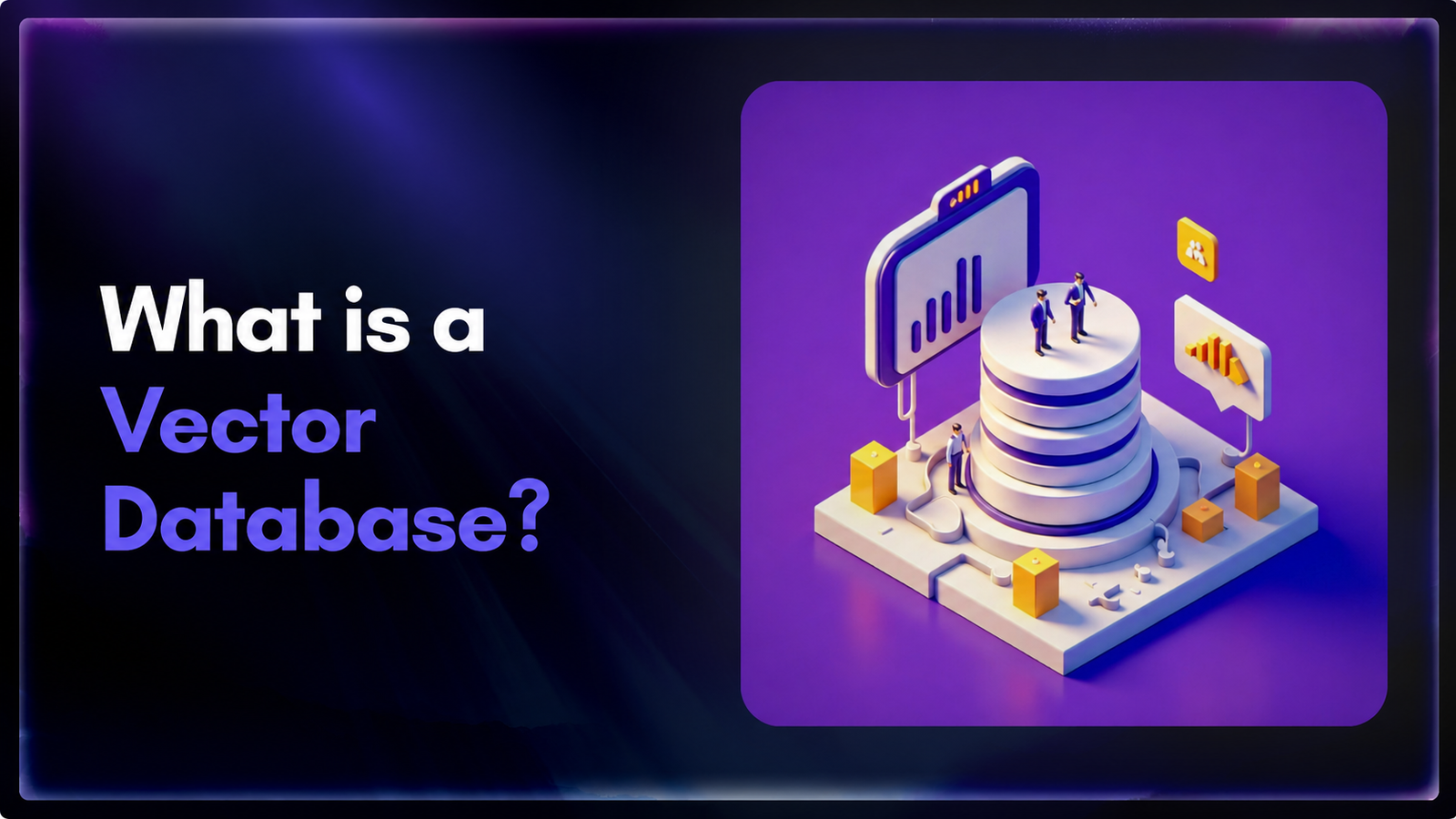
A vector database is a specialized type of database that stores data as high-dimensional vectors. These vectors represent the “meaning” of objects such as text, images, audio, or even video. Each piece of data is converted into a vector using AI models like embedding models.
For example, the sentences:
- “How to fix a slow laptop”
- “Why is my computer running slowly?”
may look different in text form, but in vector form, they are placed very close together because they have similar meanings.
This ability to understand semantic similarity is what makes vector databases extremely powerful for AI applications.
Why Traditional Databases Are Not Enough
Traditional databases like relational or document-based systems are excellent for structured queries. They work well when you know exactly what you are looking for. However, they struggle when queries are based on meaning rather than exact matches.
For example:
- Traditional search: Finds results matching exact keywords
- Vector search: Finds results that are conceptually similar, even if wording is different
This limitation becomes critical in modern AI systems like chatbots, recommendation engines, and search assistants, where users rarely phrase queries in a perfectly structured way.
Some key limitations of traditional databases include:
- Poor handling of semantic search
- Limited support for high-dimensional data
- Inefficiency in similarity comparisons
- Weak performance in AI-driven retrieval tasks
Vector databases solve these challenges by using mathematical similarity instead of keyword matching.
How Vector Databases Work
Vector databases operate by converting raw data into embeddings using machine learning models. These embeddings are numerical vectors with hundreds or even thousands of dimensions. Once data is converted, the database uses similarity metrics to compare and retrieve relevant results.
The basic process looks like this:
- Data (text, image, audio) is input
- AI embedding model converts it into a vector
- Vector is stored in the database
- Query is also converted into a vector
- System finds the closest matching vectors
The “closeness” is usually calculated using methods like cosine similarity or Euclidean distance.
This approach allows AI systems to retrieve results based on meaning rather than exact wording.
Key Features of Vector Databases
Vector databases are designed specifically for speed and scalability when dealing with large-scale AI workloads. They include features that make them ideal for modern applications.
Some important features include:
- High-dimensional search capabilities for complex AI embeddings
- Approximate nearest neighbor (ANN) algorithms for fast retrieval
- Scalability to handle millions or billions of vectors
- Real-time query processing for interactive AI applications
- Hybrid search support combining keyword and semantic search
These features allow vector databases to power systems that need both accuracy and speed at scale.
How Vector Databases Power AI Applications
Vector databases are now used across a wide range of AI-powered systems. Their ability to understand meaning rather than just text makes them essential for modern intelligent applications.
1. AI Chatbots and Virtual Assistants
Large language models rely heavily on vector databases to retrieve relevant context from documents, knowledge bases, or past conversations. This is often called Retrieval-Augmented Generation (RAG).
In simple terms, when you ask a chatbot a question:
- Your query is converted into a vector
- The system searches for similar information in the database
- Relevant context is added to the AI’s response
This improves accuracy and reduces hallucinations.
2. Semantic Search Engines
Instead of searching for exact keywords, semantic search engines understand intent. Vector databases allow search engines to return results that are conceptually related, even if they don’t share the same words.
For example:
- Searching “best place to learn coding online”
- May return results about “top programming courses” or “learn software development platforms”
This improves user experience significantly.
3. Recommendation Systems
Platforms like streaming services, e-commerce websites, and social media apps use vector databases to recommend content based on user behavior.
They compare:
- User preferences
- Product descriptions
- Viewing or purchase history
This allows systems to suggest items that users are more likely to engage with.
4. Image and Multimedia Search
Vector databases are not limited to text. Images and videos can also be converted into embeddings. This enables reverse image search and content-based retrieval.
For example:
- Uploading an image of a shoe
- The system finds visually similar shoes in a database
This is widely used in fashion, design, and e-commerce platforms.
5. Fraud Detection and Anomaly Detection
Financial systems use vector similarity to detect unusual behavior. Transactions that deviate significantly from normal patterns can be flagged as suspicious.
This helps in:
- Credit card fraud detection
- Cybersecurity threat detection
- Network anomaly identification
Popular Vector Databases in Use Today
Several specialized vector database systems have emerged to support AI workloads efficiently.
Some widely used ones include:
- Pinecone
- Weaviate
- Milvus
- FAISS (Facebook AI Similarity Search)
- Chroma
Each of these tools offers optimized search algorithms for large-scale vector operations and integrates well with AI frameworks.
Challenges in Vector Databases
Despite their advantages, vector databases also come with challenges that developers must consider.
- High memory usage due to large embeddings
- Complexity in tuning similarity search performance
- Difficulty in maintaining real-time updates at scale
- Trade-offs between speed and accuracy in ANN algorithms
- Cost of infrastructure for large deployments
These challenges are actively being addressed as the technology matures.
The Future of Vector Databases in AI
Vector databases are expected to become even more central to AI systems in the future. As AI models become more advanced, the need for efficient retrieval of relevant knowledge will increase significantly.
Future developments may include:
- Tighter integration with large language models
- Better hybrid search combining structured + semantic data
- Real-time learning and adaptive indexing
- Edge-based vector search for faster local AI apps
- More efficient compression techniques for embeddings
As AI applications become more personalized and context-aware, vector databases will act as the backbone that connects raw data with intelligent reasoning systems.
Conclusion
Vector databases are a foundational technology powering the next generation of AI applications. By enabling machines to understand meaning rather than just matching words, they unlock capabilities like semantic search, intelligent chatbots, recommendation engines, and advanced fraud detection systems.
As AI continues to evolve, vector databases will play an even more critical role in bridging the gap between human language and machine understanding. They are not just supporting modern AI apps—they are helping define what those apps can become in the future.