For years, B2B marketers relied on analytics, CRMs, marketing automation platforms, and attribution tools to understand how buyers moved through the sales funnel. Website visits, email clicks, webinar registrations, and demo requests were treated as reliable indicators of purchase intent.
Dark Funnel B2B Marketing is transforming how enterprise buyers research, evaluate, and choose vendors. Traditional marketing relied on website analytics, CRM data, and attribution models to understand the buyer journey. Today, however, buyers increasingly form opinions through AI assistants, private communities, customer recommendations, podcasts, and peer networks—channels that remain invisible to conventional analytics. As a result, marketers are losing visibility into the moments that matter most.
Modern B2B buyers are forming opinions long before they appear in marketing dashboards. They gather insights through private conversations, executive networks, Slack and WhatsApp groups, podcasts, industry communities, customer recommendations, and increasingly, AI assistants. These interactions leave little or no measurable digital footprint, creating what marketers now call the dark funnel.
What Is the Dark Funnel?
The dark funnel refers to all the buyer research and decision-making that occurs outside traditional marketing attribution.
Previously, this included word-of-mouth referrals and offline networking. Today, it has expanded significantly. Enterprise buyers ask AI tools to compare vendors, discuss products in private communities, consult peers, and evaluate recommendations before ever visiting a company’s website.
Dark Funnel B2B Marketing vs Traditional Funnel –
| Aspect | Traditional Funnel | Dark Funnel B2B Marketing |
|---|---|---|
| Buyer Research | Website visits and content downloads | AI tools, communities, and peer conversations |
| Tracking | Clicks, forms, and CRM data | Limited visibility and indirect signals |
| Trust Source | Brand messaging | Customer recommendations and industry networks |
| Measurement | Attribution and conversions | Influence mapping and qualitative insights |
| Marketing Goal | Generate leads | Build trust and influence decisions |
Insight: B2B buying decisions are shifting from measurable clicks to invisible influence. Dark Funnel B2B Marketing helps brands understand how AI, communities, and peer recommendations shape buyer decisions.
Dark Funnel B2B Marketing: Why Buyers Are Forming Opinions Beyond Your Analytics
Dark Funnel B2B Marketing is transforming how enterprise buyers research, evaluate, and choose vendors. For years, B2B marketers relied on website analytics, CRM platforms, marketing automation, and attribution models to understand the buyer journey. These tools tracked measurable interactions such as page visits, email clicks, and demo requests, creating the belief that every buying decision left a digital footprint.
Today, that assumption is no longer accurate. Buyers increasingly form opinions through AI assistants, private communities, customer recommendations, podcasts, executive networks, and peer discussions—channels that remain invisible to traditional analytics. By the time a prospect contacts a sales team, much of the buying decision has already been influenced behind the scenes. Understanding this “dark funnel” is becoming essential for B2B organizations that want to build trust and stay competitive in the AI-driven search era.
Why Traditional Attribution Is Losing Effectiveness –
Dark Funnel B2B Marketing is transforming how enterprise buyers research, evaluate, and choose vendors. Dark Funnel B2B Marketing has become one of the biggest challenges for organizations trying to understand the modern buyer journey.
- Website visits
- Email engagement
- Content downloads
- Webinar registrations
- Form submissions
As AI adoption grows, Dark Funnel B2B Marketing is becoming a strategic priority for organizations that want to understand hidden buyer behavior.
- Internal buying committee discussions
- Peer recommendations
- Private LinkedIn messages
- Executive networking groups
- Customer referrals
- AI-generated research
As a result, marketers often optimize campaigns based on what is measurable rather than what is truly influential.
AI Is Making the Funnel Even Darker –
This is why Dark Funnel B2B Marketing requires marketers to move beyond traditional attribution models and focus on influence rather than only measurable interactions. AI is accelerating Dark Funnel B2B Marketing by allowing buyers to gather trusted information without directly engaging with vendor websites.
Instead of visiting multiple websites, decision-makers increasingly ask AI assistants questions such as:
- Which CRM is best for enterprise companies?
- Compare leading cybersecurity vendors.
- What do customers dislike about Vendor X?
AI synthesizes information from reviews, documentation, analyst reports, and public content into a single response. Buyers receive recommendations without visiting many of the original sources.
For marketers, this creates a new challenge: influence without measurable interaction.
Your content may shape an AI-generated recommendation while producing zero website traffic.
Visualizing the Dark Funnel B2B Buyer Journey –
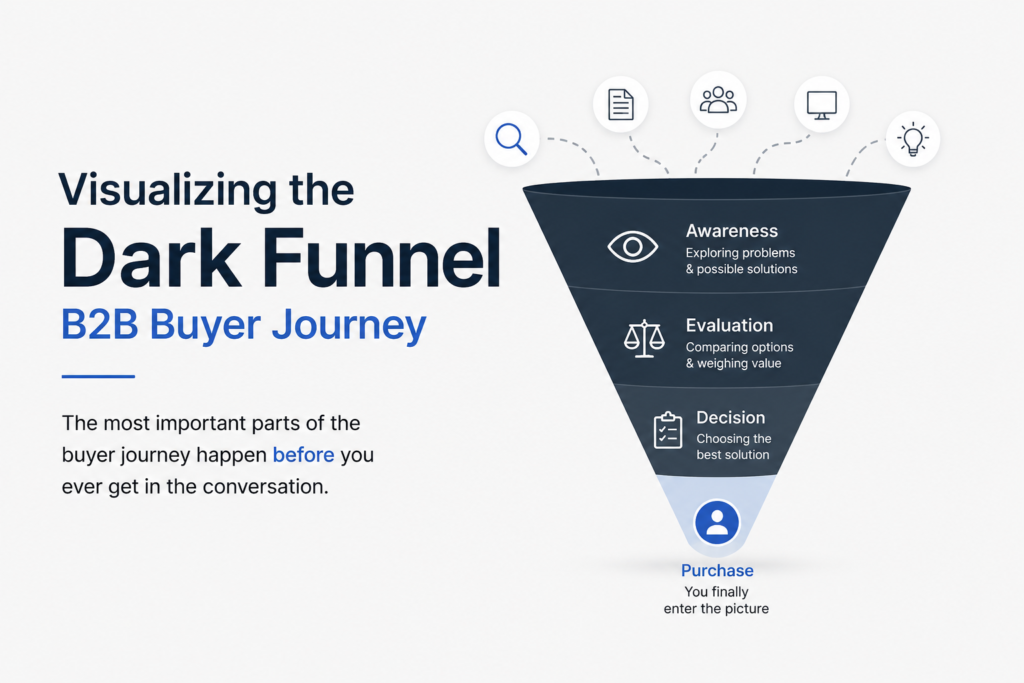
How the Dark Funnel Shapes Modern B2B Buying Decisions
The modern B2B buyer journey is no longer a straight path from search to purchase. Buyers move through multiple invisible touchpoints, including AI research, peer recommendations, private communities, and customer conversations before engaging with a brand.
Why Content Metrics Need to Change –
Many organizations still judge content performance using clicks, downloads, impressions, and conversions.
These metrics remain useful, but they tell only part of the story.
A technical guide may never generate a lead yet become widely shared inside procurement teams. A podcast appearance may spark executive discussions that eventually lead to a large enterprise deal. A thought leadership article might receive few social interactions but significantly influence private conversations.
Instead of measuring only engagement, marketers should also evaluate influence.
Questions worth asking include:
- Did the content improve brand credibility?
- Did it help buyers understand a complex problem?
- Was it referenced during sales conversations?
- Did customers share it internally?
Customer Advocacy Matters More Than Ever –
In high-value B2B purchases, trust often outweighs advertising.
Enterprise buyers frequently seek recommendations from colleagues, former coworkers, industry experts, and existing customers before engaging vendors.
These conversations rarely appear in analytics platforms, yet they often determine which vendors make the shortlist.
This makes customer success, advocacy programs, testimonials, and reference customers some of the most valuable assets in modern B2B marketing.
Sales and Marketing Must Share Intelligence –
Sales teams regularly hear objections, competitor comparisons, pricing concerns, and stakeholder questions that never appear in marketing reports.
Instead of treating CRM notes as administrative data, organizations should view them as market intelligence.
Patterns in sales conversations often reveal:
- Missing content
- Competitive threats
- Buyer concerns
- Emerging market trends
Closer collaboration between sales and marketing helps organizations better understand the invisible parts of the buyer journey.
Focus on Influence, Not Perfect Attribution –
Attempting to track every private conversation is neither practical nor desirable.
Instead, successful marketers should build influence maps rather than relying solely on attribution models.
Combine multiple sources of insight, including:
- Marketing analytics
- Customer interviews
- Win/loss analysis
- Sales feedback
- Brand perception studies
- Community monitoring
- Customer success insights
Together, these create a far more accurate understanding of how buying decisions are made.
Build Content That Travels Beyond Your Website –
If buyers increasingly consume information through AI assistants, newsletters, podcasts, communities, and peer recommendations, content must be designed for sharing.
High-performing B2B content includes:
- Original research
- Practical frameworks
- Technical documentation
- Customer case studies
- Industry benchmarks
- Expert opinions
- Transparent comparisons
This type of content earns trust and continues influencing buyers long after publication.
The Future of the B2B Dark Funnel –
The dark funnel is unlikely to disappear. As AI, private communities, and collaborative buying continue to grow, marketers will have less visibility into the early stages of the buyer journey.
Organizations that succeed will stop asking only, “Which channel generated the lead?”
Instead, they will ask:
- Who influenced the buyer before they contacted us?
- Which customer experiences built trust?
- What information did AI tools surface?
- Which peer recommendations shaped the shortlist?
These questions provide a deeper understanding of buyer behavior than attribution reports alone.
Conclusion –
The future of B2B marketing is not about tracking every interaction—it is about building influence wherever buyers form opinions.
While analytics and attribution remain valuable, they no longer tell the complete story. AI-driven research, private communities, customer advocacy, and executive networks now shape purchasing decisions long before measurable engagement occurs.
The organizations that thrive in 2026 will create trusted content, strengthen customer advocacy, align sales and marketing insights, and optimize for both human and AI-driven discovery. In an increasingly invisible buyer journey, the brands that consistently educate, earn trust, and provide genuine value will stand out—even when the marketing dashboard cannot fully explain why.
Frequently Asked Questions (FAQs)
Dark Funnel B2B Marketing refers to the hidden parts of the B2B buyer journey where decisions are influenced through private conversations, AI tools, customer recommendations, and professional networks that traditional analytics cannot track.
The buyer journey is becoming harder to measure because prospects increasingly research solutions through private communities, peer discussions, podcasts, and AI assistants before engaging directly with a brand.
AI allows buyers to compare vendors, analyze reviews, and gather recommendations without visiting company websites. This creates new challenges for marketers trying to measure influence and attribution.
Most dark funnel activities cannot be tracked directly. However, marketers can understand its impact through customer interviews, sales insights, win-loss analysis, brand research, and influence mapping.