Introduction
Agentic AI is becoming one of the most important developments in artificial intelligence in 2026, changing how businesses operate, manage workflows, and make decisions. Unlike traditional AI tools that primarily respond to individual prompts, Agentic AI systems can understand objectives, plan multiple steps, interact with digital tools, and execute tasks with varying levels of human supervision. This shift is creating new opportunities for organizations looking to improve productivity, reduce repetitive work, and build more intelligent business operations.
As enterprises continue investing in digital transformation, AI agents are moving beyond simple chatbots and content-generation applications. They are increasingly being explored for practical business activities such as customer support, software development, financial operations, sales assistance, data analysis, and IT management. Instead of simply providing information, these systems can help complete workflows by coordinating multiple actions across business applications.
However, the rise of Agentic AI also introduces important questions about security, accountability, reliability, and the future role of human employees. Businesses must understand both the opportunities and limitations before integrating autonomous AI agents into critical operations. This article explores how Agentic AI works, its major business applications, benefits, challenges, and potential impact on the future of work.
What Is Agentic AI?
Agentic AI refers to artificial intelligence systems designed to pursue specific goals by making decisions, planning actions, using tools, and adapting their approach based on the results they receive. These systems are commonly called AI agents. They can operate independently within defined boundaries, allowing them to complete multi-step tasks rather than simply responding to individual instructions.
Traditional AI applications usually depend on direct human input for every interaction. For example, a conventional chatbot answers a customer’s question, while an AI agent could potentially understand the customer’s issue, retrieve relevant account information, check available solutions, update a support ticket, and escalate the matter when human intervention is necessary.
The key difference is the ability to move from generating information to taking coordinated action. This makes Agentic AI particularly relevant for organizations with complex workflows involving multiple departments, applications, and decision-making processes.
Key Characteristics of Agentic AI –
Several capabilities distinguish AI agents from conventional AI applications:
- Goal-oriented execution: AI agents work toward defined objectives instead of responding only to individual prompts.
- Planning and reasoning: They can break complex objectives into smaller tasks and determine an appropriate sequence of actions.
- Tool integration: Agents can interact with APIs, databases, enterprise software, and other digital tools when authorized.
- Context awareness: They can use relevant information from previous interactions and available business data.
- Adaptability: Agents can adjust their approach based on task results, feedback, and changing conditions.
- Human collaboration: They can request approval, escalate exceptions, and involve employees when decisions require human judgment.
For businesses, these capabilities create opportunities to automate complete processes rather than individual repetitive activities.
How Does Agentic AI Work?
Understanding how Agentic AI works is important before implementing it within an enterprise environment. Although different platforms use different architectures, most AI agent systems follow a similar process involving goal interpretation, planning, execution, observation, and improvement.
An AI agent typically receives an objective from a user or an automated trigger. It then analyzes the request, identifies the information and tools required, creates an action plan, and executes the necessary steps. After each action, it evaluates the result to determine whether the objective has been achieved or whether additional steps are necessary.
For example, imagine a business manager asking an AI agent to prepare a weekly sales performance report. Instead of manually searching through multiple systems, the agent could retrieve authorized sales information, organize the data, identify important changes, and prepare a report for managerial review.
The Working Process of an AI Agent –

The typical workflow involves these stages:
- Goal identification: The agent receives a task or business objective.
- Planning: It breaks the objective into smaller, manageable actions.
- Information gathering: It retrieves relevant information from approved sources.
- Decision-making: It evaluates available options and selects an appropriate action.
- Task execution: It interacts with authorized tools, applications, or systems.
- Monitoring and evaluation: It checks the outcome and identifies errors or incomplete tasks.
- Human approval: It requests human intervention when a task involves sensitive decisions or exceeds its permissions.
This process can repeat until the task is completed, an approval is required, or the agent reaches a predefined stopping condition.
Importantly, Agentic AI does not mean unlimited autonomy. Organizations should define permissions, operational boundaries, approval requirements, and monitoring mechanisms before allowing agents to perform business activities.
Agentic AI vs Generative AI: Understanding the Difference –
Generative AI and Agentic AI are closely related, but they serve different purposes in business environments. Generative AI primarily focuses on producing content, while Agentic AI focuses on achieving objectives through coordinated actions.
For example, a generative AI application can write an email, summarize a document, or generate software code. An AI agent can potentially take that capability further by identifying a task, creating the required content, interacting with connected applications, and completing a broader workflow.
Generative AI can also be a component of an AI agent. Many agent architectures use large language models (LLMs) for interpreting instructions, reasoning through tasks, and selecting tools.
Major Differences Between Generative AI and Agentic AI –
| Feature | Generative AI | Agentic AI |
|---|---|---|
| Primary purpose | Generate content | Achieve objectives |
| Main function | Respond to prompts | Plan and execute tasks |
| Workflow | Usually prompt-driven | Often multi-step |
| Decision-making | Primarily produces recommendations or outputs | Can select actions within defined boundaries |
| Tool usage | May use connected tools | Often coordinates multiple tools |
| Human involvement | Usually requires prompting | Can operate with varying supervision |
| Example | Writing a marketing email | Preparing and coordinating a marketing campaign |
A generative AI tool can create a personalized sales email based on customer information. An Agentic AI system could potentially identify a suitable prospect, retrieve approved customer information, draft a personalized email, update the CRM, and schedule a follow-up after receiving the required approval.
This distinction explains why businesses are increasingly interested in combining generative AI capabilities with agent-based automation.
Powerful Ways Agentic AI Is Transforming the Future of Work
The impact of Agentic AI extends beyond individual productivity tools. It has the potential to change how entire business processes are designed, coordinated, and managed.
Organizations can use AI agents to support employees, improve operational efficiency, and reduce the time spent on repetitive digital activities.
Let’s explore seven important applications.
Automating Repetitive Business Workflows –

One of the most practical applications of Agentic AI is business process automation. Many organizations still depend on employees to perform repetitive tasks across different applications. These activities may include collecting information, updating records, generating reports, reviewing documents, and coordinating approvals.
Traditional automation systems typically follow predefined rules. Agentic AI can add more flexibility by interpreting requests, handling variations, and deciding which authorized tools to use.
For example, an AI agent in a procurement department could assist with processing purchase requests. It might extract information from submitted documents, check the request against internal policies, retrieve supplier information, and prepare an approval request for a manager.
Business applications include:
- Processing invoices and purchase requests.
- Updating customer relationship management (CRM) records.
- Organizing internal documents.
- Preparing recurring business reports.
- Coordinating employee onboarding activities.
- Managing routine administrative workflows.
The biggest opportunity is not simply automating individual tasks but connecting multiple steps into a coordinated business process.
Transforming Customer Support and Experience –

Customer experience is another area where Agentic AI can create meaningful business value. Customers increasingly expect quick responses, personalized communication, and consistent support across digital channels.
Traditional chatbots generally respond to questions using predefined flows or knowledge sources. More advanced AI agents can potentially access authorized business systems and perform actions related to customer requests.
For example, when a customer reports a delivery issue, an AI agent could:
- Understand the customer’s problem.
- Retrieve the relevant order information.
- Check the available delivery status.
- Identify the appropriate resolution based on company policies.
- Update the support ticket.
- Escalate the issue to a human employee if necessary.
This approach can help businesses handle routine customer requests while allowing support professionals to focus on complex problems.
However, customer-facing agents should operate with clear permissions and escalation rules, particularly when handling refunds, account changes, personal information, or complaints.
Improving Software Development and IT Operations –

Software development is experiencing significant changes through AI-powered coding assistants and agent-based development tools.
Developers can use AI agents to support different stages of the software development lifecycle, including understanding requirements, generating code, reviewing changes, writing tests, and investigating errors.
For example, a development team could assign an AI agent to analyze a reported software bug. The agent might examine relevant logs, identify potentially related code, suggest a solution, and prepare a test for developer review.
In IT operations, agents can also help investigate alerts, summarize system events, and recommend troubleshooting steps.
Strengthening Human-AI Collaboration –

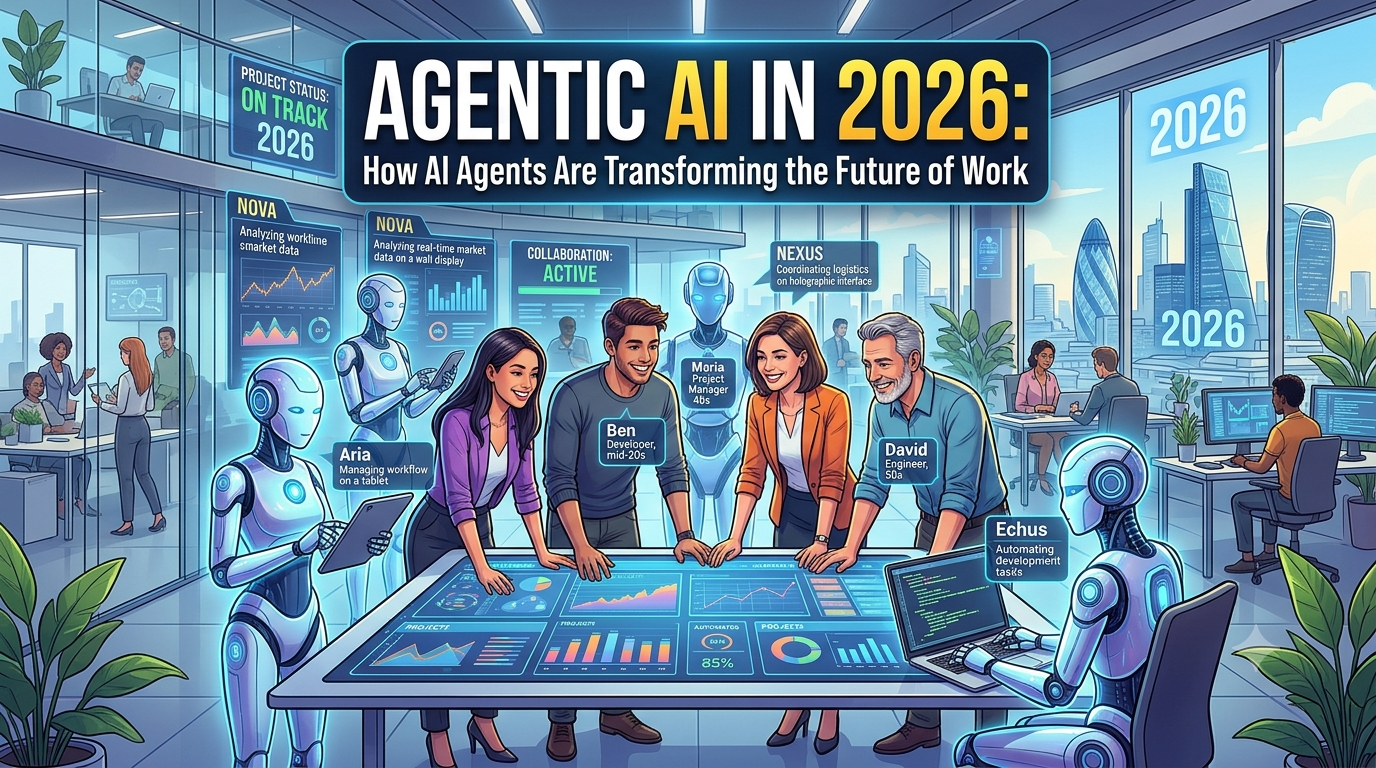
The future of work is unlikely to be defined entirely by humans or entirely by autonomous machines. Instead, many organizations will explore collaborative working environments where employees and AI agents contribute different capabilities.
Humans bring contextual understanding, creativity, emotional intelligence, ethical judgment, and business experience. AI agents can support information processing, repetitive execution, research, and coordination across digital systems.
For example, in a finance department, an AI agent could organize expense reports, identify missing information, and flag transactions that require additional review. Finance professionals would then investigate exceptions and make final decisions.
This approach creates a collaborative model in which technology supports employees without removing human accountability.
Human-AI collaboration can help organizations:
- Reduce repetitive administrative work.
- Improve access to information.
- Support employee productivity.
- Enable faster task coordination.
- Give professionals more time for strategic activities.
- Improve consistency in routine processes.
Businesses should focus on redesigning jobs and workflows around human strengths and AI capabilities rather than assuming that every task should be automated.
Enabling Multi-Agent Systems Across Enterprises –

One of the more advanced developments in Agentic AI is the concept of multi-agent systems.
A multi-agent system consists of multiple AI agents that work together to accomplish a larger objective. Each agent may have a specific responsibility, specialized tools, or access to particular information sources.
For example, an enterprise planning workflow could involve:
- A research agent that gathers relevant market information.
- A data analysis agent that examines business performance.
- A finance agent that prepares cost-related insights.
- A reporting agent that organizes the findings.
- A coordinating agent that manages the overall workflow.
These agents can communicate and exchange relevant outputs through an orchestrated system.
However, multi-agent systems also introduce additional complexity. Organizations must manage communication between agents, prevent conflicting actions, control permissions, and maintain reliable oversight.
Conclusion –
Agentic AI in 2026 represents an important development in the evolution of artificial intelligence. By moving beyond simple content generation and enabling systems to plan, coordinate, and execute multi-step tasks, AI agents are creating new possibilities for enterprise automation and digital transformation.
From customer support and software development to financial operations, sales, manufacturing, and business intelligence, Agentic AI can help organizations improve workflow coordination and support employee productivity. Multi-agent systems may extend these capabilities further by allowing specialized agents to collaborate on complex business objectives.
However, successful adoption requires more than advanced AI technology. Businesses must address data privacy, cybersecurity, system integration, reliability, governance, and human accountability. AI agents should operate within clearly defined boundaries, with appropriate monitoring and approval mechanisms.
Frequently Asked Questions (FAQs)
Agentic AI is a type of artificial intelligence that can understand goals, plan actions, use digital tools, and complete multi-step tasks with varying levels of human supervision. Unlike traditional AI applications that mainly respond to prompts, AI agents can work toward achieving specific objectives.
Generative AI primarily creates content such as text, images, code, and summaries. Agentic AI focuses on completing objectives through planning and executing actions. An AI agent can use generative AI capabilities to understand instructions, make plans, and interact with connected applications.
AI agents are changing how businesses manage repetitive tasks, customer support, software development, reporting, and workflow coordination. They can help employees reduce administrative work and focus on activities that require creativity, critical thinking, and human judgment.
Major business applications include customer service automation, sales and marketing assistance, financial document processing, IT operations, software development, business intelligence, supply chain coordination, and internal workflow management.
Agentic AI can automate certain tasks and change how some jobs are performed. However, human expertise remains important for decision-making, leadership, creativity, communication, ethical judgment, and complex problem-solving. Its impact will vary across industries and job roles.