Physical Address
304 North Cardinal St.
Dorchester Center, MA 02124
Physical Address
304 North Cardinal St.
Dorchester Center, MA 02124

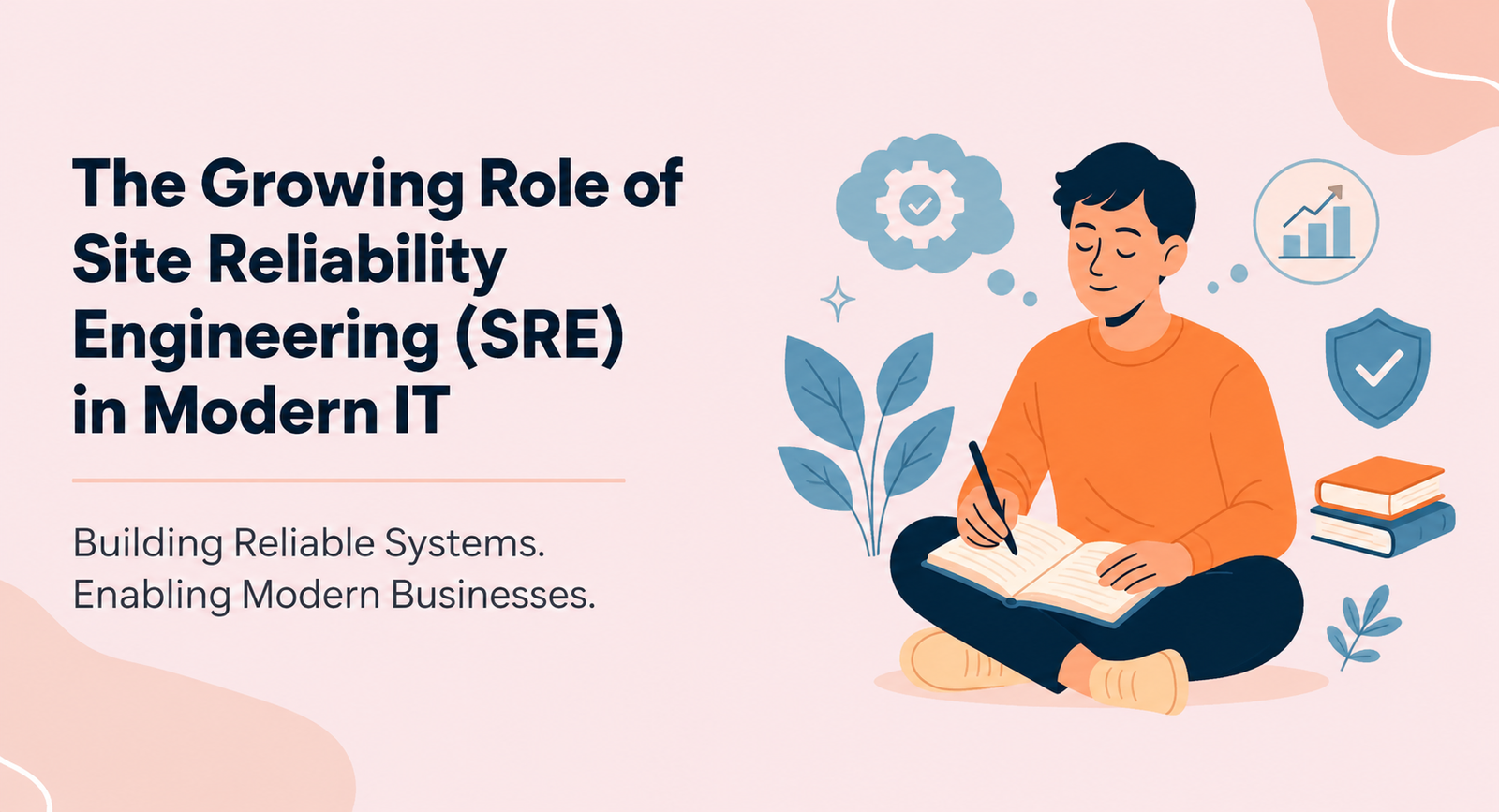
As organizations continue to accelerate their digital transformation journeys, IT environments have become increasingly complex. Businesses today rely heavily on cloud-native applications, distributed systems, microservices, and always-on digital platforms to support customers and internal operations. In this fast-paced ecosystem, maintaining system reliability while delivering rapid innovation has become one of the biggest challenges for IT teams.
This is where Site Reliability Engineering (SRE) has emerged as a critical operational strategy. Originally introduced by Google, SRE combines software engineering principles with IT operations practices to create highly reliable, scalable, and efficient systems. Instead of relying solely on manual operational processes, SRE focuses on automation, monitoring, performance optimization, and proactive incident management.
Modern enterprises are increasingly adopting SRE practices to improve uptime, reduce operational risks, and enhance customer experiences. As businesses demand faster deployments without sacrificing reliability, the role of SRE continues to grow across industries.
Site Reliability Engineering is a discipline that applies software engineering approaches to IT operations problems. The main goal of SRE is to build scalable and highly reliable software systems while reducing manual intervention.
SRE teams bridge the gap between development and operations by automating repetitive tasks, improving monitoring systems, and ensuring applications meet defined reliability standards. Unlike traditional IT operations teams that primarily focus on system maintenance, SRE engineers use coding, automation, and analytics to improve operational efficiency.
At its core, SRE revolves around balancing two essential business priorities:
This balance helps organizations maintain stable services while continuing to release new features rapidly.
The increasing adoption of cloud computing, DevOps, and microservices has dramatically changed how applications are built and managed. Modern systems are no longer simple monolithic infrastructures; they are highly distributed and interconnected environments.
Several factors are driving the growing importance of SRE:
Modern enterprise environments often include:
Managing these systems manually is no longer practical. SRE practices help automate operational processes and maintain system stability at scale.
Customers today expect digital services to be available 24/7. Even minor outages can lead to financial losses, reputational damage, and customer dissatisfaction.
SRE teams help organizations achieve higher uptime through:
Businesses now release software updates more frequently than ever before. Continuous Integration and Continuous Deployment (CI/CD) pipelines allow teams to push updates multiple times a day.
However, rapid deployments can introduce instability if not managed properly. SRE ensures that reliability remains a top priority during fast release cycles.
SRE engineers play multiple roles within modern IT organizations. Their responsibilities go beyond system monitoring and troubleshooting.
One of the core responsibilities of SRE teams is maintaining visibility into system performance. Observability tools help teams analyze system behavior in real time.
SRE teams monitor:
Advanced observability platforms provide insights that help engineers identify issues before they impact users.
When system failures occur, SRE teams are responsible for minimizing downtime and restoring services quickly. They create incident response processes that ensure teams can react efficiently during outages.
Key incident management practices include:
This structured approach helps organizations reduce recurring problems and strengthen operational resilience.
Automation is one of the foundational principles of SRE. Manual operational tasks consume valuable engineering time and increase the likelihood of human error.
SRE teams automate processes such as:
By reducing manual intervention, organizations can improve consistency and operational efficiency.
SRE frameworks rely heavily on measurable reliability metrics. Three important concepts form the foundation of reliability measurement:
SLIs measure specific aspects of system performance, such as:
These indicators provide real-time insights into service health.
SLOs define the target reliability goals for a system. For example, a company may establish a 99.9% uptime objective for a business-critical application.
SLOs help teams balance innovation and reliability by defining acceptable risk levels.
SLAs are formal agreements between service providers and customers that outline expected performance standards. Failure to meet SLA targets may result in financial penalties or contractual consequences.
Together, SLIs, SLOs, and SLAs provide a structured framework for managing service reliability.
SRE and DevOps are closely related but serve different purposes. DevOps primarily focuses on improving collaboration between development and operations teams, while SRE emphasizes system reliability and operational excellence.
SRE complements DevOps by adding:
Many organizations integrate SRE into their DevOps pipelines to ensure that rapid deployments do not compromise system stability.
Organizations adopting SRE practices often experience significant operational and business benefits.
SRE practices reduce downtime and improve application availability. This leads to better customer experiences and stronger business continuity.
Automation reduces the workload on IT teams and minimizes repetitive manual tasks. Engineers can focus more on innovation rather than maintenance.
Advanced monitoring and incident response strategies help organizations detect and resolve issues quickly before they escalate.
SRE frameworks help businesses scale infrastructure efficiently while maintaining consistent performance under increasing workloads.
SRE teams rely heavily on metrics and analytics, enabling organizations to make informed operational decisions based on real-time data.
Although SRE offers numerous advantages, implementation can present several challenges.
Traditional IT teams may resist changes in operational workflows and automation strategies. Building a culture that embraces reliability engineering requires leadership support and cross-functional collaboration.
SRE requires expertise in:
Finding professionals with both development and operational expertise can be difficult.
Modern observability and automation platforms can become complex to manage, especially in large enterprise environments.
Organizations must carefully select tools that align with their operational goals and infrastructure needs.
As digital ecosystems continue to evolve, the importance of SRE will only increase. Emerging technologies such as artificial intelligence, machine learning, and predictive analytics are already transforming reliability engineering practices.
Future SRE trends may include:
Organizations that invest early in SRE capabilities will be better positioned to maintain resilient and scalable IT environments in the future.
Site Reliability Engineering has become a cornerstone of modern IT operations. As businesses rely more heavily on cloud services, distributed applications, and digital customer experiences, ensuring system reliability is no longer optional—it is a business necessity.
By combining software engineering expertise with operational best practices, SRE enables organizations to improve uptime, accelerate deployments, automate infrastructure management, and enhance overall operational resilience. Although implementing SRE may require cultural and technical transformation, the long-term benefits far outweigh the challenges.
In the evolving world of enterprise technology, SRE is not just an operational model; it is a strategic approach that helps organizations achieve both innovation and reliability at scale.