Introduction
The Automation Trap is becoming an increasingly important challenge for modern businesses as organisations continue investing in technologies designed to improve operational efficiency. From automated reporting systems and customer relationship management (CRM) platforms to AI-powered decision-making tools and intelligent workflow automation, businesses are using technology to reduce manual effort, minimise errors, and accelerate everyday operations. Tasks that previously required hours of human involvement can now be completed within minutes, allowing employees to focus on other responsibilities.
However, faster execution does not necessarily translate into better business outcomes. As automation becomes deeply embedded in organisational processes, an important question deserves greater attention: are businesses becoming more intelligent through technology, or are they simply becoming faster at executing processes without questioning whether those processes still make sense?
The real challenge is that automation can improve operational speed without improving the quality of thinking behind business decisions. Organisations may successfully automate workflows, reporting, and analysis while gradually losing the human judgement needed to interpret information, identify underlying problems, and recognise new opportunities. Understanding The Automation Trap is therefore essential for businesses that want to achieve sustainable digital transformation rather than simply automate everything they can.
Understanding The Automation Trap in Modern Businesses
Automation has traditionally been introduced to solve operational challenges. Businesses want to reduce repetitive work, improve consistency, eliminate unnecessary delays, and make better use of available resources. When implemented correctly, these technologies can create substantial improvements across departments.
However, problems emerge when organisations begin treating automation as an objective rather than a means of achieving better business outcomes.
The Automation Trap occurs when businesses become so focused on automating activities that they stop evaluating the purpose, relevance, and effectiveness of the processes being automated.
Consider an organisation that introduces an automated reporting platform. The system collects operational data, identifies declining performance, generates reports, and distributes recommendations to department managers. Although this improves reporting efficiency, it does not necessarily explain why performance is declining.
If managers simply follow the system’s recommendations without investigating the underlying reasons, the organisation may spend resources addressing symptoms instead of solving the actual problem.
This creates several challenges:
- Reduced critical thinking: Employees may become overly dependent on automated outputs instead of questioning their accuracy and relevance.
- Process dependency: Existing workflows continue operating even when business requirements change.
- Limited problem-solving: Teams may focus on following automated instructions rather than understanding unexpected situations.
- False confidence: Faster reporting and automated recommendations can create the impression that business decisions are automatically becoming better.
The important distinction is that automation can improve how efficiently information is processed, but it cannot independently guarantee that the organisation is asking the right questions.
How AI Is Making The Automation Trap More Significant
Artificial intelligence has expanded the possibilities of business automation. Modern AI-powered systems can analyse large datasets, recognise patterns, generate forecasts, recommend actions, and support decisions across different business functions.
For enterprise organisations, these capabilities can be particularly valuable when managing complex operations and large volumes of information.
However, AI-generated recommendations are only as useful as the information, assumptions, and context behind them.
An AI-powered sales analytics platform, for example, might recommend prioritising a particular customer segment because historical data indicates stronger conversion rates. However, the system may not fully account for emerging market opportunities, changing customer expectations, or recent competitive developments.
Similarly, an HR analytics platform might identify employees as potential retention risks based on historical patterns without understanding individual circumstances or organisational factors influencing their decisions.
These examples demonstrate why businesses should avoid treating AI recommendations as unquestionable answers.
The Difference Between Data Analysis and Business Understanding
Data analysis identifies patterns and relationships. Business understanding explains why those patterns matter and what actions should follow.
AI can support both activities, but its recommendations still require appropriate human evaluation, particularly when decisions involve complex organisational or commercial considerations.
Businesses should therefore establish clear practices for evaluating AI-generated insights:
- Examine the information and assumptions behind important recommendations.
- Consider whether historical data accurately reflects current business conditions.
- Identify potential gaps in the available information.
- Evaluate recommendations against organisational objectives.
- Involve relevant employees before implementing decisions with significant business consequences.
The goal should not be to reduce AI adoption. Instead, organisations must ensure that AI strengthens decision-making rather than replacing the thinking required to make decisions responsibly.

The Risk of Losing Human Intelligence Through Excessive Automation
One of the less visible consequences of automation is the gradual reduction of human involvement in activities that require judgement, interpretation, and creative problem-solving.
Automation works particularly well when tasks are repetitive, predictable, and governed by clearly defined rules. Examples include processing invoices, generating standard reports, updating customer records, and routing support requests.
However, business environments are rarely predictable enough for every situation to be handled through predefined instructions.
Customer expectations change. Market conditions fluctuate. Employees respond differently to organisational decisions. Unexpected operational problems frequently require solutions that cannot be anticipated in advance.
When organisations automate too many decision-making activities, employees may have fewer opportunities to develop the analytical capabilities needed to handle unfamiliar situations.
Over time, this can create a workforce that is highly efficient at operating established systems but less confident when those systems fail or produce unexpected results.
Why Human Judgement Still Matters
Human intelligence contributes capabilities that remain essential to complex business environments.
These include:
- Contextual understanding: Recognising circumstances that may not be reflected in available datasets.
- Critical evaluation: Questioning recommendations and identifying assumptions that require further investigation.
- Creative problem-solving: Developing alternative approaches when established processes are no longer effective.
- Emotional intelligence: Understanding customer expectations, employee concerns, and interpersonal dynamics.
- Strategic thinking: Connecting operational information with long-term business objectives.
The Automation Trap becomes particularly dangerous when organisations begin measuring employee productivity only through their ability to operate automated systems.
Technology should strengthen human capabilities, not gradually remove opportunities for employees to exercise them.
The Hidden Financial and Operational Costs of Over-Automation
Automation is often justified through measurable business benefits such as reduced operating costs, shorter processing times, fewer manual tasks, and improved productivity.
These measurements are important, but they do not always represent the complete financial impact of introducing technology.
An organisation might invest in several software platforms to automate individual departmental activities, only to discover that those systems do not communicate effectively with one another.
Another business may automate a complicated approval process without simplifying it first. As a result, the same unnecessary steps remain in place, but employees now complete them through a digital platform.
This is an important aspect of The Automation Trap: technology can accelerate existing inefficiencies without actually eliminating them.
Common Business Costs Associated With Poor Automation Decisions
1. Disconnected technology platforms
When departments introduce separate automation solutions without considering integration requirements, employees may need to manage multiple systems and manually transfer information between them.
2. Increased maintenance requirements
Automated workflows require monitoring, maintenance, configuration updates, and troubleshooting. Poorly designed systems can create additional operational responsibilities.
3. Repeated process inefficiencies
Automating an inefficient process does not automatically make it efficient. Unnecessary approvals, redundant activities, and outdated procedures may continue operating.
4. Additional correction work
Employees may spend considerable time reviewing incorrect outputs, correcting system errors, and resolving exceptions generated by automated workflows.
5. Reduced organisational flexibility
Businesses that become overly dependent on rigid automated processes may struggle to respond quickly when market conditions or operational requirements change.
Measuring Automation Beyond Time Savings
Instead of evaluating automation projects exclusively through implementation costs or processing speed, organisations should examine their wider business impact.
Useful evaluation areas include:
- Accuracy and consistency of outputs.
- Reduction in unnecessary process steps.
- Employee productivity and experience.
- System integration and maintenance requirements.
- Quality of decisions supported by automation.
- Ability to adapt when business requirements change.
Ultimately, successful automation should make business operations simpler, more accurate, and more effective.
Why Automating Inefficient Processes Creates Bigger Problems
One of the most common mistakes organisations make is introducing technology before understanding the processes they want to improve.
When a workflow contains unnecessary approvals, duplicated activities, unclear responsibilities, or outdated business rules, automation may simply reproduce those problems at a faster pace.
For example, consider an enterprise procurement process that requires several levels of approval for routine purchases.
Instead of reviewing the approval structure, an organisation might implement workflow automation to move requests between departments automatically.
Although the system reduces manual communication, it does not necessarily eliminate unnecessary approvals or improve decision-making.
A better approach would involve examining the process first, identifying which approvals genuinely add value, clarifying responsibilities, and simplifying the workflow before introducing automation.
A Better Approach to Business Process Automation
Organisations should follow a structured approach before automating important workflows:
- Understand the existing process: Document how the workflow operates and identify its actual business purpose.
- Identify inefficiencies: Examine duplicated activities, unnecessary approvals, and recurring bottlenecks.
- Simplify the workflow: Remove steps that do not contribute meaningful value.
- Introduce appropriate technology: Select automation solutions based on actual operational requirements.
- Evaluate the results: Monitor whether the redesigned process delivers better business outcomes.
This approach ensures that business automation supports process improvement instead of simply digitising existing inefficiencies.
How Businesses Can Avoid The Automation Trap
Avoiding The Automation Trap requires organisations to rethink how they evaluate technology investments.
Automation should be treated as a business transformation decision rather than simply a software implementation exercise.
Technology leaders, department managers, and operational employees must work together to determine where automation creates genuine value and where human judgement remains essential.
The following practices can help organisations establish a more balanced automation strategy.
1. Understand the Purpose Before Automating
Before implementing automation, businesses should understand why a particular process exists and what outcome it is expected to deliver.
Not every manual activity needs to become automated. Some processes may benefit more from simplification, better coordination, or clearer responsibilities.
2. Keep Human Oversight in Important Decisions
Automated systems should support employees rather than become unquestionable decision-makers.
Organisations should establish clear accountability for automated recommendations and define situations where human evaluation is necessary.
This is particularly important in areas such as:
- Financial approvals and risk assessments.
- Recruitment and employee management.
- Customer prioritisation.
- Strategic planning.
- Business forecasting and resource allocation.
3. Regularly Evaluate Automated Systems
Business requirements evolve, and technology that performs effectively today may become less relevant as organisational priorities change.
Regular reviews help identify outdated rules, inaccurate assumptions, integration problems, and workflows that no longer deliver the expected value.
4. Invest in Employee Analytical Skills
Automation should create opportunities for employees to focus on higher-value responsibilities.
Organisations should encourage employees to develop skills in data interpretation, problem-solving, analytical thinking, and strategic decision-making.
Training should also help employees understand how automated systems work, where their limitations exist, and when their outputs require further investigation.
5. Encourage Collaboration Between Technology and Business Teams
Automation decisions should not be made exclusively by IT departments.
Business leaders understand operational requirements, technology teams understand system capabilities, and employees understand the practical challenges associated with everyday workflows.
Combining these perspectives helps organisations select appropriate automation opportunities and avoid introducing unnecessary complexity.
6. Measure Business Outcomes Instead of Automation Volume
The number of automated workflows is not a reliable indicator of business intelligence or transformation success.
Organisations should evaluate whether automation improves customer experiences, reduces operational friction, strengthens decision-making, and supports strategic objectives.
7. Design for Exceptions and Changing Conditions
No automated system can anticipate every possible business situation.
Organisations should create clear escalation procedures that allow employees to intervene when unusual circumstances arise, system outputs appear incorrect, or business conditions change.

The Future of Business Automation: Faster Execution, Smarter Decisions
The future of enterprise automation will not be determined simply by how many activities organisations can automate.
Businesses will increasingly need to consider how technology, employee capabilities, organisational knowledge, and decision-making processes work together.
AI-powered platforms, intelligent workflows, predictive analytics, and integrated enterprise systems can help organisations manage complexity and improve operational performance.
However, their effectiveness will depend on how intelligently businesses implement and govern these technologies.
For example, an organisation using automated customer service can allow AI systems to handle routine enquiries while directing complex or sensitive situations to experienced support professionals.
Similarly, an enterprise using automated financial reporting can allow technology to collect and organise information while financial leaders investigate unusual patterns, assess risks, and make strategic recommendations.
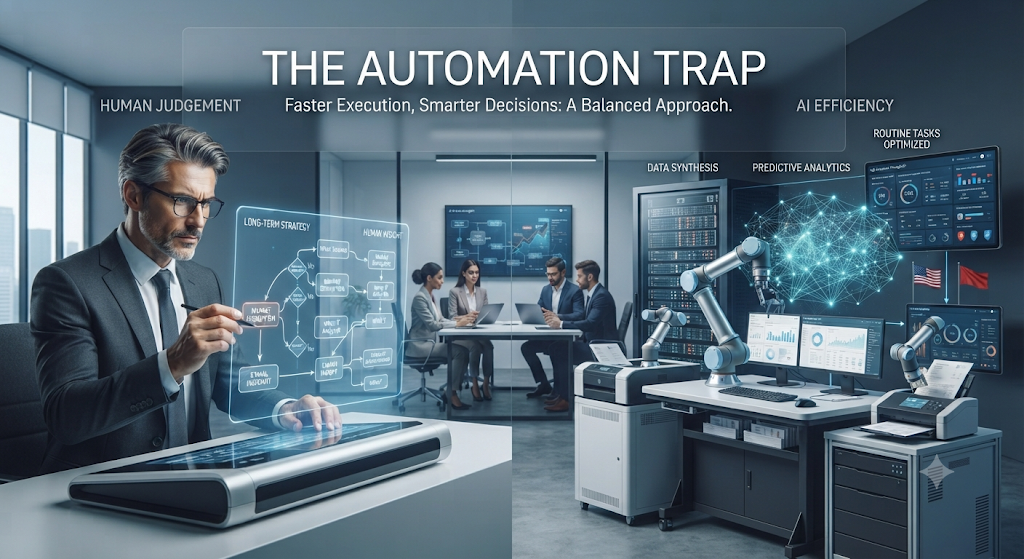
These approaches demonstrate that automation and human intelligence do not need to compete.
Instead, they should complement one another.
Businesses that understand this relationship will be better positioned to build flexible operations, improve employee capabilities, and make decisions that reflect both available data and real-world business context.
Conclusion
The Automation Trap highlights an important challenge facing modern organisations: becoming faster does not automatically mean becoming smarter.
Automation can significantly improve productivity, reduce repetitive work, and simplify operational activities. However, when businesses prioritise efficiency without questioning the processes behind it, they risk creating greater technology dependency, weaker critical thinking, and decisions that lack sufficient context.
The solution is not to slow down automation or avoid adopting artificial intelligence. Instead, organisations must become more thoughtful about where technology creates genuine value and where human judgement remains indispensable.
Successful businesses will be those that simplify processes before automating them, evaluate AI-generated recommendations carefully, maintain accountability, and continuously develop employee capabilities.
Ultimately, technology should handle repetitive activities, organise information, and accelerate execution so that people can concentrate on solving problems, understanding customers, improving processes, and identifying new opportunities.
In the race to automate everything, businesses must remember one important distinction: being able to do something faster does not automatically mean knowing how to do it better.
Frequently Asked Questions
What is The Automation Trap?
The Automation Trap refers to a situation where businesses become overly dependent on automated systems and focus more on operational speed than on understanding processes, evaluating decisions, and solving underlying problems.
Why can automation make businesses less intelligent?
Automation can reduce opportunities for employees to question processes, interpret information, and develop problem-solving skills. When organisations blindly accept automated outputs, critical thinking and contextual understanding can gradually become weaker.
How does artificial intelligence contribute to The Automation Trap?
AI systems can analyse information and generate recommendations, but their outputs depend on available data, assumptions, and context. Businesses that accept AI-generated recommendations without appropriate evaluation may make incomplete or unsuitable decisions.
Does business automation always improve productivity?
No. Automation can improve productivity when applied to appropriate processes. However, automating inefficient workflows, introducing disconnected systems, or creating additional maintenance responsibilities can reduce overall operational effectiveness.
How can businesses avoid The Automation Trap?
Businesses can avoid The Automation Trap by reviewing processes before automation, maintaining human oversight, evaluating automated systems regularly, investing in employee analytical skills, and measuring business outcomes rather than automation volume.
Why is human judgement important in automated business processes?
Human judgement helps organisations interpret complex situations, understand customer expectations, identify unusual circumstances, and make decisions that require contextual understanding or creative problem-solving.
What should businesses automate first?
Businesses should generally begin with repetitive, predictable, rule-based activities that consume significant employee time and have clearly defined outcomes. Examples include routine data entry, invoice processing, standard reporting, and workflow notifications.
How should organisations measure the success of automation?
Organisations should consider processing efficiency, accuracy, operational costs, employee productivity, customer experience, system integration, and the quality of decisions supported by automated systems.
Can automation and human intelligence work together?
Yes. Automation can manage repetitive activities, organise information, and support analysis, while employees provide contextual understanding, critical evaluation, creativity, and strategic direction. Combining both creates a more balanced approach to business transformation.