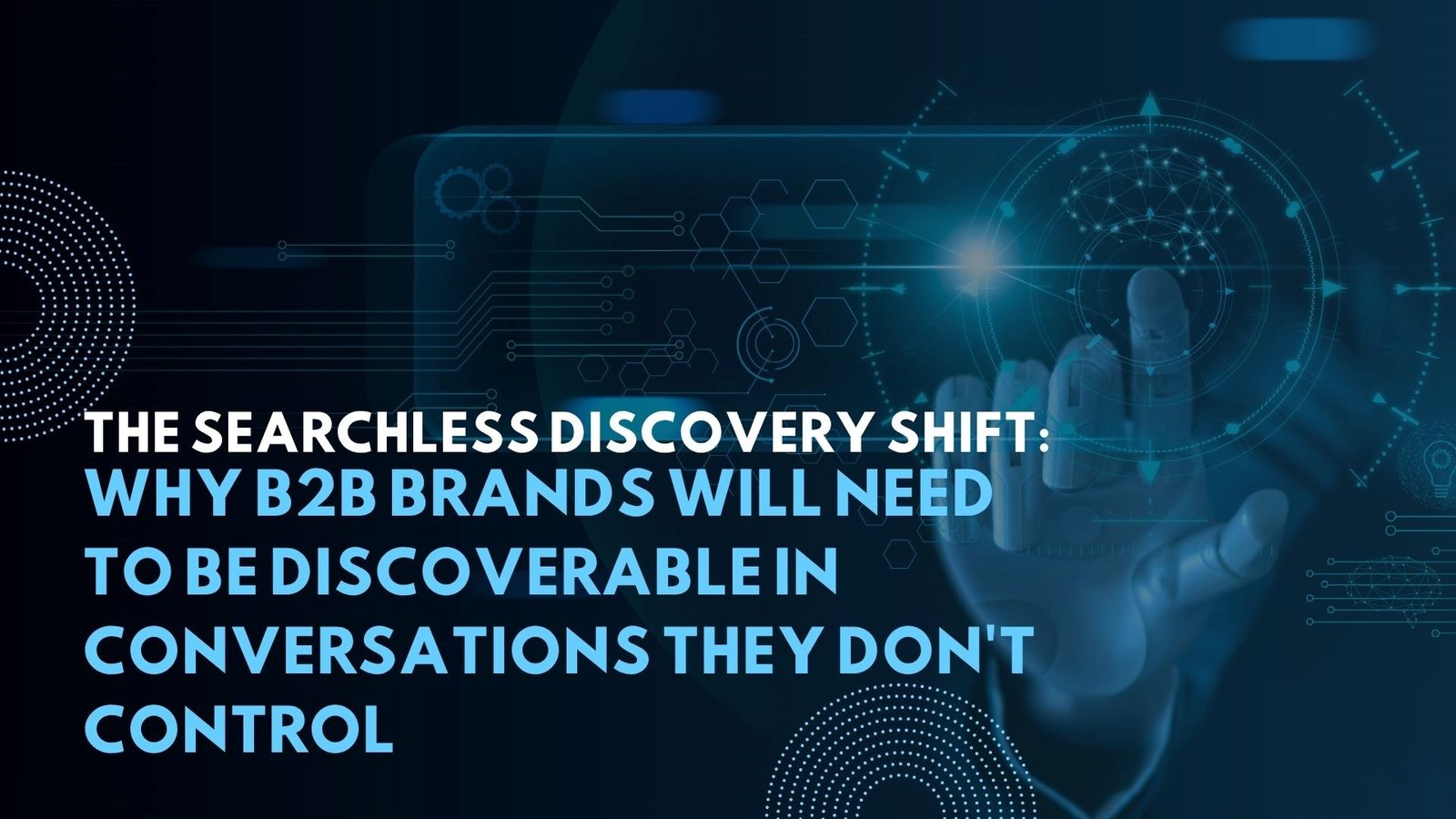
The Search Less Discovery Shift is changing how B2B buyers discover companies, evaluate solutions, and form opinions. For years, B2B marketing followed a relatively predictable model where buyers searched for a problem, reviewed search results, visited websites, and compared potential vendors. Companies could optimize pages, target keywords, invest in paid visibility, and measure the journey from search to conversion.
That model is now becoming more fragmented. Buyers are increasingly discovering companies through AI-generated answers, peer recommendations, professional communities, industry groups, private conversations, analyst commentary, and social platforms. Instead of relying on one search engine to guide discovery, buyers are moving across multiple information sources before they ever contact a vendor.
The important change is not simply that buyers are searching less. Discovery itself is becoming more conversational, distributed, and difficult to measure. This creates what can be called the Search Less Discovery Shift: a move from controlled search visibility toward a world where brands must become recognizable and credible across conversations they do not own.
What Is the Search Less Discovery Shift?
The Search Less Discovery Shift describes the movement from traditional search-based discovery toward a broader environment shaped by AI, people, communities, recommendations, and professional conversations. Search engines still matter, but they are no longer the only place where buyers begin researching a company or solution.
A B2B buyer may ask an AI assistant for vendor recommendations, speak with colleagues, read an industry discussion, or ask a trusted professional for advice before visiting a company’s website. As a result, companies need to think beyond rankings and traffic and focus on whether their expertise is visible across the conversations that influence buyer decisions.
Key changes include:
- AI is becoming part of the research process.
- Peer recommendations influence consideration.
- Private conversations can shape vendor decisions.
- Professional communities are becoming discovery channels.
- Buyers may form opinions before visiting a website.
How the Search Less Discovery Shift Is Changing B2B Marketing –
Traditional SEO remains important, but it does not capture every interaction that influences a B2B purchase. Search impressions, clicks, website visits, and form submissions are easy to measure because they happen within identifiable marketing channels. However, many important discovery moments now happen outside those channels.
The Search Less Discovery Shift is forcing B2B marketers to rethink how they measure brand visibility and buyer influence.
A buyer might hear about a company from an executive peer, see it recommended in an industry community, or ask an AI assistant to compare vendors. These interactions may never create a website visit or form submission, but they can still influence whether the company enters the buyer’s consideration set.
Traditional metrics can show:
- Search impressions
- Website traffic
- Leads
- Conversions
- Campaign performance
From Search Rankings to Contextual Discoverability –
The traditional SEO question has often been, “How do we rank for this keyword?” The more important question in a distributed discovery environment is becoming, “How do we become relevant when buyers discuss this problem?”
This is where contextual discoverability becomes important. A company may rank well for a specific keyword but still have limited influence when buyers discuss the broader business challenge behind that keyword. Strong discoverability means becoming associated with the problems, technologies, and outcomes that matter to a target audience.
For example, a cybersecurity company can build visibility around more than just “cybersecurity software.” It can establish expertise around:
- Cloud security
- Data protection
- Cybersecurity risk
- Identity management
- Regulatory compliance
- Enterprise resilience
The goal is to make the company recognizable when the relevant problem enters the conversation.
How AI Is Changing B2B Discovery –
AI is one of the strongest forces accelerating the Search Less Discovery Shift. Traditional search generally provided users with a collection of links, requiring them to research and compare information themselves. AI systems increasingly summarize information, explain complex topics, compare approaches, and recommend potential vendors.
This changes what brand visibility means. A company does not necessarily need to occupy the first search position if buyers are receiving synthesized answers instead. The organization needs to be represented accurately and credibly within the information that AI systems use to construct those answers.
AI-driven discovery makes several factors increasingly important:
- Clear company information
- Authoritative expertise
- Original research
- Technical documentation
- Customer evidence
- Third-party credibility
- Consistent brand positioning
The competitive question is becoming less about one keyword and more about whether the brand is understandable and credible across the information ecosystem.
Why Traditional SEO Alone Will Not Be Enough –
SEO is not becoming irrelevant. Instead, the role of SEO is expanding as buyers use more sources to research companies and solutions. B2B organizations need to make their information accessible not only to search engines but also to AI systems, industry audiences, customers, analysts, and professional communities.
A company can have excellent technical SEO but weak third-party credibility. Another organization may have strong thought leadership but limited technical information. A third may have satisfied customers but very little public evidence of its expertise.
A stronger discovery strategy combines:
- SEO for search visibility.
- AI visibility for machine interpretation.
- Thought leadership for authority.
- Customer evidence for credibility.
- Third-party references for reputation.
- Community participation for relevance.
This makes B2B discoverability an ecosystem problem rather than a single-channel SEO problem.
The Rise of Private B2B Conversations –
Some of the most influential B2B conversations happen in places marketers cannot directly access. Executives may discuss vendors in private messaging groups, teams may compare solutions internally, and industry professionals may exchange recommendations inside closed communities.
These conversations can happen months before a formal procurement process begins. A buyer may ask someone they trust whether they have worked with a particular vendor or which company they would recommend for a specific business problem.
These recommendations can carry significant influence because they come from people with direct experience or professional credibility.
Important private discovery environments include:
- Executive networks
- Internal company discussions
- Private messaging groups
- Closed professional communities
- Industry associations
- Peer-to-peer conversations
The brand may never know that these discussions happened, but its reputation determines whether it gets mentioned.
Brand Presence vs. Brand Control –
The Search Less Discovery Shift creates an important distinction between brand presence and brand control. Traditional marketing often focused on controlling the message, channel, audience, and measurement process. Modern discovery makes that increasingly difficult because buyers receive information from many sources outside a company’s official channels.
Customers, employees, partners, analysts, communities, executives, and industry experts all contribute to how the market understands a company. A brand therefore exists not only through what the company publishes but also through how other people interpret and discuss it.
Companies should pay attention to:
- What customers say about them.
- How employees describe their expertise.
- What analysts associate with the brand.
- Which ideas executives are known for.
Consistency Matters More Than Repetition –
Companies cannot control every conversation about their brand, but they can make their core ideas consistent across the information ecosystem. When the website, customer stories, executive perspectives, research, and technical documentation all communicate different messages, buyers may struggle to understand what the company actually stands for.
Consistency helps create a recognizable market identity. When different sources reinforce the same expertise and customer outcomes, the company becomes easier for both people and machines to understand.
Consistency should exist across:
- Website messaging
- Customer outcomes
- Executive content
- Research
- Technical documentation
- Product positioning
- Thought leadership
The objective is not to repeat the same sentence everywhere. It is to make sure different sources reinforce the same underlying ideas.
Why B2B Thought Leadership Matters More –
The role of B2B thought leadership is changing as discovery becomes more distributed. Traditional content often focuses on capturing existing search demand, while modern thought leadership can help create ideas that spread beyond the company’s own website.
A strong article may be referenced by another publication. A proprietary framework may be discussed by consultants. Original research may become part of an executive conversation. A distinctive idea may eventually be repeated by customers or industry experts.
Effective thought leadership can:
- Build category authority.
- Create recognizable ideas.
- Support executive credibility.
- Give sales teams useful talking points.
- Generate third-party references.
- Strengthen AI understanding of expertise.
The goal is not simply to publish more content. The goal is to publish ideas that other people find useful enough to remember, discuss, and reference.
Measurement Will Become More Difficult –
One of the biggest challenges of distributed discovery is measurement. Marketing teams are accustomed to tracking impressions, clicks, website traffic, leads, and conversions. These metrics remain useful, but they cannot capture every interaction that influences a buyer.
A prospect may tell a salesperson that they have heard about the company from several people. That could represent significant brand influence even though there is no identifiable campaign or website interaction responsible for it.
Conclusion –
The Search Less Discovery Shift does not mean that search or SEO is disappearing. Instead, it signals that B2B discovery is expanding beyond traditional search engines and company-owned channels. Buyers are increasingly using AI systems, professional communities, peer recommendations, customer experiences, industry experts, and private conversations to understand companies and evaluate solutions.
Ultimately, the Search Less Discovery Shift is not the end of SEO, but the beginning of a broader approach to B2B discoverability.
For B2B brands, this means that visibility alone is not enough. Companies need to build contextual discoverability by developing original ideas, publishing credible evidence, creating useful customer stories, strengthening technical expertise, and earning recognition beyond their own websites.
The strongest brands will not necessarily be the ones that publish the most content or appear on the most channels. They will be the ones whose ideas, expertise, reputation, and evidence are strong enough to travel without them.
The future of B2B discoverability is not about being everywhere. It is about being meaningfully present where important decisions are being discussed.
Frequently Asked Questions
The Search Less Discovery Shift describes the movement from traditional search-based discovery toward AI answers, peer recommendations, professional communities, industry discussions, and other conversational discovery channels.
Yes. SEO remains an important part of B2B marketing. However, companies should combine SEO with AI visibility, thought leadership, original research, customer evidence, and third-party credibility to build broader discoverability.
AI can summarize markets, compare solutions, explain complex topics, and recommend potential vendors. This means buyers can form opinions about companies before visiting their websites or speaking with sales teams.
Contextual discoverability is the ability of a company to become visible and relevant when buyers discuss a problem, technology, category, or business challenge that the company can solve.
Companies can improve AI search visibility by publishing authoritative information, creating original research, developing useful frameworks, strengthening technical documentation, publishing customer evidence, and earning credible third-party references.
B2B thought leadership gives buyers and industry audiences useful ideas, research, frameworks, and expert perspectives. Strong ideas can also be referenced by other people and become part of broader industry conversations.