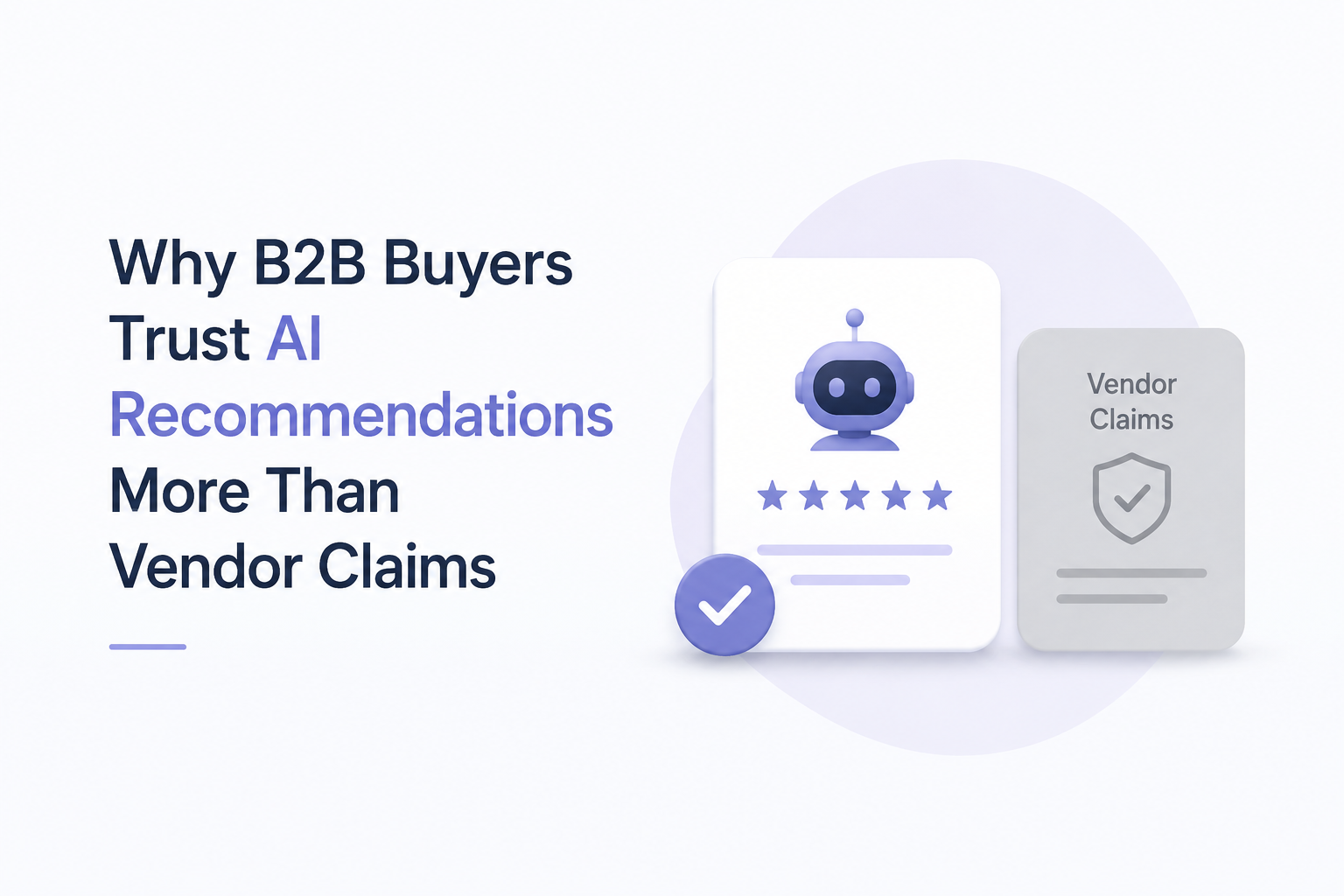
Why B2B Buyers Trust AI Recommendations More Than Vendor Claims :
Introduction –
The B2B buying process has undergone a significant transformation in recent years. Buyers are no longer relying solely on sales representatives, marketing materials, or vendor promises when evaluating products and services. Instead, they are increasingly turning to artificial intelligence-powered tools, recommendation engines, and AI-driven research platforms to gather information and make purchasing decisions.
This shift reflects a broader change in how businesses approach procurement and vendor evaluation. Modern B2B buyers are more informed, more skeptical, and more data-driven than ever before. They have access to vast amounts of information and expect objective insights rather than promotional messaging. As a result, AI recommendations are becoming a trusted source of guidance throughout the buyer journey.
But why are B2B buyers placing more trust in AI recommendations than traditional vendor claims? The answer lies in factors such as objectivity, personalization, transparency, efficiency, and the evolving expectations of modern decision-makers.
The Growing Skepticism Toward Vendor Claims –
For decades, vendors controlled much of the information available to potential buyers. Product brochures, sales presentations, case studies, and marketing campaigns were primary sources of information.
However, today’s buyers understand that vendor-created content naturally highlights strengths while minimizing weaknesses.
Common concerns among B2B buyers include:
- Marketing exaggeration
- Selective presentation of success stories
- Lack of competitor comparisons
- Biased product positioning
- Overpromising capabilities
As a result, buyers often seek independent validation before making significant purchasing decisions.
This growing skepticism has created an environment where objective recommendations carry more weight than promotional claims.
How AI Is Changing the B2B Buying Journey-
Artificial intelligence is transforming the way organizations research, compare, and select solutions.
AI-powered platforms can:
- Analyze large volumes of market data
- Compare products objectively
- Surface customer reviews and sentiment
- Identify trends and performance metrics
- Recommend solutions based on specific business needs
Instead of relying on a single vendor’s perspective, buyers can access insights generated from broader datasets and multiple information sources.
This creates a perception of neutrality that traditional vendor messaging often lacks.
The Power of Data-Driven Recommendations-
One of the primary reasons buyers trust AI recommendations is that they are often based on data rather than persuasion.
AI systems can process:
- Product reviews
- Industry reports
- Customer feedback
- Performance benchmarks
- Market trends
- User behavior patterns
By analyzing thousands or even millions of data points, AI can generate recommendations that appear more objective and evidence-based.
For decision-makers responsible for large budgets and strategic investments, data-driven guidance provides greater confidence than marketing claims alone.
Personalization Increases Trust –
Modern B2B buyers expect personalized experiences.
Traditional marketing often delivers broad messages intended for large audiences. While these messages may be relevant to some prospects, they rarely address the unique challenges faced by individual organizations.
AI recommendations can be tailored based on:
- Industry
- Company size
- Business objectives
- Technology stack
When recommendations directly address a buyer’s specific situation, they feel more relevant and trustworthy.
Personalization helps buyers believe that the recommendation is designed to solve their problem rather than simply sell a product.
Reduced Influence of Sales Pressure –
Many buyers prefer conducting research independently before speaking with sales teams.
Research consistently shows that B2B decision-makers complete a significant portion of their buying journey before contacting vendors.
Reasons include:
- Avoiding sales pressure
- Conducting unbiased research
- Comparing multiple options
- Building internal consensus
AI-powered recommendation tools support this self-service approach by providing insights without requiring interaction with a salesperson.
This independence often increases trust because buyers feel they maintain greater control over the decision-making process.
AI Can Compare Multiple Vendors Simultaneously –
Vendor claims naturally focus on a single solution.
AI systems, however, can evaluate multiple vendors at once.
This capability allows buyers to:
- Compare features
- Analyze pricing structures
- Review customer satisfaction data
- Evaluate implementation complexity
- Assess long-term value
Because AI recommendations often consider multiple alternatives, buyers perceive them as more balanced and comprehensive.
The ability to compare competing solutions side by side creates confidence that the recommendation is not biased toward a particular provider.
Transparency Through Customer Feedback –
Modern AI systems frequently incorporate user-generated content into their recommendations.
This includes:
- Customer reviews
- Peer ratings
- Community discussions
- Case studies
- User experiences
Buyers often trust the experiences of other businesses more than vendor-produced content.
When AI analyzes and summarizes feedback from actual customers, the resulting recommendation feels more authentic and credible.Peer validation has become a critical component of modern B2B purchasing decisions.
The Future of Trust in B2B Marketing –
Trust has become one of the most valuable assets in modern B2B marketing.
As artificial intelligence continues to influence purchasing decisions, buyers will increasingly rely on data-driven recommendations, peer insights, and independent validation.
This does not mean vendors lose their influence. Instead, it means organizations must shift from traditional promotional approaches toward transparency, authenticity, and customer-centric communication.
Companies that consistently deliver value and earn positive customer experiences will benefit from both human recommendations and AI-generated endorsements.
Conclusion –
B2B buyers trust AI recommendations more than vendor claims because AI is often perceived as objective, data-driven, personalized, and less influenced by sales agendas. In an environment where buyers have access to more information than ever before, trust is increasingly built through evidence rather than promotion.
As AI-powered research and recommendation tools become more advanced, businesses must adapt their marketing strategies to meet changing expectations. Organizations that prioritize transparency, customer success, and measurable outcomes will be better positioned to earn buyer trust and succeed in the evolving B2B marketplace.