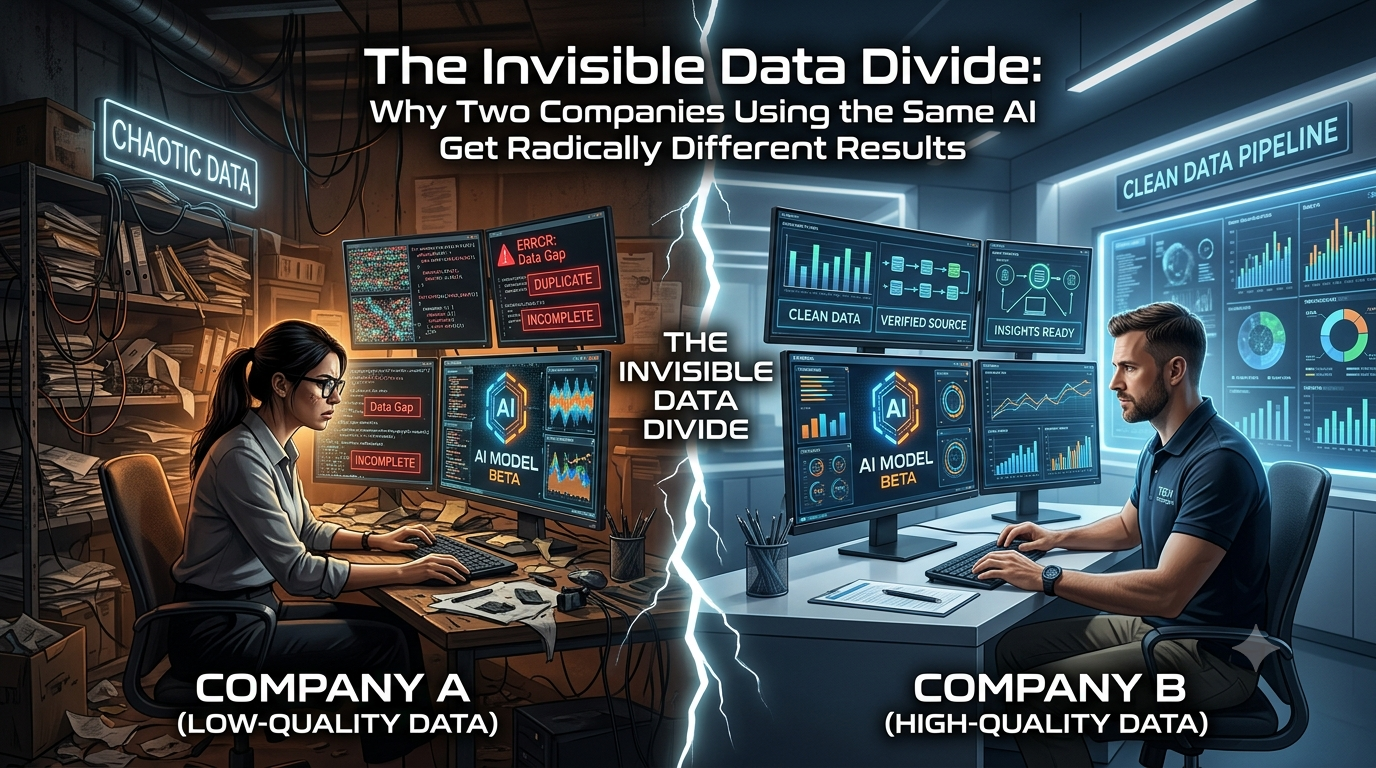
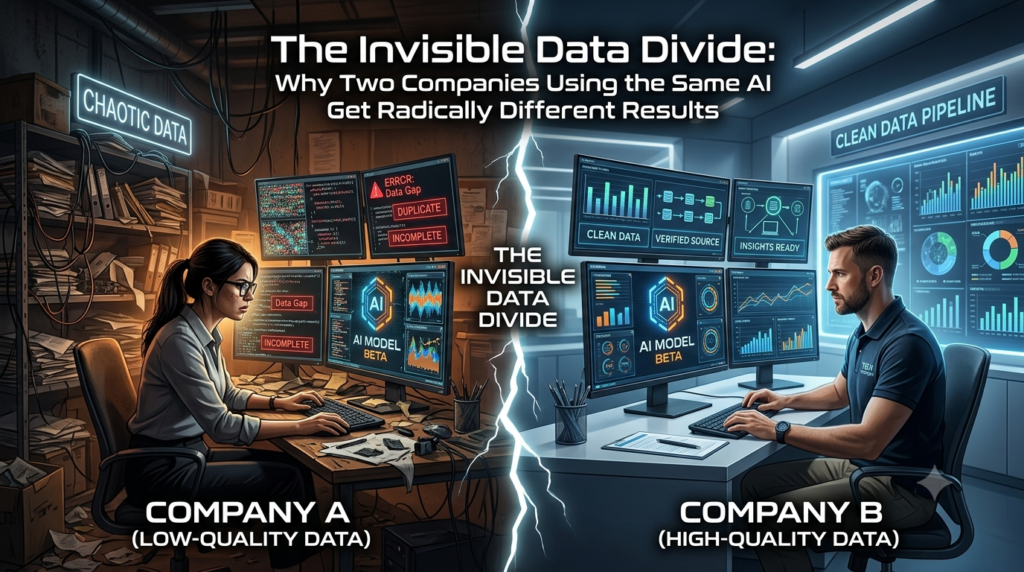
AI data quality is becoming a critical factor in determining whether businesses turn artificial intelligence investments into measurable results or struggle with inconsistent outputs and disappointing returns. As AI tools become more accessible, organizations across industries can use similar platforms to automate workflows, analyze information, improve customer engagement, and support strategic decisions. Yet access to the same technology does not guarantee the same business outcomes.
AI data quality is becoming a critical factor in determining whether businesses can turn artificial intelligence investments into measurable results. As organizations adopt AI across sales, marketing, operations, and customer service, AI data quality helps determine how relevant, reliable, and actionable their AI-generated insights will be.
This growing gap creates an invisible data divide between businesses that can translate AI capabilities into practical value and those that struggle to move beyond experimentation. For B2B organizations, understanding this divide is essential to building an effective AI strategy, improving operational efficiency, and establishing a sustainable competitive advantage.
Why AI Data Quality Determines Business Outcomes –
The assumption that a more advanced AI model automatically delivers better results overlooks the role of the information supporting it. AI systems generate responses and recommendations based on their underlying capabilities, available data, instructions, and access to relevant business context. When these inputs are incomplete, outdated, or inconsistent, even a capable model may produce results that sound convincing but fail to address the actual business problem.
Consider two B2B companies using the same AI platform to identify potential customers. One maintains accurate customer relationship management (CRM) records, regularly updates its ideal customer profile, and connects marketing performance with sales feedback. The other relies on disconnected spreadsheets, outdated contact information, and inconsistent lead qualification criteria.
Although both companies use similar technology, the first is better positioned to generate relevant recommendations. The second may receive polished prospect lists that reflect weaknesses in its data rather than genuine market opportunities.
Strong AI data quality depends on connecting relevant information across enterprise systems. When CRM, marketing, finance, and customer support data remain fragmented, AI applications may overlook relationships that influence customer acquisition, retention, and operational efficiency.
What influences AI performance?
Several interconnected factors determine how effectively AI supports business decisions:
- Accuracy: Information must reflect current business realities and customer details.
- Consistency: Teams need shared definitions for metrics, customer segments, and business outcomes.
- Relevance: Data should directly support the task or decision the AI system is expected to handle.
- Context: Recommendations must account for operational constraints, business priorities, and customer relationships.
- Feedback: Organizations need processes to evaluate outputs, identify errors, and improve future decisions.
When these foundations are in place, businesses can evaluate AI based on its contribution to meaningful outcomes instead of relying on output volume or the number of automated tasks completed.
Break Down Data Silos Across Enterprise Systems –
One of the biggest barriers to effective AI adoption is fragmented enterprise data. As organizations grow, information becomes distributed across CRM platforms, marketing automation tools, financial systems, customer support applications, project management software, and departmental spreadsheets.
Each system may contain valuable information, but the complete business picture often remains scattered across disconnected platforms.
For example, marketing may understand which campaigns generate engagement, while sales knows which prospects demonstrate genuine buying intent. Customer success may identify patterns in renewals and cancellations, and finance may understand which accounts contribute the greatest long-term value.
If an AI system can access only marketing engagement data, it may recommend targeting audiences that rarely convert into customers. Connecting relevant information can help the organization evaluate campaign performance against actual sales and customer outcomes.
How enterprise data integration improves AI –
A practical data integration strategy helps organizations:
- Connect relevant information across business applications.
- Establish a consistent view of customers, accounts, and operational performance.
- Reduce duplicated records and conflicting information.
- Enable AI tools to consider relationships between departments.
- Improve collaboration between IT, operations, sales, marketing, and finance.
Enterprise data integration does not mean every AI application needs access to every company system. Instead, organizations should provide the appropriate information for each use case while maintaining access controls and data protection requirements.
The objective is to help AI support decisions that reflect broader business priorities rather than optimizing individual activities in isolation.
Establish Strong Data Governance and Consistent Definitions –
More data does not automatically produce better AI results. The value of information depends on its reliability, relevance, and consistency.
For example, a sales department might define a qualified lead based on job title, while marketing prioritizes engagement and business size. Another team may use demonstrated purchase intent as its primary criterion. If these definitions are inconsistent, AI-generated recommendations may vary depending on the dataset or process being used.
Similar challenges emerge when customer records contain duplicates, historical information becomes outdated, or reporting metrics change without clear documentation.
These problems can be difficult to identify because AI-generated responses often appear polished and authoritative, even when the underlying information is unreliable.
Building a practical data governance framework –
Businesses can strengthen AI data quality by establishing clear ownership and maintenance practices.
- Define data ownership: Assign responsibility for maintaining critical datasets and resolving quality issues.
- Standardize business terminology: Align teams on definitions for qualified leads, customer value, conversion, and other important metrics.
- Validate information regularly: Identify duplicate records, missing fields, outdated details, and conflicting entries.
- Document data sources: Help teams understand where information originates and when it was last updated.
- Establish access controls: Ensure AI applications use information according to organizational policies and applicable requirements.
Strong data governance creates a more dependable foundation for AI implementation. It also helps businesses explain where information came from, evaluate the reliability of recommendations, and identify the source of recurring errors.
Give AI the Business Context It Needs –
Even accurate data can produce incomplete recommendations when important context is missing.
AI may identify a prospect as an attractive sales opportunity because the organization operates in the right industry, has a suitable employee count, and appears to be expanding. However, the recommendation may overlook previous unsuccessful outreach, geographic service limitations, an existing customer relationship, or evidence that the prospect is unlikely to benefit from the company’s offering.
These details can change the decision entirely.
The same challenge applies to internal operations. An AI system might recommend removing a quality check because historical records indicate that errors are uncommon. However, if the check addresses a regulatory obligation or a high-impact operational risk, eliminating it could create consequences that outweigh any efficiency gains.
How to provide useful AI context –
Organizations should identify the information and constraints that materially influence each AI-supported decision.
- Business objectives: Define what success means for the specific workflow.
- Operational constraints: Account for capacity, budgets, service territories, and existing commitments.
- Customer history: Incorporate relevant interactions, preferences, and previous outcomes.
- Policies and requirements: Make applicable procedures and approval rules available to the system.
- Decision boundaries: Specify when AI can make recommendations and when human approval is required.
Providing context transforms AI from a general-purpose assistant into a more relevant business tool. It helps ensure that recommendations are evaluated against real operating conditions instead of being accepted simply because they sound reasonable.
Combine AI Capabilities With Human Expertise –
Not every important business insight exists in a structured database. Employees develop practical knowledge through customer conversations, operational experience, collaboration, and problem-solving.
A salesperson may know that a particular industry responds poorly to generic outreach. A customer success manager may understand why an account is considering cancellation. An operations specialist may recognize that an apparently unnecessary verification step prevents recurring errors.
When organizations introduce AI without capturing this knowledge, they risk automating existing inefficiencies rather than improving the underlying process.
Human expertise is especially valuable when AI encounters unusual circumstances, ambiguous information, or decisions requiring judgment.
Creating an effective human-AI feedback loop –
Businesses can combine employee knowledge with AI capabilities through practical processes:
- Encourage employees to flag inaccurate or irrelevant AI recommendations.
- Document recurring customer objections, operational exceptions, and lessons learned.
- Provide clear escalation paths for uncertain or high-impact decisions.
- Review AI-generated outputs against actual business outcomes.
- Update workflows and guidance when repeated issues are identified.
The objective is not to replace human judgment with technology or assume that employees are always correct. It is to establish a continuous improvement process in which AI supports human expertise and employees help improve the information and rules guiding AI.
Improve AI Data Quality in B2B Sales and Marketing –
Sales and marketing are particularly important areas for examining the business impact of AI data quality. Organizations increasingly use AI to research accounts, identify decision-makers, personalize outreach, prioritize leads, and analyze campaign performance.
However, these activities depend on accurate information and meaningful qualification criteria.
Outdated contact details can lead to messages reaching the wrong people. Targeting based primarily on engagement may generate more responses without improving qualified opportunities. Disconnected marketing and sales data can also prevent teams from understanding which campaigns ultimately contribute to revenue.
These problems do not necessarily indicate that AI is ineffective. They may reveal weaknesses in the processes surrounding its implementation.
Practical applications for B2B teams :

AI-powered lead qualification
Combine reliable account information, clearly defined ideal customer profiles, and relevant buying signals to prioritize prospects more effectively. Sales teams should validate recommendations against actual qualification criteria.

Campaign performance analysis
Connect marketing engagement with qualified opportunities and sales outcomes to identify which campaigns contribute to business objectives, rather than measuring success through clicks alone.

Personalized customer outreach
Use accurate customer information, relevant account context, and appropriate messaging guidelines to create more meaningful communications while maintaining human review where necessary.
A stronger approach combines AI-generated insights with accurate CRM data, shared qualification standards, and continuous feedback from customer-facing teams.
For B2B organizations, the most useful measure is not simply how many leads AI can generate. It is whether those leads contribute to better conversations, more qualified opportunities, and improved business outcomes.
Build a Continuous Improvement Strategy for AI Adoption –
The data divide can become more pronounced as businesses continue using AI. Organizations that systematically evaluate recommendations can learn which outputs are useful, where errors occur, and which processes require additional oversight.
This creates a feedback loop in which reliable information supports better recommendations, and observed outcomes help refine future decisions.
Organizations without this discipline may respond to disappointing results by changing prompts, purchasing additional tools, or switching platforms without addressing the underlying information problems.
A sustainable AI strategy focuses on improving the entire decision-making process, not simply upgrading the technology.
A practical framework for improving AI readiness –
Businesses can take the following steps to build a more effective AI environment:
- Identify high-value use cases. Start with a specific business challenge, such as improving lead qualification, reducing processing delays, or strengthening customer support.
- Assess data readiness. Determine whether the information required for the use case is accurate, accessible, current, and consistently defined.
- Address critical gaps. Prioritize the most consequential data quality issues and assign clear ownership for resolving them.
- Run controlled pilots. Test AI against realistic workflows and compare its outputs with existing processes or defined performance benchmarks.
- Measure business outcomes. Track relevant indicators such as qualified lead rates, processing time, error rates, customer retention, and resource utilization.
- Gather employee feedback. Collect examples of incorrect recommendations, useful insights, and situations requiring human intervention.
- Refine and scale. Expand successful use cases gradually, maintaining appropriate security, governance, and performance monitoring.
This approach helps organizations make more informed investment decisions and reduces the risk of scaling an AI application before its underlying processes are ready.
Importantly, smaller businesses do not necessarily need extensive technology infrastructure to begin. Accurate customer records, a focused dataset, consistent definitions, and a disciplined review process can provide a practical starting point.
Measuring the Business Value of AI Data Quality –
Improving AI data quality should produce observable changes in how the business operates. Without clear measurement, organizations may struggle to determine whether better information is improving decisions or simply increasing the volume of AI-generated output.
The right metrics depend on the use case, but businesses should connect technical improvements with operational and commercial results.
| Measurement area | Example indicators |
|---|---|
| Data quality | Duplicate records, missing fields, outdated information |
| Sales and marketing | Lead qualification rate, conversion rate, campaign contribution |
| Operational efficiency | Processing time, manual rework, avoidable errors |
| Customer outcomes | Retention, response quality, customer satisfaction |
| AI performance | Recommendation acceptance, correction frequency, output relevance |
| Governance and risk | Policy exceptions, access violations, review completion |
These metrics should be interpreted in context. For example, a higher AI recommendation acceptance rate does not automatically indicate better performance if employees are accepting unsuitable recommendations without scrutiny.
Businesses should establish a baseline before implementation, define the expected improvement, and review results regularly. Where possible, controlled comparisons can help distinguish the effects of AI improvements from other changes in the business.
The goal is to demonstrate that better data and more effective AI processes contribute to measurable business value.
Conclusion –
The invisible data divide is changing how businesses compete in an increasingly AI-driven economy. As access to capable AI models becomes more widespread, simply adopting the latest technology may no longer be enough to create a meaningful advantage. The quality of the underlying information, the context available to AI systems, and the processes used to evaluate their recommendations can be equally important.
For B2B organizations, improving AI data quality means addressing fragmented systems, establishing consistent data governance, capturing operational knowledge, and connecting AI initiatives to measurable business outcomes. It also requires a willingness to evaluate results critically rather than assuming that automation automatically leads to greater efficiency.
Businesses do not need to solve every data challenge before beginning their AI journey. They need to identify the decisions that matter most, provide the information those decisions require, and build a disciplined process for learning from results.
Ultimately, the organizations best positioned to benefit from AI will not necessarily be those using the most advanced models or the greatest number of tools. They will be those that combine technology with trustworthy data, relevant business context, human expertise, and a clear understanding of what success looks like.
The competitive advantage lies not just in having AI, but in creating the conditions that allow AI to deliver meaningful results.
Frequently Asked Questions –
AI data quality refers to how accurate, complete, consistent, relevant, and current the information used by AI systems is. High-quality data helps businesses generate more reliable insights and recommendations, although results also depend on the model, instructions, context, and implementation.
Companies may use the same AI platform but provide different data, instructions, business context, and workflows. Organizations with accurate information, connected systems, and clear objectives are often better positioned to obtain useful outputs than those working with fragmented or outdated data.
Poor data quality can lead to irrelevant recommendations, inaccurate analysis, inconsistent outputs, and flawed business decisions. It can also increase manual corrections and reduce confidence in AI-generated insights.
Data governance establishes ownership, standards, access controls, and procedures for maintaining reliable information. These practices help businesses manage data risks, improve consistency, and provide AI applications with more dependable inputs.