Physical Address
304 North Cardinal St.
Dorchester Center, MA 02124
Physical Address
304 North Cardinal St.
Dorchester Center, MA 02124
Artificial Intelligence has transformed the way businesses interact with technology. From virtual assistants and AI chatbots to enterprise automation and intelligent search systems, AI models are becoming increasingly important in daily operations. However, despite the rapid growth of generative AI, one major concern continues to challenge organizations across industries — accuracy.
Traditional AI models are designed to generate responses based on information learned during training. While these systems can produce highly advanced and human-like answers, they are also known to generate incorrect or misleading information at times. This issue, commonly referred to as AI hallucination, has become a major limitation for enterprises that require reliable and trustworthy AI outputs.
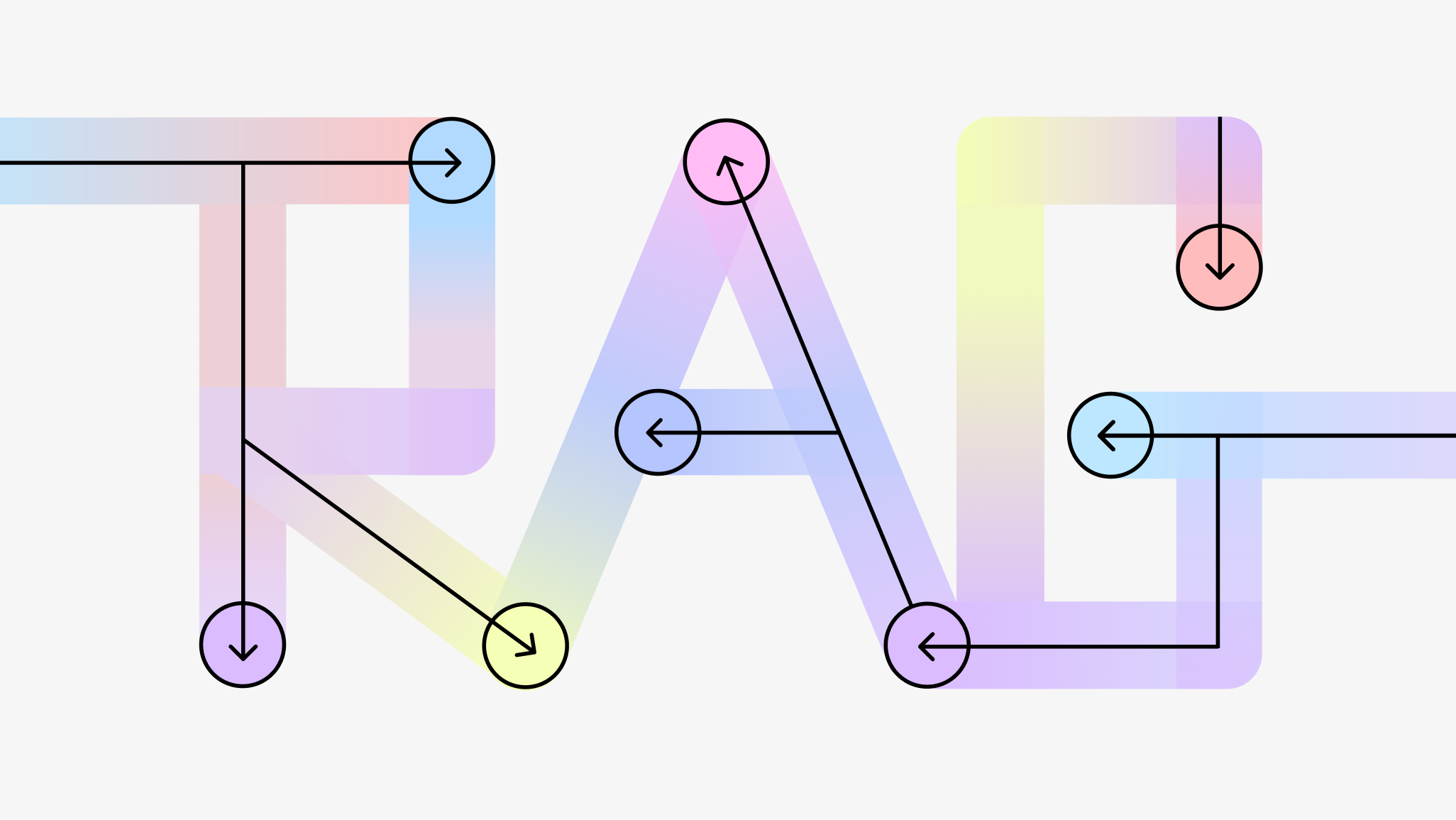
To solve this problem, businesses and AI researchers are increasingly adopting Retrieval-Augmented Generation, widely known as RAG. This modern AI architecture improves response quality by combining language generation with real-time information retrieval. Instead of relying only on pre-trained knowledge, RAG systems retrieve relevant information from external sources before generating answers.
As organizations continue integrating AI into customer service, analytics, healthcare, finance, and operational systems, Retrieval-Augmented Generation is emerging as one of the most effective methods for improving AI accuracy and reliability.
Retrieval-Augmented Generation is an AI framework that enhances language models by allowing them to access external data sources during response generation. Traditional large language models generate answers based solely on patterns and knowledge captured during training. In contrast, RAG systems first retrieve relevant information from databases, documents, APIs, or enterprise knowledge systems before creating a response.
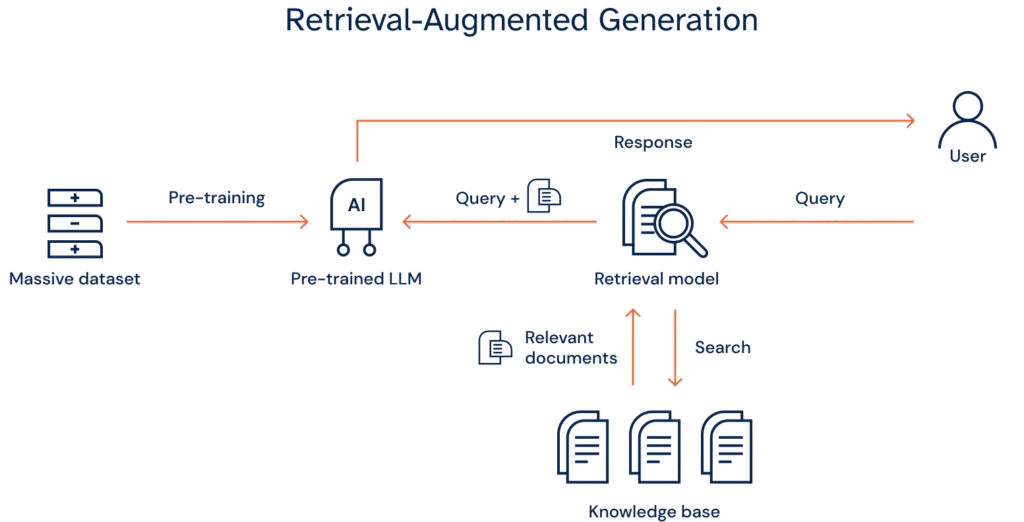
This approach allows AI systems to work with current and context-specific information rather than depending entirely on static training data. The retrieved content acts as supporting context that guides the language model toward more accurate and relevant outputs.
For example, if a user asks about updated company policies, recent business reports, or product specifications, a RAG-based AI system can search connected knowledge repositories in real time and use the retrieved information to generate a reliable answer.
This capability significantly improves the usefulness of AI systems in enterprise environments where information changes frequently.
Large language models are trained on massive datasets collected from books, articles, websites, and digital resources. Once training is completed, the model’s knowledge becomes fixed unless retrained again using newer data.
This creates several limitations in practical business environments. AI systems may provide outdated information, misunderstand business-specific terminology, or generate responses that sound correct but are factually inaccurate. Since traditional models predict responses based on probabilities rather than verified facts, they sometimes produce hallucinated answers with high confidence.
For enterprises, this creates operational and reputational risks. In industries such as healthcare, legal services, cybersecurity, and finance, inaccurate AI responses can lead to poor decision-making and customer distrust.
Retraining models regularly is also expensive, time-consuming, and technically complex. Businesses need AI systems capable of accessing updated information dynamically without requiring complete retraining cycles.
This is exactly where Retrieval-Augmented Generation provides value.
The core strength of RAG lies in its ability to connect AI models with live and verified information sources. When users submit a query, the system first searches relevant knowledge repositories to retrieve related content. The language model then uses that retrieved information to generate a context-aware response.
Because the AI works with fresh and relevant data, the risk of hallucination decreases significantly. Responses become more accurate, more explainable, and more aligned with real-world information.
RAG also allows organizations to maintain control over the information used by AI systems. Enterprises can connect internal databases, policy documents, CRM systems, research repositories, or operational records directly into the retrieval process.
This creates AI systems that are not only intelligent but also deeply connected to organizational knowledge.
| Feature | Traditional AI Models | RAG-Based AI Systems |
|---|---|---|
| Knowledge Source | Static training data | Real-time external data |
| Information Freshness | Limited after training | Continuously updated |
| Accuracy Level | Moderate | Higher contextual accuracy |
| Hallucination Risk | Higher | Lower |
| Enterprise Knowledge Access | Limited | Strong integration support |
| Adaptability | Requires retraining | Easier data updates |
| Response Reliability | Variable | More trustworthy |
Modern organizations generate enormous amounts of information every day. Customer records, operational reports, product documentation, support tickets, compliance policies, and internal communications constantly evolve. Traditional AI systems struggle to keep pace with these changes because their knowledge remains frozen after training.
RAG solves this issue by allowing AI systems to retrieve enterprise-specific information dynamically. This makes AI more practical for business applications where accuracy and real-time knowledge are critical.
For example, customer support AI can access updated troubleshooting guides before responding to customers. Financial institutions can use RAG systems to retrieve recent compliance regulations. Healthcare organizations can connect AI systems with medical databases and treatment guidelines to improve response reliability.
Because information retrieval occurs in real time, businesses can update knowledge repositories without retraining the underlying AI model repeatedly.
One of the most important technologies behind modern RAG systems is the vector database. Unlike traditional keyword-based search engines, vector databases use semantic search techniques that understand meaning and context.
When information is stored, the system converts text into mathematical representations called embeddings. These embeddings capture the meaning of words and sentences rather than simply matching exact keywords.
As a result, RAG systems can retrieve information based on intent and context. Even if users phrase questions differently, the system can still identify relevant content.
For example, a query about “server performance issues” may retrieve documents related to infrastructure bottlenecks, API delays, or network congestion even if those exact words are not used.
This semantic understanding greatly improves retrieval quality and overall AI accuracy.
RAG offers several important advantages for enterprises adopting AI technologies. One major benefit is improved reliability. Since responses are grounded in retrieved information, businesses gain greater confidence in AI-generated outputs.
Another advantage is access to real-time knowledge. Organizations no longer need to wait for expensive retraining cycles whenever information changes. Updated documents and databases automatically become part of the AI’s accessible knowledge base.
RAG also supports personalization. AI systems can retrieve organization-specific information, customer history, or operational data to deliver more tailored responses.
Cost efficiency is another important factor. Instead of constantly retraining large language models, organizations can maintain smaller retrieval systems that update independently.
Additionally, RAG improves transparency because retrieved documents can often be referenced directly, helping users understand where information originated.
Although RAG significantly improves AI performance, implementation can be technically challenging. Organizations must build efficient retrieval systems capable of searching large volumes of enterprise data quickly and accurately.
Data quality also becomes extremely important. Poorly organized or outdated documents may reduce retrieval accuracy and affect AI responses negatively.
Another challenge involves security and privacy. Enterprise AI systems often access sensitive business information, making strong governance and access controls essential.
Businesses must also carefully optimize retrieval relevance. If unrelated or low-quality information is retrieved, the AI model may still generate inaccurate responses despite the presence of external knowledge.
Despite these challenges, RAG remains one of the most effective solutions for enterprise-grade AI reliability.
Retrieval-Augmented Generation is expected to become a foundational architecture for future enterprise AI systems. As organizations demand more trustworthy and explainable AI solutions, the need for retrieval-based intelligence will continue increasing.
Future RAG systems will likely support multimodal retrieval involving text, images, videos, and audio data. AI systems may also integrate more deeply with enterprise workflows, enabling real-time operational decision-making and intelligent automation.
Advancements in vector databases, semantic search, and large language models will further improve retrieval speed, contextual understanding, and response quality.
As AI adoption expands across industries, RAG will play a critical role in bridging the gap between generative intelligence and factual accuracy.
Retrieval-Augmented Generation represents a major advancement in the evolution of Artificial Intelligence. By combining real-time information retrieval with powerful language generation capabilities, RAG addresses one of the biggest weaknesses of traditional AI systems — unreliable accuracy.
Instead of relying solely on static training data, RAG-based systems dynamically access relevant and updated information before generating responses. This approach improves reliability, reduces hallucinations, and enables AI systems to deliver more context-aware and trustworthy outputs.
For enterprises operating in data-intensive and rapidly changing environments, RAG offers a scalable and efficient way to build intelligent AI systems capable of supporting real-world business operations.
As organizations continue investing in AI-driven transformation, Retrieval-Augmented Generation is likely to become a central technology powering the next generation of accurate, enterprise-ready artificial intelligence solutions.