


Introduction:
The B2B marketing landscape is changing rapidly. Businesses are publishing more content than ever before, using artificial intelligence (AI) to generate blog articles, social media posts, email campaigns, newsletters, white papers, and website copy at unprecedented speed. Marketing teams that once struggled to maintain a consistent publishing schedule can now produce multiple pieces of content in a single day.
At first glance, this increase in productivity appears to be a significant advantage. More content can create more opportunities to improve search visibility, attract potential customers, and establish industry authority. However, as more businesses adopt AI-powered content creation, a fundamental challenge is emerging: publishing more content no longer guarantees more visibility, engagement, or qualified leads.
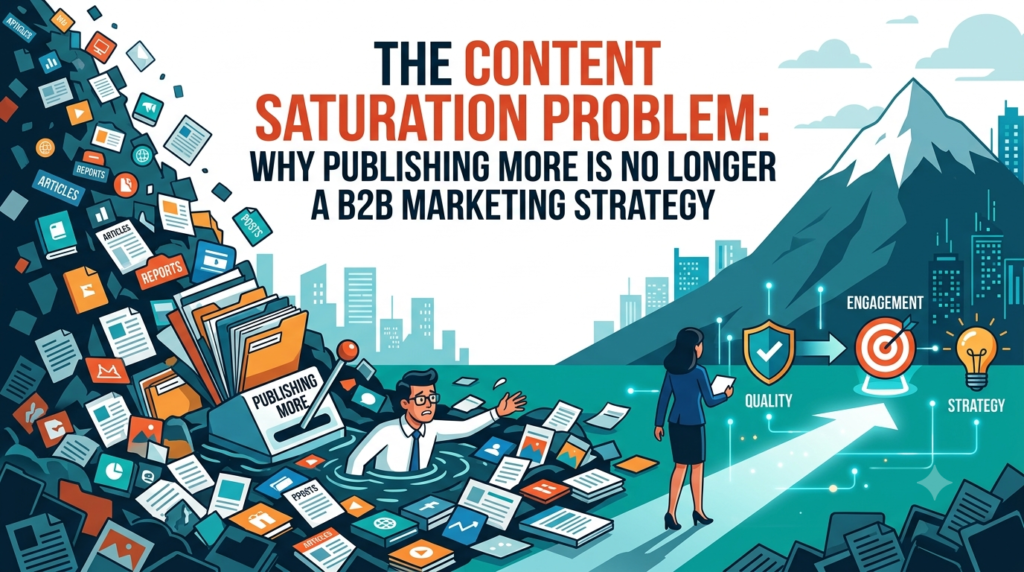
This is the content saturation problem. Buyers are overwhelmed by articles offering similar advice, LinkedIn posts repeating familiar observations, newsletters competing for attention, and AI-generated explanations that often sound remarkably alike.
For B2B marketers, the challenge is no longer simply producing enough content to remain visible. It is developing a B2B content marketing strategy that prioritises relevance, originality, credibility, and measurable business value.
The businesses that stand out will not necessarily be those that publish the most. They will be those that understand their audiences, communicate distinctive insights, and create content that helps decision-makers solve real business problems.
What Is Content Saturation in B2B Marketing?
Content saturation occurs when an audience encounters more information on a particular topic than it can reasonably consume or distinguish. As businesses compete to publish similar ideas across the same channels, individual pieces of content become harder to notice and remember.
This challenge has become more visible with the adoption of generative AI. Businesses can now research topics, draft articles, repurpose existing material, and create social media campaigns with fewer resources. Although these capabilities improve production efficiency, they also make it easier for multiple brands to publish similar messages.
Consider a common B2B marketing topic such as digital transformation. Dozens of companies might publish articles explaining the importance of automation, data-driven decisions, customer experience, and technological innovation. These themes are relevant, but repeating them without new evidence or a distinctive perspective gives readers little reason to choose one article over another.
Content saturation does not mean that every valuable topic has been exhausted. Instead, it means that generic information is becoming less effective as a competitive advantage.
To succeed, businesses need to move beyond producing more material and focus on creating content that offers a clear answer, a credible perspective, or a practical insight that audiences cannot easily find elsewhere.
Why Publishing More Content Is No Longer Enough –
Traditional content marketing rewarded consistency because regular publishing helped businesses build awareness, attract organic traffic, and develop relationships with potential customers. These principles remain important, but they must now be supported by a stronger strategy.
AI Has Increased the Volume of Similar Content –
Artificial intelligence has lowered many of the barriers associated with content creation. Marketing teams can generate outlines, draft articles, summarise research, and adapt long-form content into shorter formats much faster than before.
The challenge arises when businesses use these tools primarily to increase publishing frequency.
For example, a marketing team might generate ten posts about customer engagement or five articles about the future of sales. The content may be grammatically correct and professionally structured, yet it may repeat recommendations already published by competitors.
Common themes such as personalisation, innovation, data-driven decision-making, and operational efficiency appear across countless marketing resources. While these subjects remain relevant, their value depends on how effectively an article explores them.
AI-generated content is not inherently ineffective. The problem is content created without sufficient research, original thinking, audience understanding, or expert review.
The opportunity is to use AI to improve content quality and efficiency, rather than simply increasing output.
B2B Buyers Have Less Reason to Engage With Generic Content –
B2B purchasing decisions often involve multiple stakeholders, extended evaluation periods, and considerable financial or operational risk. Buyers research problems, compare alternatives, assess vendors, and discuss potential solutions with colleagues before making a decision.
During this process, they encounter competing claims about expertise, innovation, efficiency, and measurable results.
Publishing frequently may demonstrate that a company is active, but it does not automatically establish credibility. Buyers need information that helps them understand their circumstances and make informed decisions.
An article that explains why a business problem occurs, explores the trade-offs involved in solving it, and offers practical guidance is more useful than another general list of industry best practices.
Effective B2B content marketing demonstrates expertise through the quality of its explanations, the relevance of its examples, and the credibility of its recommendations.
More Content Does Not Automatically Mean Better SEO Performance –
Publishing additional blog posts can create more opportunities to appear in search results, but content volume alone does not guarantee higher rankings or sustainable organic traffic.
Search-focused content needs to satisfy user intent, answer relevant questions, and provide value beyond what existing pages already offer.
When businesses repeatedly publish articles targeting nearly identical topics, they may create unnecessary overlap within their own websites. This can make it harder to establish a clear purpose for each page and may contribute to keyword cannibalisation when multiple URLs compete for similar queries.
A stronger B2B SEO strategy starts with understanding the keywords and questions that matter to potential customers. It then maps those topics to useful content formats, identifies gaps in existing resources, and ensures each page serves a distinct purpose.
Instead of publishing several similar articles about content marketing trends, a business might develop one comprehensive resource supported by original examples, expert insights, and practical recommendations.
The objective is not to publish less for the sake of publishing less. It is to ensure that every new piece adds meaningful value to the website.
How to Build a B2B Content Marketing Strategy That Stands Out –
Overcoming content saturation requires a shift from volume-led publishing to a more deliberate approach. Businesses need to understand what their audiences need, identify where they can offer distinctive expertise, and measure success through meaningful outcomes.
Prioritise Original Insights Over Generic Information –
When AI tools can summarise existing information quickly, original insights become an important way to differentiate a brand.
These insights can come from customer interviews, industry experience, proprietary data, expert opinions, case studies, surveys, or practical observations from real projects.
For example, an article explaining that personalisation improves customer engagement offers a familiar recommendation. A more distinctive article might examine why personalisation initiatives fail when customer data is fragmented, how outdated records affect campaign performance, or why poorly integrated systems create additional work for sales teams.
The second approach explores the practical challenges behind the broader concept and gives readers a more specific understanding of the issue.
Businesses do not need to discover an entirely new subject every time they publish. They need to contribute something meaningful to the conversation.
Before publishing an article, ask:
- Does this content offer an insight that is not already widely available?
- Can we support its claims with credible evidence or relevant experience?
- Does it explain a problem or solution in a way that helps our audience?
- Would a reader remember our perspective after reading similar articles?
These questions help distinguish valuable thought leadership from content that simply repeats established ideas.
Understand Your Audience and Its Search Intent –
Content saturation is not only a problem of quantity. It is also a problem of relevance.
A well-written article can fail to engage its intended audience if it addresses the wrong question, assumes too much prior knowledge, or overlooks the decisions readers need to make.
Different B2B stakeholders approach the same topic from different perspectives. A technology executive may focus on security and integration, while a finance leader evaluates costs, returns, and financial risk. A sales director may be more interested in productivity, conversion rates, and pipeline growth.
A single generic article may not adequately address these different priorities.
A more effective content marketing strategy begins by identifying:
- The audience’s most pressing business challenges.
- The questions they ask when researching solutions.
- The information they need at different stages of the buying journey.
- The objections or risks that could prevent them from making a decision.
- The search terms they use to find answers and evaluate alternatives.
Keyword research can help identify search demand, while customer conversations provide context about the motivations behind those searches.
By combining both sources, businesses can create content that aligns with search intent while remaining relevant to real buying decisions.
Use Customer Conversations to Discover Better Content Ideas –
Marketing teams often rely on industry reports, competitor analysis, search trends, and social media discussions to identify content opportunities. These sources are useful, but they should not replace direct customer insight.
Sales calls, product demonstrations, customer support interactions, onboarding sessions, and feedback meetings can reveal questions that are not always visible in published research.
Customers may express concerns about implementation, pricing, integration, expected returns, internal resistance, or the complexity of comparing competing solutions.
These questions are valuable because they reflect real obstacles in the buying process.
Marketing teams can collaborate with sales and customer success departments to identify recurring questions and turn them into practical resources, including:
- Detailed blog posts addressing common customer problems.
- Comparison guides explaining the differences between potential solutions.
- Implementation articles outlining practical considerations.
- Case studies showing how customers approached specific challenges.
- FAQs answering recurring questions about products and services.
This approach makes content creation more purposeful. Rather than publishing because a topic is trending, businesses create resources that answer questions their audiences genuinely need resolved.
Align Content With the B2B Buyer Journey –
Not every potential customer needs the same information at the same time. A person who is beginning to understand a problem requires different guidance from someone comparing suppliers or preparing a business case for approval.
An effective B2B content marketing strategy addresses these different stages.
Awareness stage: Help readers recognise a challenge, understand its causes, and explore why it matters.
Suitable formats include educational blog posts, industry explainers, introductory guides, and research-based articles.
Consideration stage: Help readers evaluate approaches, understand trade-offs, and compare potential solutions.
Useful formats include comparison articles, expert interviews, practical frameworks, and solution evaluation guides.
Decision stage: Help stakeholders assess implementation requirements, commercial considerations, potential risks, and evidence of results.
Relevant formats include case studies, implementation guides, product comparisons, ROI resources, and detailed service information.
When businesses focus exclusively on introductory topics, they may attract visitors without helping them progress towards a decision.
Mapping content to the buyer journey creates a more balanced resource library and helps ensure that readers can find useful information as their needs evolve.
Measure Content Quality and Business Impact, Not Just Output –
Publishing frequency, impressions, social media likes, and website visits can help teams understand distribution and engagement. However, these metrics do not always show whether content is contributing to business growth.
A post might receive substantial attention from an audience that has little relevance to the company’s target market. Meanwhile, a specialised article may attract fewer visitors but support an important sales conversation or help a decision-maker evaluate a solution.
A stronger measurement framework connects content performance with audience quality and business objectives.
Important metrics include:
- Organic search performance: Relevant keyword rankings, qualified organic traffic, and engagement with priority pages.
- Audience engagement: Meaningful interactions, returning visitors, newsletter engagement, and relevant content downloads.
- Lead quality: Qualified enquiries, conversion rates, and alignment between incoming leads and the target customer profile.
- Sales enablement: How frequently sales teams use content and whether it helps address buyer questions or objections.
- Business impact: Opportunities influenced by content, pipeline contribution, and revenue where reliable attribution is available.
The appropriate metrics depend on the purpose of each asset. An awareness article should not necessarily be judged by the same conversion target as a product comparison page.
The goal is to understand which content helps the business reach the right audience, build trust, and support meaningful commercial outcomes.
The Role of AI in a Smarter Content Strategy –
AI can make content marketing more efficient by helping teams research topics, organise ideas, create initial drafts, summarise information, and adapt existing resources for different channels.
However, efficiency and effectiveness are not the same.
A team that uses AI to produce ten similar articles may increase its output without improving audience engagement. A team that uses the same technology to research a customer problem, structure expert interviews, strengthen an existing resource, and improve the clarity of its recommendations may create significantly more useful content.
The difference lies in how the technology is applied.
Use AI to Support Human Expertise –
A practical AI-assisted content workflow should include several stages:
- Research: Use AI to explore topic ideas and organise preliminary research, then verify important claims against reliable sources.
- Planning: Identify the audience, search intent, content objective, and distinctive perspective before drafting.
- Drafting: Use AI to develop an initial structure or draft where appropriate.
- Expert input: Incorporate customer insights, original data, industry experience, and specialist knowledge.
- Editorial review: Check accuracy, clarity, originality, relevance, and repetitive language.
- SEO optimisation: Improve headings, keyword alignment, internal links, metadata, and content structure without sacrificing readability.
- Performance review: Evaluate how the content performs and update it when audience needs or supporting information change.
This workflow allows teams to benefit from AI without treating generated text as a finished product.
The objective is to combine the speed of technology with the judgement, experience, and understanding that make content valuable.
Why Content Distribution Matters as Much as Content Creation –
Even a valuable article may struggle to reach its intended audience if distribution is treated as an afterthought.
Publishing an article on a website and sharing it once on LinkedIn does not guarantee that the right people will discover it. Conversely, repeating the same message across every available channel can create noise without improving engagement.
An effective content distribution strategy considers the purpose of each channel and adapts the message accordingly.
A detailed industry analysis may work best as a long-form blog post. A key finding from that article might become a LinkedIn discussion, while a newsletter can provide additional context to subscribers who have already expressed interest. A webinar can help subject matter experts explore a complex issue and answer questions directly.
Repurposing content can extend the value of existing research, provided that each format is adapted to its audience and context.
Businesses should also consider how customers discover information across traditional search engines, professional communities, industry publications, peer recommendations, and AI-powered search tools.
Clear explanations, well-organised pages, credible sources, original insights, and useful examples can make content easier for people to understand and easier for discovery systems to interpret.
Rather than chasing every new platform, businesses should concentrate on the channels that help them reach their intended audiences and reinforce their expertise.
How to Refresh Existing Content Instead of Publishing More –
One of the most overlooked opportunities in content marketing is improving the resources a business already has.
Before commissioning another article on a familiar topic, marketing teams should review their existing content library to identify pages that could be updated, consolidated, expanded, or repositioned.
A content audit can reveal several opportunities:
- Update outdated information: Replace old examples, statistics, references, and recommendations with accurate material.
- Improve search intent alignment: Refine pages that attract visitors but do not adequately answer their questions.
- Consolidate overlapping articles: Combine similar resources where doing so creates a more useful and comprehensive page.
- Strengthen internal linking: Connect related articles so readers can explore a topic in greater depth.
- Add original evidence: Include expert commentary, customer insights, practical examples, or research that improves the resource.
- Improve conversion paths: Add relevant next steps, such as a related guide, case study, newsletter subscription, or service page.
Not every existing page needs a complete rewrite. Sometimes, improving the structure, clarifying an explanation, or adding a missing section can make a resource more useful.
A systematic content audit also helps teams identify gaps in their website and avoid creating unnecessary duplication.
Conclusion –
Content saturation does not mean businesses should stop publishing. Consistent communication, search visibility, and effective distribution remain important parts of a successful B2B marketing strategy.
What needs to change is the assumption that more content automatically produces better results.
As AI makes content production faster and more accessible, the ability to identify valuable topics, understand buyer needs, contribute original insights, and communicate with credibility becomes increasingly important.
Businesses that rely on generic content may find it difficult to distinguish themselves in a crowded market. Those that invest in customer research, expert knowledge, original evidence, thoughtful SEO, and meaningful performance measurement can build a stronger foundation for long-term growth.
The most effective content strategy is not necessarily the one that fills the publishing calendar fastest. It is the one that consistently helps the right people understand their problems, evaluate their options, and make better decisions.
Frequently Asked Questions (FAQs)
Content saturation occurs when businesses publish large amounts of similar information, making it harder for individual articles, campaigns, and brand messages to stand out. It increases the importance of relevance, originality, and audience understanding.
AI makes it faster and easier to research, draft, and repurpose content. When businesses use similar prompts and rely on generic outputs without adding original insights or expert review, the result can be a growing volume of repetitive material.
Businesses can improve their strategy by researching customer needs, aligning content with search intent and the buyer journey, incorporating original insights, refreshing existing resources, distributing content effectively, and measuring performance against business goals.
Not automatically. Publishing useful content can create more opportunities to rank, but performance depends on factors such as search intent, content quality, relevance, site structure, competition, and the overall user experience. Updating or consolidating existing content may sometimes be more valuable than publishing another similar article.
Marketers should evaluate content using metrics that match its purpose, including relevant organic traffic, audience engagement, qualified leads, sales enablement, influenced opportunities, and revenue contribution where measurable. Publishing frequency alone is not a reliable indicator of success.