


Shadow AI is becoming a growing concern for enterprise IT leaders as employees adopt artificial intelligence tools faster than organisations can establish effective governance. Although Shadow AI can improve productivity, unmanaged adoption may introduce data security, compliance, and operational risks that businesses cannot afford to overlook.
For many businesses, the challenge is not simply deciding whether employees should use artificial intelligence. It is understanding which tools they are using, what information they are sharing, and whether those applications meet the organisation’s security, privacy, and compliance requirements. Employees can access AI services through a web browser, personal accounts, free applications, or features embedded in existing business software. As a result, AI adoption can spread across departments without formal evaluation or oversight.
The solution requires a balanced approach that protects sensitive information without discouraging useful innovation. Businesses need to understand why employees turn to unapproved tools, establish practical governance policies, provide effective alternatives, and make responsible AI use part of everyday operations. By addressing Shadow AI proactively, organisations can reduce avoidable risks while creating a more structured environment for enterprise AI adoption.
What Is Shadow AI, and Why Is It Becoming an Enterprise IT Problem?
Shadow AI refers to the use of artificial intelligence tools, applications, or features within an organisation without the knowledge, approval, or oversight of the appropriate IT, security, or governance teams. It can involve standalone AI chatbots, document-processing applications, content-generation platforms, coding assistants, or AI capabilities integrated into existing software.
Unlike formally approved enterprise applications, these tools may operate outside established processes for security reviews, access management, data protection, vendor assessment, and compliance. This makes Shadow AI difficult to manage because employees can begin using a new service almost immediately, while the organisation may take considerably longer to evaluate its suitability.
The issue is closely related to traditional shadow IT, where employees adopt unauthorised software or cloud services to solve workplace problems. However, AI introduces additional considerations because users may submit information for analysis, summarisation, transformation, or generation without fully understanding how the service handles that information.
How Shadow AI Enters the Workplace
Shadow AI rarely begins as a deliberate attempt to bypass company policies. More often, it develops when employees discover a convenient tool that helps them complete a task more efficiently than their existing workflow allows.
Common examples include:
- Marketing: Using public AI assistants to generate campaign copy, analyse customer feedback, or develop content ideas.
- Sales: Submitting account research, meeting notes, or customer information to an AI chatbot to prepare proposals and sales conversations.
- Human resources: Using AI applications to draft job descriptions, refine internal communications, or compare candidate information.
- Finance: Uploading spreadsheets to obtain summaries, identify patterns, or prepare preliminary financial analyses.
- IT and software development: Using unapproved coding assistants, troubleshooting tools, or AI-powered automation services.
These examples illustrate why Shadow AI should be treated as an organisational challenge rather than simply a list of prohibited applications. Employees are often responding to genuine productivity needs. Understanding those needs helps businesses identify appropriate solutions and introduce controls that support rather than obstruct legitimate work.
7 Major Shadow AI Risks Every Business Should Understand
Shadow AI can affect several areas of enterprise operations at once. Its risks depend on the application, the information being processed, the way employees use it, and the controls available to the organisation. A tool used to brainstorm public marketing ideas may present a different risk profile from one used to process confidential customer records.
Understanding these differences allows business leaders to prioritise the risks that matter most.
1. Data Exposure and Confidentiality Risks
One of the most immediate Shadow AI concerns is the possibility of sensitive information being shared with an application that has not been approved for that purpose. Employees may submit internal documents, customer details, pricing information, financial records, source code, or business strategies to obtain faster results.
The consequences depend on the service’s terms, configuration, retention practices, access controls, and data-processing arrangements. Some enterprise offerings provide specific protections, while consumer services may operate under different conditions. Businesses should not assume that every AI tool handles submitted information in the same way.
For example, an employee preparing a customer proposal might upload an internal pricing spreadsheet to an unfamiliar AI service. Even if the employee intends only to simplify the analysis, the organisation may have no established assurance about how that information is processed or retained.
Businesses should therefore:
- Classify information according to its sensitivity and permitted uses.
- Define which data categories can be processed by approved AI applications.
- Evaluate vendor privacy, security, and retention controls before adoption.
- Train employees to recognise confidential, personal, and contractually protected information.
2. Compliance and Regulatory Exposure
Organisations operating in regulated industries or handling sensitive personal information must consider how AI-assisted workflows interact with their existing legal, contractual, and compliance obligations.
An unapproved application may introduce uncertainty about data processing, recordkeeping, access permissions, or the handling of information subject to specific requirements. The precise obligations vary by jurisdiction, industry, data type, and business activity, so an AI tool should be evaluated within its actual operating context.
For instance, an HR team using an external AI service to analyse candidate profiles must consider privacy, fairness, appropriate access, and the organisation’s responsibilities in employment-related decisions.
Practical safeguards include documenting approved use cases, involving legal and compliance teams when necessary, and maintaining appropriate records of higher-risk AI applications.
3. Inaccurate Outputs and Unverified Business Decisions
AI-generated content can sound authoritative even when it contains errors, unsupported claims, incomplete analysis, or misleading recommendations. When employees rely on these outputs without verification, mistakes can enter business processes and influence decisions.
A sales proposal could contain an incorrect product specification. A financial summary could overlook an important assumption. A contract summary could omit a significant exception. In each case, the problem is not merely the quality of the AI output but the absence of an effective review process.
Organisations should establish verification requirements based on the consequences of an error. Routine drafting may require a basic review, while financial analysis, contractual interpretation, and other consequential work may require specialist validation.
4. Fragmented Tools and Unnecessary Technology Spending
When departments independently adopt AI applications, businesses can accumulate overlapping subscriptions, inconsistent workflows, and duplicated capabilities. Marketing may use one assistant, sales another, and individual employees several free services for similar tasks.
This fragmentation makes it harder to manage software costs, maintain consistent standards, and understand which applications deliver meaningful business value. It can also leave employees switching between tools instead of working within a coherent technology environment.
A central inventory of approved and discovered AI applications helps IT teams identify duplication, assess business value, and decide where consolidated enterprise solutions may be appropriate.
5. Weak Access Controls and Accountability
Unapproved AI services may not integrate with the organisation’s identity management, access control, logging, or incident response processes. Depending on the application, this can create gaps in visibility and make it harder to understand who accessed information or how a particular workflow was performed.
Accountability also becomes unclear when employees use AI to generate work that influences customer interactions, operational decisions, or internal recommendations.
Businesses should define who can approve AI tools, who is responsible for reviewing outputs, and who must respond when something goes wrong. The objective is to make AI-assisted work traceable and appropriately supervised.
6. Unfair or Inappropriate Use in Sensitive Workflows
AI tools used in recruitment, employee evaluation, customer eligibility, or other consequential processes can introduce concerns about bias, privacy, explainability, and human oversight.
For example, an employee might use an unapproved system to rank job applicants based on information that has not been evaluated for suitability or fairness. If the output influences a hiring decision, the organisation may struggle to explain or justify the process.
Such applications require greater scrutiny than tools used for low-risk drafting or brainstorming. Businesses should assess whether AI is appropriate for the task, define meaningful human oversight, and ensure that relevant decisions remain subject to suitable review.
7. Limited Visibility Across the AI Environment
Perhaps the most fundamental Shadow AI risk is that the organisation may not know where AI is being used in the first place. Without that visibility, IT and security teams may struggle to prioritise reviews, identify overlapping applications, or provide targeted guidance.
AI capabilities can also appear inside existing productivity suites, analytics platforms, customer management systems, and other business applications. Monitoring standalone AI websites alone may therefore provide an incomplete picture.
A useful approach combines software inventories, appropriate technical monitoring, departmental engagement, and employee self-reporting to build a more realistic understanding of AI usage.
Managing Shadow AI requires organisations to understand how employees use AI applications, what information they share, and whether those tools meet enterprise security requirements. A structured Shadow AI management strategy helps IT teams identify risks while supporting legitimate business needs.
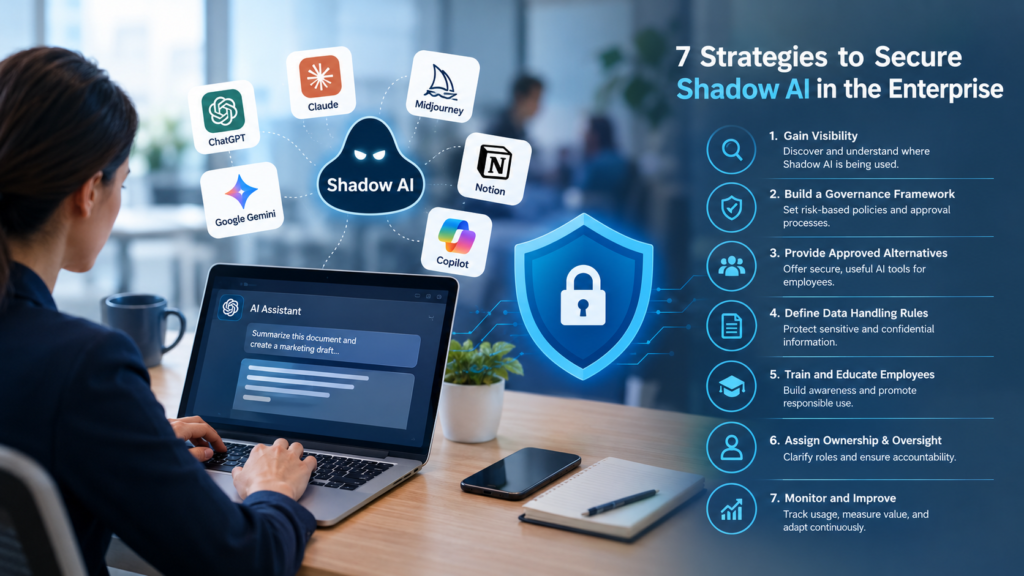
How to Manage Shadow AI: 7 Practical Strategies for Enterprise IT Leaders
Managing Shadow AI effectively requires more than blocking websites or publishing a policy. Organisations need a coordinated approach that combines visibility, risk assessment, approved alternatives, employee education, and ongoing oversight.
The following seven strategies provide a practical starting point for enterprise IT teams.
1. Establish Visibility Into Existing AI Usage
Before introducing new restrictions, understand how employees are already using AI. Review existing software inventories, consult departmental leaders, assess available security information where appropriate, and provide a straightforward process for employees to disclose the tools they use.
The purpose is to identify both potential risks and legitimate business requirements. If several teams independently use AI to summarise documents or analyse feedback, that pattern may reveal an opportunity to provide a secure, supported solution.
An initial assessment should identify:
- Which AI tools and AI-enabled features are in use.
- Which departments and business processes depend on them.
- What categories of information are being processed.
- Whether applications have undergone appropriate review.
- Which business needs remain unmet by approved technology.
Treat this assessment as an ongoing activity rather than a one-time exercise. New tools and features can appear quickly, so visibility must evolve with the technology environment.
2. Create a Risk-Based AI Governance Framework
A practical AI governance framework defines how applications are assessed, approved, monitored, and reviewed. It should consider the sensitivity of the information involved, the intended business use, vendor security controls, contractual terms, retention practices, integration requirements, and the consequences of an incorrect output.
Not every AI application requires the same level of scrutiny. A tool used to generate ideas for public-facing content may need a different review from a system that processes employee records or supports financial decisions.
A risk-based approach helps organisations apply controls proportionately without creating unnecessary barriers to experimentation.
An effective framework should establish:
- Clear approval criteria for new AI tools.
- Defined requirements for sensitive data and high-risk use cases.
- Appropriate security, privacy, and vendor assessments.
- Human review requirements for consequential outputs.
- Documented ownership, escalation routes, and periodic reassessment.
Legal, compliance, HR, procurement, and business teams should participate where their responsibilities are relevant. IT and security teams can coordinate the process, but governance should reflect the full range of risks associated with the intended use.
3. Provide Useful and Secure Approved AI Alternatives
Policies are more effective when employees have access to tools that genuinely meet their needs. If an approved platform is difficult to use, lacks necessary capabilities, or requires a complicated access process, employees may continue searching for alternatives.
Organisations should evaluate AI solutions against actual workplace tasks rather than relying solely on demonstrations or feature lists.
For example, sales teams may need secure account research and meeting preparation, while finance teams may require analysis within a controlled data environment. Marketing teams may need content-generation support alongside factual review and brand guidelines.
IT leaders should work with department representatives to select suitable tools, simplify access, and explain which use cases are permitted.
The goal is not to provide the largest possible collection of AI applications. It is to provide a manageable set of useful, approved solutions that support real business requirements.
4. Establish Clear AI Data Handling Rules
Employees need practical guidance on what information they can submit to AI tools. General warnings about sensitive data are often insufficient when people are uncertain about how different information categories should be treated.
Create clear rules for public information, internal business documents, confidential material, personal information, regulated records, and other protected data. Specify which approved applications may process each category and what additional permissions or safeguards are required.
For example, asking an approved AI assistant to improve the structure of a generic sales email may be acceptable under an organisation’s policy. Uploading an entire customer database to an unapproved consumer chatbot may create unacceptable risks.
Data handling rules should also address the outputs generated by AI. Employees must understand when AI-assisted content requires verification, where approved outputs may be stored, and whether records must be retained for business or compliance purposes.
5. Train Employees Through Realistic Workplace Scenarios
Effective AI training goes beyond prompt-writing techniques. Employees need to understand the boundaries of acceptable use, how to recognise sensitive information, why generated outputs require verification, and when to seek guidance.
Scenario-based training helps translate policies into everyday decisions.
Useful examples include:
- Comparing the risks of summarising a public report with those of uploading an internal financial forecast.
- Explaining why AI-generated product claims must be checked before being shared with customers.
- Demonstrating why recruitment-related AI use requires different safeguards from routine writing assistance.
- Showing employees how to identify approved tools and report a new application they want to use.
Training should be relevant to each department’s work and updated as approved applications and organisational policies change.
6. Define Ownership and Human Oversight
AI governance becomes difficult to enforce when responsibility is unclear. Employees need to know who approves applications, who manages access, who reviews outputs, and who handles incidents.
Responsibility should be distributed according to the nature of the work. IT and security teams may oversee technical assessments and access controls, while business managers remain accountable for the quality and suitability of work produced by their teams. Legal, compliance, HR, and other specialists should participate when their expertise is required.
Human oversight should reflect the potential consequences of an error. AI-generated brainstorming suggestions may need only routine review, whereas outputs that influence financial decisions, hiring, contractual commitments, or customer eligibility may require more formal checks.
Governance should remain proportionate. If every low-risk experiment requires lengthy approval, employees may return to unapproved tools. Clear responsibilities and straightforward escalation processes make responsible adoption easier.
7. Monitor AI Adoption and Improve the Framework Continuously
Shadow AI management is an ongoing discipline because AI capabilities, business needs, and vendor offerings continue to evolve. Organisations should regularly review approved applications, reassess relevant vendor changes, examine newly discovered tools, and update policies when circumstances change.
Monitoring should also measure whether AI is delivering meaningful value. Relevant indicators may include time saved on defined tasks, improvements in work quality, reductions in manual effort, employee satisfaction, and the frequency of policy exceptions or reported incidents.
These indicators help leaders distinguish productive adoption from technology that introduces complexity without sufficient benefit.
Review findings should inform future decisions about tool consolidation, training, access controls, and investment. A successful programme should become more effective over time, responding to actual employee behaviour rather than relying on assumptions about how AI is being used. An effective Shadow AI governance framework should combine application visibility, risk-based approvals, employee education, and clear accountability. By making approved AI tools accessible and useful, organisations can reduce reliance on unapproved services and encourage responsible AI adoption.
Shadow AI vs. Shadow IT: Understanding the Difference
Shadow AI and shadow IT share a common foundation: employees use technology outside the organisation’s formal approval and management processes. However, AI introduces additional questions about information processing, generated outputs, and the role of automated recommendations in business decisions.
Traditional shadow IT might involve an employee storing files in an unauthorised cloud account or using an unapproved collaboration application. Shadow AI may involve those same types of services, but it can also include submitting sensitive information for analysis, relying on generated recommendations, or enabling an AI feature within an existing platform.
The distinction matters because controls designed for conventional software may not fully address AI-specific risks.
| Area | Traditional shadow IT | Shadow AI |
|---|---|---|
| Typical use | Unapproved software, storage, or communication services | Unapproved AI assistants, generators, and AI-enabled features |
| Data considerations | Uncontrolled storage, sharing, and access | Data handling plus AI-specific processing and output considerations |
| Output risks | Incorrect access, lost records, or inconsistent workflows | Those risks plus inaccurate or misleading generated content |
| Governance needs | Software approval, access management, and security controls | Those controls plus AI-use policies, output verification, and appropriate oversight |
| Visibility challenges | Discovering unauthorised applications and accounts | Discovering applications, embedded AI capabilities, and AI-assisted workflows |
The two categories overlap, and Shadow AI should not be treated as entirely separate from shadow IT. Instead, businesses should extend existing technology governance to address the additional risks associated with AI systems.
Building a Responsible Enterprise AI Adoption Strategy
Managing Shadow AI effectively is not just a cybersecurity exercise. It is an opportunity to establish a more coherent enterprise AI strategy that connects technology investment with real business requirements.
Organisations need to balance three objectives: enabling productivity, protecting information, and maintaining appropriate accountability. Overemphasising restrictions can discourage useful experimentation, while unrestricted adoption can introduce avoidable risks.
A structured strategy helps align these objectives.
Align AI Investments With Business Requirements
Start by identifying where AI can support specific business outcomes. Rather than purchasing tools simply because they are popular, prioritise use cases with clear objectives, appropriate data access, and measurable benefits.
Examples may include reducing repetitive administrative work, supporting internal knowledge discovery, improving document preparation, or helping teams organise and analyse information. Each use case should be evaluated according to its business value, risk profile, and suitability for available technology.
Integrate AI Into Existing Technology Governance
AI applications should be assessed alongside existing processes for software procurement, identity management, cybersecurity, data governance, vendor management, and incident response.
This integration reduces duplication and helps organisations maintain consistent standards. It also makes it easier to evaluate AI features introduced through existing business software rather than treating every new capability as an entirely separate application.
Encourage Employee Feedback and Responsible Experimentation
Employees often understand workflow problems that are not immediately visible to central technology teams. Providing a simple way to propose AI tools, request approvals, and share successful use cases can help organisations discover valuable opportunities.
A transparent process also helps build trust. Employees are more likely to follow guidance when they understand why particular controls exist and can access practical alternatives that meet their needs.
Measure Outcomes, Not Just Tool Adoption
The number of AI applications deployed is not a reliable measure of business success on its own. Leaders should assess whether tools improve work quality, reduce unnecessary effort, support better decisions, or make processes more consistent.
These outcomes should be considered alongside security, compliance, and operational requirements. A tool that saves time but creates unacceptable exposure may not be suitable for a particular workflow. Equally, a well-controlled application that employees rarely use may indicate that the solution needs to be improved or reconsidered.
A responsible enterprise AI strategy treats governance and business value as complementary objectives. The purpose is to help employees use appropriate tools effectively while ensuring the organisation retains the oversight necessary to manage its risks.
The Future of Shadow AI Management in the Enterprise
Shadow AI is likely to remain an ongoing consideration as AI becomes embedded in more workplace applications. Employees may not always recognise when a familiar business service introduces a new AI capability, making it increasingly important for organisations to review existing vendors and software features as well as standalone applications.
This evolution calls for continuous governance rather than occasional policy updates. IT teams will need to maintain visibility into relevant AI usage, review changes to approved services, and reassess whether existing controls remain appropriate for new capabilities and business processes.
Organisations should also recognise that AI governance cannot rely exclusively on technical enforcement. Monitoring and access controls can help identify or prevent certain activities, but they cannot replace employee understanding, sound management decisions, and clear accountability.
Businesses that establish practical governance early can create a stronger foundation for responsible experimentation. They can identify unmet needs, support useful applications, and adapt their controls as the technology changes.
The objective is not to eliminate every instance of unauthorised experimentation. It is to reduce avoidable risks, make AI adoption more visible, and create clear pathways through which valuable ideas can become approved business capabilities.
Conclusion
Shadow AI represents a growing challenge for enterprise IT because employees can adopt powerful AI tools faster than organisations can establish the visibility, policies, and controls needed to manage them. Unapproved applications may create risks involving confidential information, compliance, inaccurate outputs, duplicated technology spending, and unclear accountability. Yet these risks often emerge alongside genuine attempts by employees to improve productivity and solve workplace problems.
The most effective response combines oversight with practical support. Businesses should identify existing AI usage, establish risk-based governance, provide useful approved alternatives, clarify data handling rules, train employees, define accountability, and continuously review adoption. These measures help organisations manage risks without creating unnecessary barriers to innovation.
Ultimately, successful Shadow AI management depends on understanding how employees work and providing a safer way to meet their needs. Organisations that combine employee initiative with effective technology governance can make AI adoption more transparent, consistent, and aligned with business objectives. The goal is not simply to control AI. It is to ensure that AI delivers meaningful value without introducing risks the business cannot see or adequately manage. Shadow AI management is becoming an essential part of enterprise technology governance.
Businesses that address Shadow AI through practical policies, secure tools, continuous monitoring, and employee engagement can reduce avoidable risks while creating opportunities for responsible innovation. The goal is not to prevent employees from benefiting from artificial intelligence, but to ensure that its use remains visible, secure, and aligned with business objectives.
Frequently Asked Questions
1. What is Shadow AI?
Shadow AI is the use of artificial intelligence applications or features within an organisation without appropriate knowledge, approval, or oversight from IT, security, or governance teams. Examples include using unapproved chatbots, content-generation services, coding assistants, or AI-enabled applications for business tasks.
2. Why is Shadow AI a concern for businesses?
Shadow AI can introduce risks involving sensitive data, privacy, compliance, inaccurate outputs, duplicated software spending, and limited accountability. Because employees may adopt tools independently, the organisation may not know which applications are being used or whether their controls meet business requirements.
3. How does Shadow AI differ from Shadow IT?
Shadow IT generally refers to unauthorised software, cloud services, or technology used outside formal IT oversight. Shadow AI includes similar behaviour but adds AI-specific considerations, such as how submitted information is processed and whether generated content or recommendations are being relied on without adequate verification.
4. How can organisations detect Shadow AI?
Organisations can combine software inventory reviews, appropriate security monitoring, departmental consultations, vendor assessments, and employee self-reporting. They should also review AI features embedded in existing business applications because not all AI usage involves a separate website or standalone tool.
5. Can businesses prevent employees from using unapproved AI tools?
Businesses can restrict certain applications through appropriate technical and administrative controls, but complete prevention may be difficult in practice. A more sustainable approach combines proportionate restrictions with clear policies, employee training, and approved alternatives that address genuine workplace needs.
6. What should an enterprise AI governance policy include?
An enterprise AI governance policy should define approved use cases, data handling requirements, application evaluation criteria, security and privacy expectations, access controls, output verification, human oversight, accountability, and incident reporting. The policy should distinguish between low-risk activities and use cases that could materially affect people or business decisions.
7. How can employees use AI safely at work?
Employees should use approved applications, follow company data handling rules, avoid submitting confidential information to unauthorised services, and verify AI-generated outputs before relying on them. When a tool or use case is unclear, employees should consult the designated IT, security, or governance contact.
8. What role does IT play in managing Shadow AI?
IT teams help identify AI applications, evaluate technical and vendor risks, manage access, integrate approved tools, and maintain visibility into the organisation’s technology environment. They should work with business leaders and relevant legal, compliance, HR, and security teams to ensure that controls reflect actual business requirements.
9. How should businesses measure the success of Shadow AI management?
Businesses can assess whether they have better visibility into AI usage, stronger adherence to approved data handling practices, fewer unresolved policy exceptions, and clearer accountability. They should also evaluate business outcomes such as time saved, work quality, employee satisfaction, and reductions in manual effort.
10. Will Shadow AI remain a challenge as enterprise AI adoption grows?
Shadow AI will likely remain an ongoing governance consideration as new tools and AI-enabled features become available. Organisations can manage the challenge through continuous application reviews, employee engagement, risk-based controls, and regular updates to their AI governance framework.