


Introduction
To reduce IT infrastructure costs, businesses need more than budget cuts or cheaper technology. To reduce IT infrastructure costs effectively, organizations must balance resource utilization, operational efficiency, and system performance. They need a strategic approach to managing computing resources, cloud services, storage systems, networks, and operational processes without compromising performance, availability, or security. As organizations expand their digital operations, infrastructure spending can become increasingly difficult to control, especially when resources are underutilized, cloud environments lack visibility, and legacy systems require continuous maintenance.
For enterprise IT teams, the challenge is finding the right balance between cost efficiency and operational excellence. Reducing server capacity too aggressively, selecting technology based solely on price, or delaying essential upgrades can lead to slower applications, service disruptions, and increased technical debt. Effective optimization focuses on eliminating waste, improving resource utilization, and aligning technology investments with actual business requirements. A well-planned strategy to reduce IT infrastructure costs enables enterprises to improve resource efficiency while supporting long-term business growth.
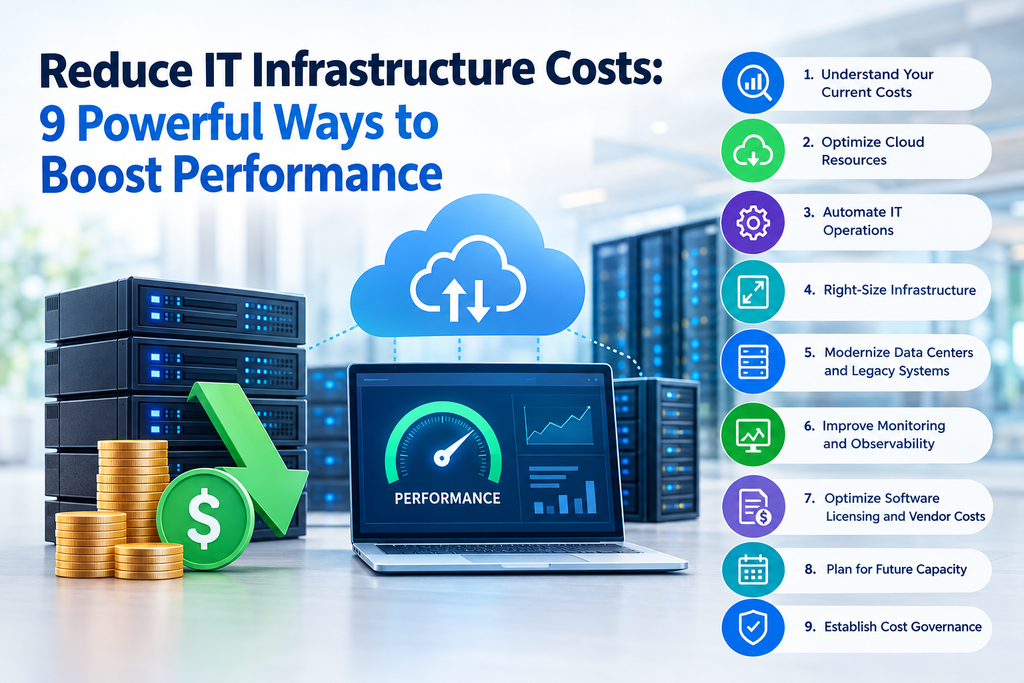
The good news is that organizations can achieve meaningful improvements by combining infrastructure monitoring, cloud cost management, automation, workload optimization, and proactive capacity planning. This guide explores nine practical strategies that help businesses manage IT expenses more effectively while preserving the performance, resilience, and scalability their operations demand.
1. Understand Your Current IT Infrastructure Costs
The first step toward effective IT cost optimization is understanding where your money goes. Infrastructure expenses often extend beyond hardware purchases and cloud subscriptions. They can include software licensing, network connectivity, storage, maintenance contracts, backup systems, power consumption, and the personnel required to manage these environments. Businesses can reduce IT infrastructure costs by identifying unused resources, reviewing recurring expenses, and improving visibility into infrastructure spending.
Without a clear picture of resource utilization and spending patterns, organizations may continue paying for unused capacity while overlooking systems that require performance improvements. A structured assessment helps IT leaders identify inefficiencies and prioritize cost-saving opportunities based on business impact.
Key areas to review
- Compute and server utilization: Identify underused virtual machines, servers, and processing resources.
- Cloud spending: Review storage, compute instances, data transfer, and subscription charges.
- Software licensing: Identify unused licenses, duplicate tools, and opportunities to consolidate subscriptions.
- Network and storage costs: Evaluate bandwidth consumption, storage tiers, and data retention policies.
- Maintenance and support: Review vendor contracts, hardware warranties, and recurring service charges.
For example, an enterprise may discover that several development environments remain active outside working hours despite having little or no demand. Scheduling these environments to shut down automatically can reduce unnecessary spending without affecting production services.
2. How to Reduce IT Infrastructure Costs Through Cloud Optimization
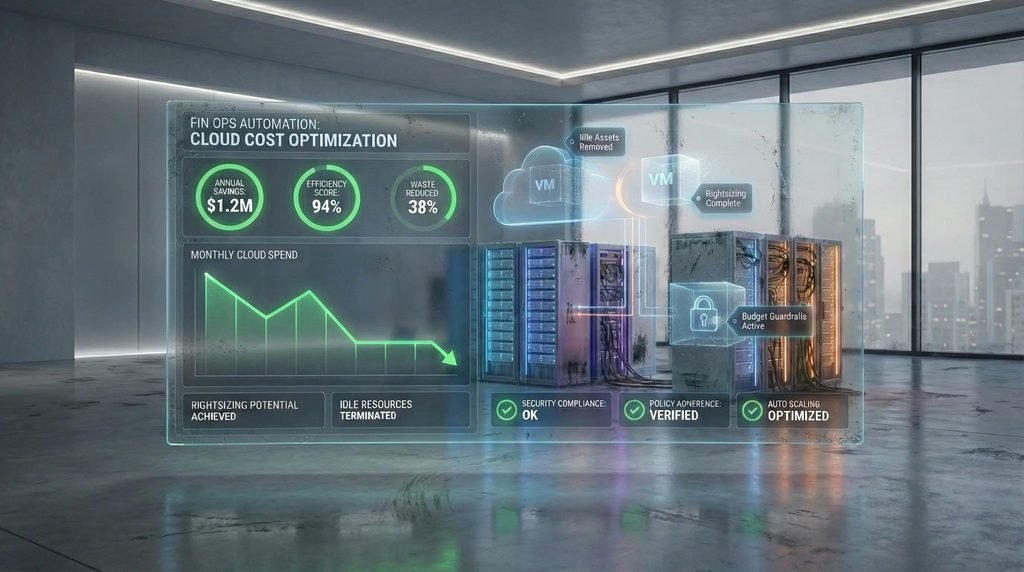
Cloud computing gives organizations flexibility, scalability, and access to managed infrastructure. However, moving workloads to the cloud does not automatically make them less expensive. Unused instances, oversized virtual machines, excessive data transfers, and inefficient storage configurations can gradually increase monthly bills.
A practical cloud cost optimization strategy connects resource consumption to actual workload requirements. Rather than choosing the cheapest configuration, IT teams should select resources that deliver the necessary performance at an appropriate cost.
Cloud cost optimization best practices
- Right-size cloud instances: Match CPU, memory, and storage capacity to workload requirements.
- Use autoscaling: Automatically adjust resources as demand changes.
- Review pricing models: Compare on-demand pricing with committed-use discounts and reserved capacity where appropriate.
- Optimize storage tiers: Move infrequently accessed data to suitable lower-cost storage options while respecting recovery requirements.
- Monitor data transfer charges: Evaluate traffic between cloud regions, availability zones, and external services.
- Remove unused resources: Identify abandoned snapshots, unattached volumes, idle instances, and obsolete environments.
One effective way to reduce IT infrastructure costs is to remove idle cloud resources and match computing capacity to actual workload requirements.
For instance, an e-commerce company may experience significant traffic fluctuations during promotional campaigns. Instead of maintaining peak capacity throughout the year, it can scale application resources according to demand. This approach helps control infrastructure expenses while preserving the ability to handle traffic spikes.
Organizations should also evaluate cloud migration decisions based on total cost of ownership (TCO), including migration expenses, ongoing operations, security, and data transfer—not just infrastructure pricing. Organizations can reduce IT infrastructure costs by reviewing cloud usage regularly and removing resources that no longer support active workloads.
3. Automate IT Operations to Reduce Manual Work
Manual infrastructure management consumes valuable staff time and can introduce configuration inconsistencies, human error, and avoidable downtime. Automating repetitive operational tasks helps IT teams improve consistency, accelerate service delivery, and focus on activities that generate greater business value. Automation helps reduce IT infrastructure costs by minimizing manual work, improving efficiency, and preventing unnecessary operational expenses.
Automation can support routine server provisioning, configuration management, patch deployment, backup scheduling, access management, and incident notifications. When combined with monitoring, it can also help teams identify and resolve certain infrastructure issues before they affect end users. Automation makes it easier to reduce IT infrastructure costs by streamlining routine maintenance, minimizing manual errors, and improving operational consistency.
High-value automation opportunities
- Infrastructure as Code (IaC): Use tools such as Terraform or Ansible to standardize infrastructure provisioning and configuration.
- Automated patch management: Schedule and validate updates according to maintenance policies.
- Backup automation: Automate backup jobs and regularly test restoration procedures.
- Alerting and remediation: Trigger approved recovery actions when predefined conditions occur.
- Environment scheduling: Automatically stop nonproduction systems when they are not required.
Consider a company managing multiple development and testing environments. If engineers must manually provision servers and configure software for every project, delivery becomes slower and operational effort increases. Standardized templates and automated deployment workflows can reduce repetitive work while improving reliability.
However, automation should include access controls, audit logs, testing, and rollback procedures. Poorly designed automation can propagate configuration errors across many systems, turning a small issue into a widespread outage.
4. Right-Size Infrastructure and Improve Resource Utilization
Overprovisioning is a common source of unnecessary IT spending. Organizations sometimes allocate more compute, memory, storage, or bandwidth than workloads actually require because they anticipate future growth or want to avoid performance problems. IT teams can reduce IT infrastructure costs by analyzing resource utilization and adjusting server capacity without affecting application performance or availability.
Underprovisioning creates the opposite risk: slow applications, resource contention, and service interruptions. The goal is to align available capacity with measured demand while maintaining an appropriate buffer for unexpected workloads and business growth.
Practical right-sizing techniques
- Analyze historical CPU, memory, storage, and network utilization.
- Identify oversized virtual machines and underused physical servers.
- Consolidate compatible workloads where security and performance requirements permit.
- Use containerization or virtualization to improve resource sharing.
- Review application dependencies before changing resource allocations.
- Establish capacity thresholds and monitor performance after each adjustment.
For example, an internal reporting application might consistently use only a small portion of its allocated compute capacity. After validating its peak demand and response-time requirements, the infrastructure team may be able to reduce its allocation without affecting users.
Right-sizing should be an ongoing process rather than a one-time exercise. Workloads change as applications evolve, users increase, and business requirements shift. Continuous measurement helps organizations maintain an appropriate balance between cost and performance.
5. Modernize Data Centers and Legacy Infrastructure
On-premises infrastructure can involve substantial expenses related to hardware maintenance, power, cooling, physical space, networking, and support contracts. Older systems may also require specialized expertise or struggle to support modern applications efficiently.
Modernization does not necessarily mean moving every workload to the cloud. A combination of virtualization, consolidation, selective cloud migration, and hardware refreshes may offer a better financial and operational outcome. Modernizing legacy systems can help reduce IT infrastructure costs by improving hardware utilization, simplifying maintenance, and eliminating redundant infrastructure.
Data center cost reduction strategies
- Consolidate servers: Reduce unnecessary hardware by combining workloads where appropriate.
- Improve virtualization: Increase resource utilization while maintaining workload isolation and availability.
- Evaluate refresh cycles: Compare continued maintenance costs with the cost and benefits of replacing aging equipment.
- Optimize power and cooling: Assess energy consumption and cooling efficiency.
- Review workload placement: Determine which applications belong on-premises, in the cloud, or in a hybrid environment.
- Retire obsolete systems: Decommission unsupported or redundant infrastructure after validating dependencies and retention obligations.
For organizations with predictable workloads, maintaining selected systems on-premises may remain economically attractive. Other workloads may benefit from cloud elasticity or managed services. The right decision depends on application performance, regulatory requirements, data transfer, resilience, staffing, and the full lifecycle cost.
6. Strengthen Infrastructure Monitoring and Observability
Infrastructure monitoring is essential for identifying waste, diagnosing bottlenecks, and preventing performance problems. Without reliable operational data, IT teams may purchase additional capacity to address issues that actually stem from inefficient applications, poorly configured databases, or network congestion. A proactive monitoring strategy helps organizations reduce IT infrastructure costs by detecting resource waste, performance bottlenecks, and unexpected increases in usage.
Effective monitoring connects resource utilization with user experience and business service health. This enables teams to distinguish genuine capacity shortages from inefficient resource allocation.
Metrics worth monitoring
- CPU and memory utilization
- Storage capacity, latency, and input/output operations
- Network throughput, latency, and packet loss
- Application response times and error rates
- Service availability and incident frequency
- Cloud resource consumption and cost trends

For example, an application may experience slow response times despite having sufficient CPU capacity. Monitoring may reveal that database queries or storage latency are causing the bottleneck. Addressing the underlying problem can restore performance without purchasing additional compute resources.
Teams should also establish service-level indicators (SLIs) and service-level objectives (SLOs) for critical services. These measures help infrastructure decisions reflect actual reliability and performance requirements rather than cost alone.
7. Optimize Software Licensing and Vendor Contracts
Infrastructure budgets frequently include recurring expenses that receive less attention than hardware and cloud bills. Software subscriptions, monitoring platforms, security products, support agreements, and managed services can overlap or remain underused as organizations grow. Reviewing software subscriptions and vendor agreements regularly can reduce IT infrastructure costs while helping businesses maintain essential technology capabilities.
A systematic review of these commitments can uncover opportunities to reduce waste while maintaining essential capabilities.
Steps to improve software and vendor spending
- Audit active licenses against actual user and system requirements.
- Remove duplicate tools that provide overlapping functionality.
- Consolidate vendors when doing so reduces complexity without creating excessive dependency.
- Review renewal dates, usage commitments, and contractual minimums.
- Compare support tiers with actual business-criticality requirements.
- Evaluate total cost of ownership before replacing established tools.
For example, an organization may use several monitoring products across different departments. Consolidating selected capabilities into a shared platform could reduce licensing and administration costs, provided the replacement meets security, integration, and operational requirements.
Procurement decisions should consider more than the initial price. Integration costs, migration effort, staff training, support quality, and exit provisions can significantly affect long-term value.
8. Implement Proactive Capacity Planning
Capacity planning helps businesses prepare for growth without purchasing resources prematurely. It combines historical usage, application requirements, business forecasts, and performance objectives to estimate future infrastructure needs. Effective capacity planning helps reduce IT infrastructure costs by aligning future resource investments with business growth, workload demand, and performance requirements.
Without a planning process, organizations may react to every performance issue by adding capacity or delay necessary investments until systems become unstable.
Build a practical capacity planning process
- Establish baseline utilization and performance metrics.
- Identify seasonal patterns, business growth expectations, and upcoming projects.
- Define capacity thresholds that trigger investigation or expansion.
- Forecast demand for compute, storage, networking, and cloud services.
- Evaluate alternative scenarios before committing to additional resources.
- Review forecasts against actual usage and adjust the plan regularly.
For example, a business preparing to launch a new digital service can model expected traffic and test application behavior before committing to a larger production environment. Load testing and capacity forecasting help identify the resources genuinely needed to support the expected demand.
Capacity planning should include resilience requirements as well as average usage. High availability, disaster recovery, and sudden traffic increases may require spare capacity. Removing that capacity without a risk assessment can create savings on paper while increasing business exposure.
9. Establish Continuous IT Cost Governance
Sustainable cost reduction requires ongoing ownership, visibility, and accountability. One-time cleanup exercises may deliver immediate improvements, but spending can rise again when new resources are deployed, projects finish without decommissioning their environments, or business needs change.
A cost governance framework helps organizations track spending, evaluate trade-offs, and ensure that technology investments remain aligned with business priorities.
Core elements of IT cost governance
- Assign ownership: Make teams responsible for the resources and services they consume.
- Set budgets and alerts: Establish spending thresholds and investigate unexpected changes.
- Use cost allocation: Apply tags, cost centers, or showback mechanisms to make consumption visible.
- Track performance alongside cost: Monitor service availability, response times, and reliability.
- Review spending regularly: Examine trends, unused resources, and optimization opportunities.
- Measure realized savings: Compare actual spending with an appropriate baseline while accounting for business growth and usage changes.
FinOps practices can be particularly useful in cloud environments because they encourage engineering, finance, and business teams to make shared decisions about cloud consumption and value.
The objective is not simply to spend less. It is to understand what each technology investment delivers and whether the resulting business value justifies its cost.
Common Mistakes to Avoid When Cutting IT Costs
Reducing infrastructure spending without a clear strategy can create new operational problems. Before implementing changes, IT leaders should recognize several common mistakes.
- Cutting resources without performance data: Changes based on assumptions can cause application slowdowns or outages.
- Choosing technology on price alone: Lower purchase costs may be offset by support, maintenance, security, or migration expenses.
- Ignoring security and compliance: Removing necessary controls can increase organizational risk.
- Overlooking backup and disaster recovery: Cost reductions should not compromise data protection or recovery capabilities.
- Treating optimization as a one-time project: Infrastructure usage changes continually, requiring regular reassessment.
- Measuring savings without context: Higher spending may be justified by business growth, stronger resilience, or increased transaction volume.
A better approach is to establish a baseline, make controlled changes, validate the results, and continuously review both cost and service quality.
How to Measure the Success of IT Cost Optimization
A cost reduction initiative should be evaluated through financial and operational metrics. A lower invoice alone does not prove that infrastructure is more efficient if application performance deteriorates or support costs increase elsewhere.
| Metric | What it helps evaluate |
|---|---|
| Infrastructure cost per workload | Spending efficiency for applications or services |
| Resource utilization | Whether allocated compute, memory, and storage are being used effectively |
| Cost per transaction | Infrastructure efficiency as business activity changes |
| Mean time to resolution (MTTR) | How quickly IT teams recover from incidents |
| Service availability | Whether reliability targets continue to be met |
| Application response time | Whether users receive acceptable performance |
| Cost variance against budget | Whether actual spending aligns with financial plans |
Organizations should compare these metrics against a defined baseline and account for changes in workload volume, service requirements, and business activity.
For example, if infrastructure spending remains stable while transaction volume grows, the cost per transaction may improve. That can indicate better efficiency even when total spending has not decreased.
Conclusion
Reducing IT infrastructure costs without compromising performance requires a balanced approach that combines financial discipline with sound engineering practices. By assessing existing spending, optimizing cloud resources, automating operations, right-sizing infrastructure, modernizing data centers, and improving observability, organizations can eliminate unnecessary expenditure while maintaining reliable services. To reduce IT infrastructure costs without compromising performance, organizations should focus on cloud optimization, automation, monitoring, and effective resource management.
Long-term success also depends on effective capacity planning, vendor management, and continuous cost governance. Infrastructure decisions should be guided by measurable performance requirements, security obligations, resilience needs, and business priorities—not by cost reduction alone.
The most effective starting point is to establish a clear spending and performance baseline, identify the highest-impact opportunities, and implement improvements in controlled stages. With regular measurement and collaboration between IT, finance, and business teams, organizations can build a more efficient, scalable, and cost-effective technology environment.
Frequently Asked Questions
Practical answers to common questions about IT infrastructure cost optimization.
1. What is IT infrastructure cost optimization?
IT infrastructure cost optimization is the process of reducing unnecessary technology spending while maintaining the performance, availability, security, and scalability of IT systems. It involves improving resource utilization, managing cloud expenses, automating operations, and reviewing infrastructure investments. The primary goal is to reduce IT infrastructure costs while maintaining reliable services, strong security, and consistent application performance.
2. What are the biggest drivers of IT infrastructure costs?
Common cost drivers include servers, cloud computing, storage, network connectivity, software licensing, data center power and cooling, maintenance contracts, security tools, and IT personnel. The largest expenses vary depending on the organization’s architecture and operational requirements.
3. How can businesses reduce cloud infrastructure costs?
Businesses can right-size cloud instances, remove unused resources, implement autoscaling, optimize storage tiers, monitor data transfer charges, and evaluate appropriate pricing commitments. Regular cost reviews help identify new inefficiencies as workloads change.
4. Can reducing infrastructure costs affect system performance?
Yes. Removing too much capacity or reducing essential support can increase latency, reduce availability, and create security or recovery risks. Organizations should use performance data, workload testing, and service objectives to validate changes before applying them to production environments.
5. How does automation help reduce IT operational expenses?
Automation reduces repetitive manual work, standardizes configuration, and can accelerate routine maintenance and incident response. It can also reduce configuration errors and unnecessary downtime when implemented with suitable testing, monitoring, and access controls.
6. Is cloud infrastructure always cheaper than on-premises infrastructure?
No. Cloud services offer flexibility and elasticity, but their costs depend on workload patterns, resource utilization, data transfer, support, and pricing arrangements. On-premises infrastructure may be more economical for certain predictable workloads. A total cost of ownership assessment helps determine the best option.
7. What tools help organizations manage IT infrastructure costs?
Useful tools include cloud cost management and FinOps platforms, infrastructure monitoring systems, IT asset management solutions, configuration management tools, and infrastructure-as-code platforms. The appropriate selection depends on the organization’s environment, existing systems, and reporting requirements.
8. How often should organizations review infrastructure costs?
Cloud spending and unusual cost changes should be monitored regularly, often daily or weekly for active environments. Broader infrastructure, licensing, capacity, and vendor reviews can be performed monthly or quarterly, depending on business complexity and spending patterns.
9. How can IT leaders measure cost optimization success?
IT leaders should compare spending against a defined baseline and monitor cost per workload or transaction, resource utilization, service availability, application response times, and incident recovery. This provides a more complete picture of savings and operational impact.