


Introduction
The Invisible Workday is becoming one of the most overlooked challenges affecting employee productivity in modern organizations. Employees may begin their mornings with clearly defined priorities, expecting to complete important projects, respond to customers, and make meaningful progress. Yet, by the end of the day, much of their time may have disappeared into activities that were never part of the original plan. The Invisible Workday often develops through small, repeated interruptions that gradually reduce employee efficiency.
A notification interrupts concentration, a colleague requests a quick update, an unexpected meeting appears on the calendar, and a simple task suddenly requires switching between several applications. Individually, these activities may seem insignificant. Collectively, however, they create a hidden layer of work that consumes employee attention without necessarily delivering meaningful business value.
This is the reality of the Invisible Workday: employees remain busy for hours but struggle to identify how much of their actual working time is spent accomplishing important objectives. For businesses, understanding this hidden productivity gap is becoming essential to improving operational efficiency, employee experience, and overall organizational performance. The Invisible Workday highlights how everyday workplace activities gradually reduce the time available for meaningful work.
1. Understanding the Invisible Workday and Its Impact on Employee Productivity
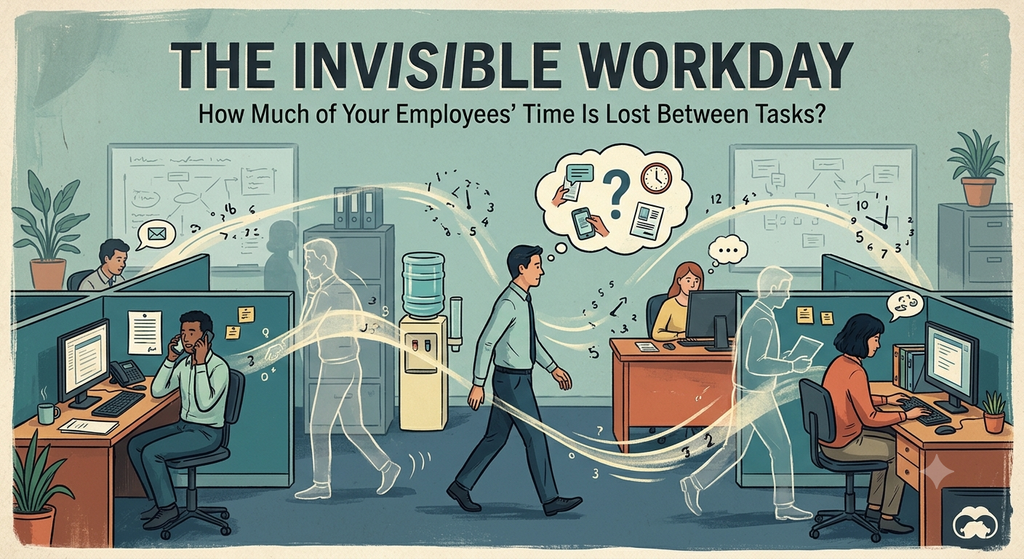
Modern workplaces are more connected than ever, but constant connectivity has introduced a significant challenge. Employees are expected to remain available, respond quickly, collaborate continuously, and simultaneously complete responsibilities that require uninterrupted concentration.
Emails, messaging platforms, project management notifications, video calls, customer requests, and internal communication systems continuously compete for attention. Employees often feel obligated to respond immediately because delayed communication may be interpreted as a lack of responsiveness or commitment. Understanding the Invisible Workday is the first step toward identifying hidden productivity gaps across enterprise teams.
As a result, work becomes fragmented into smaller activities rather than flowing through consistent periods of concentration.
Consider an employee preparing an important business report. Their workflow might look something like this:
- They begin writing the report but receive an instant message requesting an update.
- After responding, they return to the document but receive an email requiring attention.
- Before completing the report, they join a scheduled project meeting.
- Following the meeting, they review shared documents and update project management software.
- Another notification arrives, requiring them to switch attention once again.
Although every interruption may take only a few minutes, the repeated switching between activities creates additional mental effort.
The Invisible Workday is not simply about employees spending time on unnecessary activities. It is about how those activities disrupt the continuity of work and reduce the attention available for meaningful responsibilities.
For enterprise organizations, this creates an important operational question: Are employees spending their working hours progressing toward business objectives, or managing the constant demands of the systems surrounding their work?
2. The Hidden Cost of Context Switching and Workplace Interruptions
One of the most overlooked aspects of workplace productivity is the time required to mentally return to a task after an interruption. The Invisible Workday becomes more noticeable when employees repeatedly switch between unrelated responsibilities.
When employees switch between unrelated activities, they do not instantly recover the same level of concentration they had before the interruption. Their attention may remain partially occupied by a previous conversation, an unanswered message, or an upcoming meeting. Every organization should understand how the Invisible Workday influences daily operations and employee performance.
This phenomenon is commonly associated with context switching.
For example, an IT professional troubleshooting a complex infrastructure issue may need to examine system logs, compare performance data, review configuration changes, and identify the underlying cause of a problem. If that employee is repeatedly interrupted by unrelated requests, maintaining the original investigative context becomes more difficult.
The same challenge affects developers, financial analysts, marketing professionals, customer success teams, and business operations managers.
The consequences of frequent context switching include:
- Reduced concentration during complex assignments.
- Additional mental effort when returning to unfinished work.
- Greater difficulty maintaining task continuity.
- Increased chances of overlooking important details.
- Delays in completing projects that require sustained attention.
The Invisible Workday makes these productivity losses difficult to identify because traditional performance reports rarely capture the mental effort involved in recovering concentration.
An employee might technically spend several hours working on a project, but those hours could be distributed across an entire day filled with interruptions. The total time spent on a task does not necessarily reflect the quality of attention available during that time.
Organizations that want to improve employee productivity must therefore examine not only how long tasks take but also how frequently employees are forced to interrupt them.
3. Meeting Overload: When Collaboration Becomes a Productivity Barrier
Meetings are essential for collaboration, decision-making, planning, and communication. However, many organizations have gradually developed a habit of using meetings as the default solution for almost every communication requirement. Meeting overload is one of the most visible contributors to the Invisible Workday.
A question that could have been answered through a short message becomes a thirty-minute discussion. A routine status update occupies the calendars of several employees. A meeting scheduled to resolve one issue expands into multiple unrelated conversations.
The problem extends beyond the meeting itself.
Employees must prepare information, reorganize their schedules, participate in discussions, document decisions, and return to their original responsibilities afterward.
When meetings are distributed throughout the day, they can prevent employees from finding the uninterrupted time required for complex work.
How unnecessary meetings affect business operations
Meeting overload can create several challenges:
- Reduced deep-work opportunities: Employees struggle to dedicate extended periods to important assignments.
- Delayed decision-making: Discussions sometimes replace clear ownership and actionable decisions.
- Increased coordination costs: Multiple employees spend time attending conversations that may not require their involvement.
- Fragmented schedules: Short gaps between meetings make it difficult to complete meaningful tasks.
- Administrative overhead: Employees spend additional time preparing agendas, documenting discussions, and following up on action items.
Recognizing the Invisible Workday helps businesses understand why employees struggle to maintain consistent concentration.
For example, an enterprise software development team may have daily stand-ups, sprint planning, project reviews, technical discussions, stakeholder meetings, and internal coordination calls.
While each meeting may serve a legitimate purpose, organizations should periodically evaluate whether every discussion requires synchronous participation. Reducing the Invisible Workday requires a smarter approach to workplace communication and meeting management.
Practical ways to reduce meeting overload
Businesses can improve meeting efficiency by:
- Establishing clear agendas and expected outcomes.
- Replacing routine status meetings with asynchronous updates where appropriate.
- Inviting only employees whose participation is necessary.
- Setting reasonable meeting durations.
- Protecting dedicated focus periods across teams.
- Recording decisions and assigning clear action owners.
The objective is not to eliminate meetings. It is to ensure that collaboration supports productivity rather than continuously interrupting it.
4. Too Many Workplace Applications Are Creating Digital Complexity
Enterprise organizations increasingly depend on technology to coordinate business activities. Separate platforms are used for communication, customer relationship management, project tracking, file sharing, scheduling, reporting, and performance monitoring. Disconnected applications make the Invisible Workday more complicated by creating additional administrative responsibilities. The Invisible Workday becomes increasingly challenging when employees depend on multiple disconnected workplace platforms.
Each application may offer valuable functionality. However, when these systems operate independently, employees can end up spending considerable time managing technology rather than completing their actual responsibilities.
For example, a sales representative may need to:
- Review customer information in a CRM platform.
- Check internal updates through a messaging application.
- Access proposals from a document management system.
- Update opportunities in a sales dashboard.
- Coordinate follow-ups through an email platform.
- Report progress through a separate management tool.
If these systems do not integrate properly, the same information may need to be entered or verified multiple times.
This creates unnecessary administrative work and increases the complexity of everyday workflows.
The importance of digital workplace integration
Businesses should evaluate whether their technology ecosystem supports seamless information exchange.
A well-integrated digital workplace can help employees access relevant information without constantly switching between disconnected applications.
Important considerations include:
- Integrating business applications through APIs and workflow automation.
- Establishing centralized document and information management.
- Reducing duplicate data entry across enterprise systems.
- Standardizing collaboration and communication processes.
- Improving access to relevant information through unified search capabilities.
Technology should simplify work, not create additional work.
The Invisible Workday often becomes more pronounced when organizations continue adding applications without evaluating how those applications interact with existing business processes. A simplified technology environment can help minimize the impact of the Invisible Workday.
5. Why Traditional Productivity Metrics Do Not Reveal the Complete Picture
Many organizations measure employee productivity through easily available indicators such as response times, completed tasks, logged hours, application usage, and online availability. The Invisible Workday also exposes the limitations of traditional employee productivity measurements.
Although these measurements can provide useful operational insights, they do not always reflect the actual value employees create.
An employee who responds to messages throughout the day may appear highly engaged, even if constant communication prevents them from completing important assignments.
Another employee who spends several hours solving a complex technical problem may appear less active because their contribution does not generate frequent digital activity.
This creates a significant measurement challenge.
When organizations prioritize visible activity over meaningful outcomes, employees may begin optimizing their behaviour around the metrics rather than the actual objectives of their roles. The Invisible Workday demonstrates why employee activity should not be confused with actual productivity.
Activity-based measurement versus outcome-based measurement
Consider the following differences:
| Activity-Based Measurement | Outcome-Based Measurement |
|---|---|
| Number of emails answered | Quality of customer communication |
| Hours spent online | Meaningful work completed |
| Number of meetings attended | Decisions and progress achieved |
| Number of tasks updated | Business objectives accomplished |
| Response speed | Effectiveness of problem resolution |
| Application activity | Contribution to operational outcomes |
Neither category is universally sufficient on its own. However, organizations should avoid treating digital activity as a complete representation of employee performance.
A better approach combines operational indicators with measurable business outcomes, work quality, customer impact, and team effectiveness.
Understanding the Invisible Workday requires organizations to look beyond how busy employees appear and examine whether their activities contribute to meaningful progress.
6. How AI and Automation Can Reduce the Invisible Workday
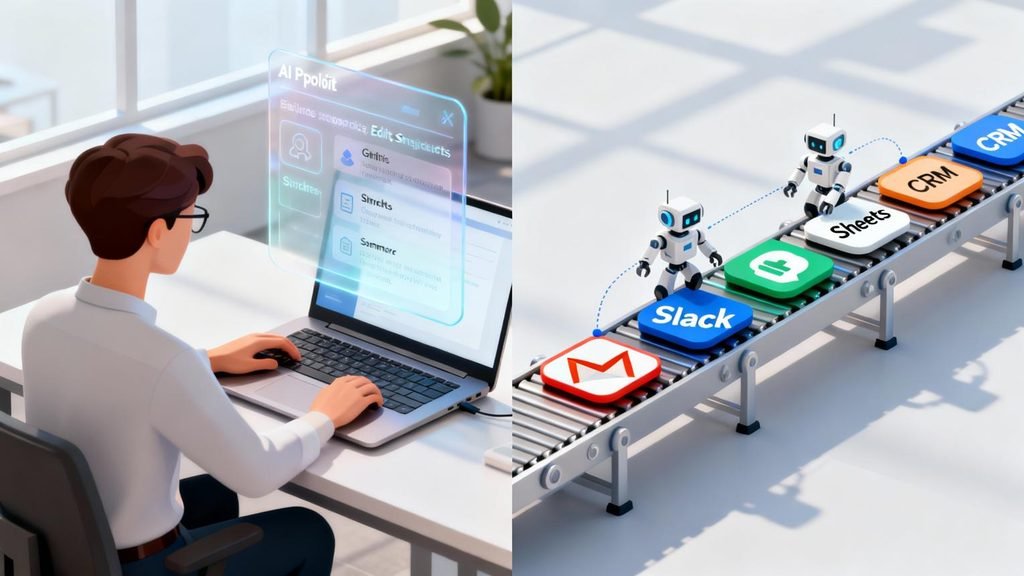
Artificial intelligence and automation offer practical opportunities to reduce the administrative burden associated with modern workplace operations.
AI-powered assistants can summarize meetings, organize information, draft routine communications, identify relevant documents, and help employees manage repetitive administrative activities.
Automation can reduce unnecessary data entry, synchronize information across applications, and eliminate manual steps that repeatedly interrupt workflows.
For example, an enterprise operations team may use workflow automation to synchronize customer information between business applications instead of requiring employees to update multiple systems manually. AI-powered automation can help organizations reduce several activities contributing to the Invisible Workday.
Similarly, an AI assistant can summarize a lengthy meeting and extract important decisions and action items, reducing the time employees spend reviewing notes and preparing follow-up communications.
Practical applications of AI and automation
1. Automated meeting summaries
AI-powered meeting tools can generate summaries, identify action items, and organize important discussion points. This helps employees spend less time preparing manual documentation.
2. Intelligent information retrieval
AI search assistants can help employees locate relevant documents, policies, project information, and internal knowledge without manually navigating multiple repositories.
3. Workflow automation
Automation platforms can connect business applications and synchronize information, reducing repetitive administrative activities.
4. Automated reporting
Routine reporting processes can be streamlined by collecting information from connected systems and generating standardized reports.
5. AI-assisted communication
AI tools can help draft routine responses, summarize lengthy email conversations, and organize communication workflows.
Avoid creating another layer of technology complexity
Although AI and automation can improve efficiency, implementation must be approached carefully.
Introducing additional tools without simplifying existing processes may create another layer of complexity. Employees could end up managing AI-generated recommendations, reviewing automated notifications, and learning multiple new systems.
Businesses should first identify repetitive activities that consume significant employee attention and then determine whether automation can genuinely simplify those workflows.
The goal should not be to automate everything. It should be to eliminate unnecessary work and give employees more time for responsibilities that require human judgment, expertise, and creativity.
7. Building a More Productive Workplace Through Better Workflow Design
Improving workplace productivity requires more than encouraging employees to manage their schedules effectively. Organizations must also examine how their internal systems, communication expectations, and management practices influence everyday work. Addressing the Invisible Workday starts with identifying unnecessary processes and communication bottlenecks.
The Invisible Workday is often a consequence of organizational processes rather than individual time-management failures.
For example, employees may experience constant interruptions because responsibilities are unclear, approval processes are unnecessarily complicated, or managers expect immediate responses to routine messages.
Addressing these challenges requires a coordinated approach.
Seven practical strategies organizations can implement
1. Establish clear communication expectations
Define which communication channels should be used for urgent matters, routine updates, and non-urgent discussions. Employees should understand when an immediate response is necessary and when a delayed response is acceptable.
2. Introduce protected focus periods
Encourage teams to establish uninterrupted working periods for complex assignments. These periods can help employees maintain concentration without constantly responding to non-urgent notifications.
3. Review recurring meetings
Regularly evaluate meeting schedules, participation requirements, and expected outcomes. Eliminate discussions that do not contribute meaningful value.
4. Simplify approval workflows
Examine internal approval processes and remove unnecessary steps. Clear ownership and predefined decision-making authority can reduce delays and repeated follow-ups.
5. Integrate workplace applications
Connect essential enterprise platforms to minimize duplicate data entry and unnecessary application switching.
6. Automate repetitive administrative activities
Identify recurring tasks such as reporting, data synchronization, document processing, and routine notifications that could be handled through automation.
7. Measure meaningful outcomes
Evaluate employee performance through work quality, project progress, customer satisfaction, operational efficiency, and business impact rather than relying exclusively on visible digital activity.
Why managers play an important role
Managers influence how employees communicate, prioritize tasks, attend meetings, and manage competing responsibilities.
When managers send frequent non-urgent messages, schedule unnecessary meetings, or expect immediate responses throughout the day, employees may find it difficult to protect their concentration.
Leaders should therefore demonstrate the same communication discipline they expect from their teams.
A productive workplace is built through organizational habits, clear expectations, and processes that allow employees to focus on meaningful responsibilities.
8. Measuring the Invisible Workday Without Creating Employee Surveillance
Organizations increasingly recognize the importance of understanding how work gets done. However, measuring workplace productivity should not become an excuse for excessive employee monitoring. Organizations should evaluate the Invisible Workday through workflow analysis rather than excessive employee surveillance.
Tracking every keystroke, application interaction, or minute of inactivity does not necessarily provide a reliable picture of productivity.
In fact, excessive monitoring may increase employee anxiety and encourage people to optimize their behaviour for surveillance metrics rather than business outcomes.
Instead, organizations should focus on identifying workflow inefficiencies at the team and process levels.
What businesses should evaluate
Useful areas of investigation include:
- The frequency of meetings and interruptions.
- The number of applications required to complete common workflows.
- Repetitive administrative tasks.
- Delays caused by approvals and handoffs.
- Duplicate information entry across business systems.
- Employee feedback about workflow obstacles.
- Project completion quality and operational outcomes.
For example, an organization could review how a customer support team handles incoming requests. If employees repeatedly move between multiple platforms to access customer information, the problem may be an integration issue rather than an employee productivity issue.
Similarly, if project approvals consistently delay delivery, simplifying the approval process may produce better results than asking employees to work faster.
The purpose of measuring the Invisible Workday should be to improve systems and working conditions, not to monitor employees unnecessarily.
9. The Future of Work Depends on Protecting Employee Attention
As enterprise technology continues to evolve, organizations will have access to increasingly sophisticated tools for communication, collaboration, automation, and artificial intelligence. The future of workplace productivity will depend partly on how effectively organizations address the Invisible Workday.
However, technological advancement alone will not guarantee better productivity.
Businesses must recognize that employee attention is a limited resource. Every unnecessary notification, poorly designed workflow, redundant meeting, and disconnected application competes for that resource.
Future-ready organizations will need to balance digital connectivity with opportunities for focused work.
This means creating communication policies that respect employee concentration, implementing technology that reduces administrative effort, and designing workflows around actual business requirements.
It also means recognizing that different roles require different working conditions. A customer support professional may need to respond to incoming requests throughout the day, while a software architect may require longer periods of uninterrupted concentration.
There is no single productivity model that works for every employee or department.
Instead, businesses should understand the demands of individual roles and create workflows that balance responsiveness, collaboration, and focused execution.
Organizations that address the Invisible Workday can build more efficient digital workplaces while improving the overall employee experience.
Conclusion
The Invisible Workday reveals an important contradiction in modern organizations: businesses have invested heavily in technologies designed to save time, yet employees often find themselves overwhelmed by the systems surrounding their work.
Constant notifications, unnecessary meetings, disconnected applications, repetitive administrative activities, and frequent context switching gradually consume the time and attention employees need to accomplish meaningful work.
The solution does not necessarily involve adding another productivity application, introducing another performance dashboard, or encouraging employees to become better at multitasking. It requires examining existing workflows, simplifying communication, reducing unnecessary interruptions, and implementing technology that genuinely supports business operations.
AI and automation can help remove repetitive tasks, while better management practices can create opportunities for uninterrupted concentration. At the same time, organizations must move beyond activity-based productivity measurements and focus on the quality and impact of completed work.
Ultimately, productivity is not determined by how many activities employees complete throughout the day. It is determined by how much meaningful progress those activities create. Ultimately, addressing the Invisible Workday means creating an environment where employees can focus on work that generates real business value.
Businesses that recognize the hidden cost of fragmented attention may discover that the most effective way to improve workplace productivity is not to make employees do more, but to give them the time, clarity, and uninterrupted focus needed to do their work well.
Frequently Asked Questions
1. What is the Invisible Workday?
The Invisible Workday refers to the hidden time employees lose through workplace interruptions, unnecessary meetings, administrative activities, context switching, and managing multiple digital tools. These activities consume attention without always contributing directly to important business objectives.
2. How does context switching affect employee productivity?
Context switching requires employees to repeatedly shift their attention between unrelated tasks. Returning to an earlier assignment often requires additional mental effort, making it harder to maintain concentration and complete complex work efficiently.
3. What are the biggest causes of lost productivity in modern workplaces?
Common causes include excessive notifications, meeting overload, disconnected business applications, unclear communication expectations, repetitive administrative tasks, and inefficient approval processes.
4. How can businesses reduce the Invisible Workday?
Businesses can reduce hidden productivity losses by protecting focus periods, simplifying workflows, reviewing unnecessary meetings, integrating workplace applications, automating repetitive activities, and establishing clear communication policies.
5. Can AI help improve workplace productivity?
Yes. AI can support workplace productivity by summarizing meetings, retrieving information, drafting routine communications, organizing documents, and assisting with repetitive administrative activities. Its effectiveness depends on how well it integrates with existing workflows.
6. How does meeting overload affect employee performance?
Meeting overload fragments employee schedules and reduces opportunities for uninterrupted work. It can also increase preparation time, follow-up activities, and coordination overhead, making it harder to complete complex assignments.
7. What is the difference between employee activity and employee productivity?
Employee activity measures visible actions such as emails answered, meetings attended, and hours logged. Employee productivity focuses on meaningful outcomes, work quality, efficiency, and contributions to business objectives.
8. How can organizations measure workplace productivity without excessive monitoring?
Organizations can evaluate project outcomes, workflow efficiency, task completion quality, customer satisfaction, process delays, and employee feedback. These indicators provide useful operational insights without relying on invasive employee surveillance.
9. Why is digital workplace integration important?
Digital workplace integration connects business applications and allows information to move between systems more efficiently. It reduces duplicate data entry, unnecessary application switching, and administrative overhead.
10. Why should businesses prioritize uninterrupted work?
Uninterrupted work allows employees to maintain concentration on complex assignments, solve problems more effectively, and complete meaningful tasks with fewer disruptions. Protecting employee attention can support both operational efficiency and the overall workplace experience.