

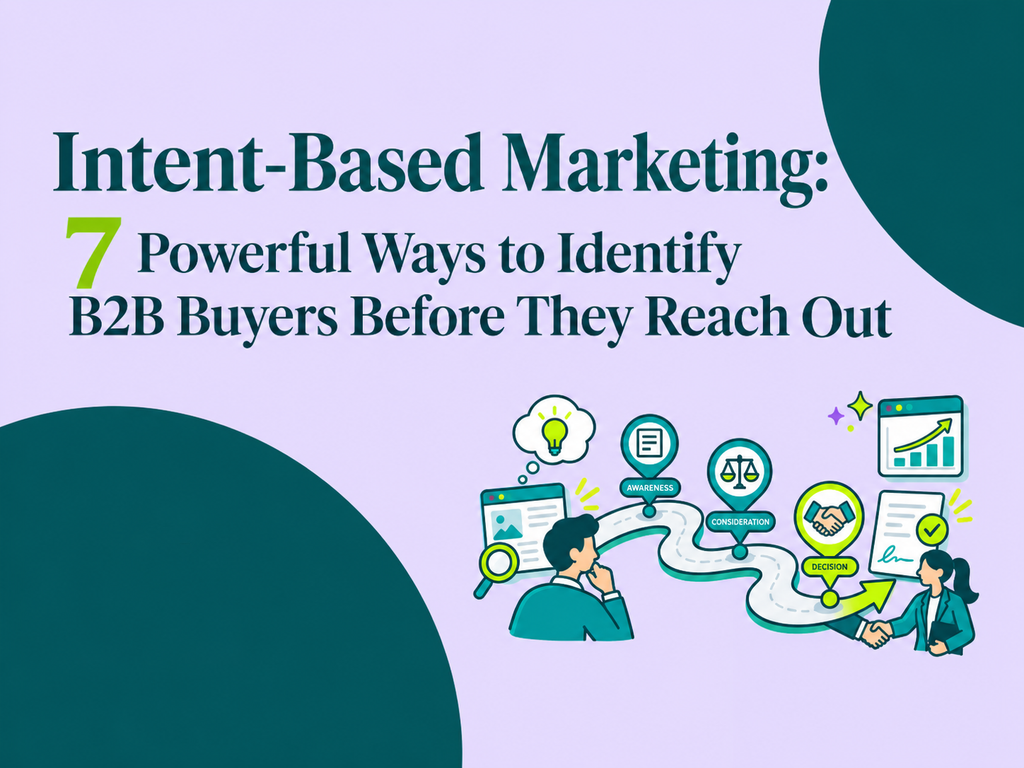
Intent-based marketing is changing how B2B organizations identify potential customers, understand buying behavior, and engage prospects throughout the purchasing journey. Traditional marketing strategies often depend on prospects filling out forms, downloading resources, attending webinars, or directly contacting sales teams. However, these interactions usually happen after buyers have already started researching solutions and evaluating potential vendors.
In today’s competitive B2B environment, businesses need a better understanding of what potential customers are researching before they express direct interest. This is where intent-based marketing becomes valuable. By analyzing digital behavior, content consumption patterns, search activity, and other relevant buying signals, organizations can identify accounts that may be actively exploring solutions related to their products or services.
For enterprise marketing and sales teams, the opportunity goes beyond generating more leads. Intent-based marketing helps businesses recognize potential buying opportunities earlier, prioritize high-value accounts, personalize communication, and improve coordination between marketing and sales. When supported by reliable data and a well-defined engagement strategy, it can make B2B customer acquisition more targeted and efficient.
What Is Intent-Based Marketing?
Intent-based marketing is a data-driven marketing approach that identifies and targets potential customers based on signals indicating their interest in a particular product, service, technology, or business solution.
Rather than relying exclusively on demographic information, company size, industry, or job titles, this strategy considers what organizations and individuals are actively researching. These insights help marketing teams understand where potential buyers might be in their decision-making process.
For example, consider an enterprise evaluating cloud infrastructure solutions. Its employees may be researching cloud migration strategies, comparing infrastructure management platforms, reading cybersecurity reports, or exploring cloud cost optimization tools. These activities can indicate that the organization is evaluating potential technology investments.
Intent data can help marketing and sales teams recognize these patterns and determine whether the organization represents a relevant business opportunity.
How Intent-Based Marketing Works
The process typically involves collecting relevant intent signals, analyzing behavioral patterns, identifying potential buying accounts, and activating personalized marketing or sales campaigns.
Some common intent signals include:
- Content consumption: Repeated engagement with articles, whitepapers, research reports, and product-related resources.
- Search behavior: Research activity around specific products, services, technologies, or business challenges.
- Website engagement: Visits to product pages, pricing information, comparison pages, and solution-focused content.
- Third-party research: Consumption of relevant content across external websites and industry publications.
- Buying committee activity: Multiple stakeholders from the same organization researching related business solutions.
These signals provide additional context about potential customer interests. However, an individual signal does not necessarily mean that a company is ready to purchase. Businesses should evaluate multiple indicators before treating an account as an active opportunity.
Why Intent-Based Marketing Matters for B2B Businesses
B2B purchasing decisions are often complex. They may involve multiple stakeholders, extended evaluation periods, budget approvals, technical assessments, and comparisons between competing vendors.
Traditional lead generation methods frequently capture prospects only after they have completed an initial research phase. By that point, potential buyers may already have shortlisted vendors or developed preferences about the solutions they want to purchase.
Intent-based marketing helps organizations become more proactive by identifying relevant buying signals earlier in the customer journey.
1. Identifying Potential Buyers Earlier
One of the biggest advantages of intent-based marketing is its ability to identify organizations researching solutions before they directly contact a vendor.
For example, a company researching enterprise cybersecurity solutions across several industry websites may be evaluating its existing security infrastructure. Intent data can help relevant cybersecurity providers recognize this interest and develop appropriate engagement strategies.
This gives businesses an opportunity to introduce useful information while potential customers are still exploring their options.
2. Improving Lead Quality and Prioritization
Not every website visitor or marketing lead represents an immediate sales opportunity. Some prospects may be conducting general research, while others may have a specific business requirement.
Intent signals provide additional information that helps marketing teams distinguish between general interest and potentially stronger buying activity.
Organizations can use these insights to:
- Prioritize accounts showing relevant research activity.
- Identify companies researching specific products or solutions.
- Focus sales resources on accounts matching their ideal customer profile.
- Develop targeted campaigns for accounts demonstrating relevant interest.
Combining intent data with firmographic information and lead qualification criteria can improve account prioritization.
3. Creating More Relevant Marketing Experiences
B2B buyers expect information that addresses their specific business challenges. Generic marketing messages often fail to capture their attention because they do not reflect the problems prospects are trying to solve.
Intent-based marketing allows organizations to align content and communication with observed interests.
For example, if an organization is researching IT infrastructure modernization, a technology provider could share relevant resources about legacy system migration, infrastructure automation, cloud adoption, and operational efficiency.
This creates a more relevant experience without relying on repetitive promotional messaging.
7 Powerful Ways to Identify B2B Buyers Before They Reach Out
Identifying potential buyers requires more than collecting website visits or tracking individual interactions. Businesses need a structured approach that combines behavioral insights, company intelligence, data analysis, and marketing technology.
The following strategies can help B2B organizations identify and engage potential customers earlier.
1. Monitor Third-Party Intent Data
Third-party intent data provides insights into research activities taking place outside a company’s own website and digital properties.
Specialized intent data providers collect and analyze relevant content consumption signals across participating publisher networks and other sources. These insights can help organizations identify companies researching specific topics, products, or business challenges.
For example, a company providing enterprise cloud management solutions may identify organizations consuming content about cloud migration, infrastructure monitoring, and multi-cloud management.
Marketing teams can use these signals to identify relevant accounts and develop campaigns around the topics those organizations appear to be researching.
However, third-party intent data should be treated as an indicator of organizational interest rather than confirmation of an individual’s purchasing intentions.
2. Analyze First-Party Website Behavior
First-party intent data comes from interactions that prospects have with a company’s own digital channels.
Unlike external research signals, these interactions provide direct information about how visitors engage with a business’s website, resources, and marketing content.
Important behavioral indicators include:
- Repeated visits to product and solution pages.
- Downloads of technical whitepapers and implementation guides.
- Visits to pricing and comparison pages.
- Engagement with case studies and customer success stories.
- Registrations for webinars and product demonstrations.
For example, if multiple visitors from the same organization repeatedly explore a company’s enterprise software solutions, this activity may indicate growing organizational interest.
Marketing automation and website analytics platforms can help consolidate these interactions and provide a clearer picture of account engagement.
3. Combine Intent Data With Account-Based Marketing
Account-based marketing (ABM) focuses on identifying and engaging specific organizations that match a business’s ideal customer profile.
When combined with intent-based marketing, ABM becomes more responsive to changing buyer interests.
Instead of targeting accounts based only on company size, industry, revenue, or location, marketing teams can also consider what those organizations are actively researching.
For example, an enterprise IT services provider may target manufacturing companies with complex infrastructure environments. If selected accounts begin researching industrial cybersecurity or cloud modernization, the provider can create relevant campaigns addressing those requirements.
This approach helps organizations align marketing activities with account-level interests.
4. Use Predictive Analytics to Identify Buying Patterns
Predictive analytics can help B2B organizations identify patterns across historical customer data, account engagement, and relevant intent signals.
By evaluating multiple indicators, analytical models can help estimate which accounts are more likely to progress toward a purchasing decision.
For instance, a company may analyze historical opportunities to understand which combinations of activities frequently occur before a sales conversation.
These patterns might include:
- Increased engagement with product-related content.
- Multiple stakeholders interacting with marketing resources.
- Repeated visits to solution pages.
- Research activity around a particular business challenge.
- Engagement with technical documentation and implementation resources.
Predictive models can help sales and marketing teams prioritize accounts, but their recommendations should be validated against actual business context and sales feedback.
5. Identify Buying Committee Engagement
Enterprise purchasing decisions rarely depend on one individual. Different stakeholders often participate in research, evaluation, technical validation, and final approvals.
A technology purchase, for example, may involve the CIO, IT director, procurement manager, finance team, and cybersecurity leadership.
Intent-based marketing can help organizations identify broader account-level research patterns and understand which topics may be relevant to different stakeholders.
Marketing teams can then create role-specific content:
- CIOs and CTOs: Strategic technology modernization, scalability, and business value.
- IT managers: Implementation requirements, integration, and infrastructure performance.
- CFOs: Cost optimization, operational efficiency, and investment considerations.
- Procurement teams: Vendor comparisons, pricing models, and contractual requirements.
- Security leaders: Compliance, risk management, and data protection.
Understanding the interests of different stakeholders helps businesses develop more relevant communication throughout complex B2B buying journeys.
6. Integrate Intent Data With CRM and Marketing Automation
Intent data becomes more valuable when it is accessible to the teams responsible for managing customer relationships and sales opportunities.
Integrating intent data with customer relationship management (CRM) and marketing automation platforms allows organizations to combine external research signals with existing account and lead information.
For example, a marketing team may identify an account showing increased interest in enterprise data management. When this information is connected to the CRM, the sales team can review existing relationships, previous conversations, account ownership, and current opportunities.
This integration supports better coordination between marketing and sales.
Businesses can also use automation to:
- Update account engagement records.
- Trigger relevant marketing campaigns.
- Notify sales representatives about important account activity.
- Adjust account prioritization based on engagement.
- Segment prospects according to their interests.
Successful integration requires consistent data definitions, reliable account matching, and clear ownership of follow-up activities.
7. Personalize Outreach Based on Buying Signals
Identifying a potential buyer is only the first step. Businesses must also determine how to engage that organization in a meaningful way.
Intent-based marketing helps sales and marketing teams develop communication based on relevant research interests rather than sending generic promotional messages.
For example, if an organization appears to be researching enterprise data security, a technology provider could share an educational guide covering modern data protection strategies, common security challenges, and relevant implementation considerations.
Effective intent-driven outreach should:
- Address a relevant business challenge.
- Offer useful educational resources.
- Reflect the prospect’s industry and business context.
- Avoid making assumptions about private research activity.
- Provide a natural next step for further discussion.
The objective is to create meaningful engagement, not to make prospects feel that their online activities are being monitored.
How Intent Data Supports the B2B Buying Journey
B2B buyers move through different stages before selecting a vendor. Understanding these stages allows organizations to align their marketing and sales activities with the information prospects need at each point.
Intent data can help identify potential engagement opportunities throughout this process.
Awareness Stage
At the awareness stage, potential buyers are identifying business challenges and exploring possible solutions.
For example, an organization may research topics such as IT infrastructure modernization, enterprise automation, or cybersecurity improvements.
Marketing teams can respond with educational content, industry reports, introductory guides, and informative webinars.
Consideration Stage
During consideration, prospects begin evaluating different approaches, technologies, and potential vendors.
They may compare software platforms, review technical specifications, explore case studies, and research implementation requirements.
Businesses can provide:
- Product comparison guides.
- Technical whitepapers.
- Customer case studies.
- Solution-focused webinars.
- Implementation and integration resources.
Decision Stage
At the decision stage, prospects may be evaluating vendors, pricing structures, implementation timelines, and business value.
Relevant content includes product demonstrations, technical consultations, customer references, and detailed solution proposals.
Intent signals can help sales teams recognize potential evaluation activity, although direct conversations are still necessary to confirm purchasing requirements and readiness.
Intent-Based Marketing vs. Traditional B2B Marketing
Both approaches can contribute to a successful B2B marketing strategy, but they differ in how they identify and engage potential customers.
| Comparison | Traditional B2B Marketing | Intent-Based Marketing |
|---|---|---|
| Targeting | Demographics and firmographics | Behavioral and research signals combined with firmographics |
| Buyer identification | Often relies on direct engagement | Can identify indirect buying signals |
| Personalization | Based on audience segments | Based on observed interests and account activity |
| Lead prioritization | Form submissions and engagement | Intent signals combined with qualification criteria |
| Campaign timing | Often campaign-driven | Can respond to changing buyer interests |
| Sales alignment | Often based on lead handoffs | Can provide additional account-level context |
Intent-based marketing does not replace traditional marketing. Instead, it adds another layer of intelligence that helps businesses make their existing campaigns more targeted and relevant.
Key Challenges in Implementing Intent-Based Marketing
Although intent-based marketing offers valuable opportunities, successful implementation requires careful planning, reliable data, and coordination across teams.
1. Data Accuracy and Reliability
Intent data quality can vary depending on the source, collection methodology, and level of detail available.
Some signals may indicate general industry research rather than genuine purchase interest. Businesses should avoid treating every research activity as evidence of an active buying opportunity.
Combining multiple signals with account-level context can help improve confidence in prioritization.
2. Data Privacy and Compliance
Collecting and using behavioral information requires responsible data management.
Organizations must consider applicable privacy regulations, consent requirements, contractual restrictions, and platform policies when collecting, processing, and activating intent data.
Transparency and responsible data practices should remain central to every intent-based marketing strategy.
3. Technology Integration
Intent data platforms, CRM systems, marketing automation tools, and analytics solutions may operate independently.
Without proper integration, organizations can experience fragmented account information, duplicate records, and inconsistent engagement tracking.
A well-defined data integration strategy helps ensure that relevant insights are accessible across marketing and sales teams.
4. Sales and Marketing Alignment
Intent data creates value only when teams understand how to interpret and act on it.
Marketing teams should define what constitutes meaningful account interest, while sales teams should provide feedback about the relevance and quality of identified accounts.
Establishing shared qualification criteria and follow-up processes can improve collaboration.
5. Measuring Business Impact
Organizations should evaluate intent-based marketing using meaningful business outcomes rather than focusing exclusively on the volume of intent signals or identified accounts.
Relevant performance indicators include:
- Target account engagement.
- Marketing-qualified account progression.
- Sales acceptance of prioritized accounts.
- Conversion from account engagement to opportunities.
- Pipeline contribution.
- Opportunity progression and revenue influence.
These metrics help businesses understand whether intent data is contributing to stronger marketing and sales performance.
Best Practices for Building an Effective Intent-Based Marketing Strategy
A successful strategy requires more than investing in an intent data platform. Businesses need a clear understanding of their target market, buying signals, technology infrastructure, and campaign objectives.
The following practices can help organizations build a sustainable approach.
Define Your Ideal Customer Profile
Start by identifying the organizations most likely to benefit from your products or services.
Consider industry, company size, technology environment, business challenges, geographic market, and relevant decision-making roles.
This ensures that intent signals are evaluated against actual business opportunities rather than treated as standalone indicators.
Select Relevant Intent Topics
Focus on research topics directly connected to your products, services, and customer problems.
For example, a managed IT services provider might track interest in infrastructure management, cloud migration, endpoint security, and IT service automation.
Relevant topics help improve account segmentation and campaign alignment.
Establish an Account Scoring Framework
Combine intent signals with existing account information and engagement data.
A practical scoring framework may consider:
- ICP fit and organizational relevance.
- Recency and frequency of research activity.
- Relevance of researched topics.
- First-party website engagement.
- Buying committee participation.
Scoring should be regularly reviewed and adjusted using feedback from actual sales outcomes.
Develop Content for Different Buying Stages
Create content that addresses the information needs of buyers at different stages of their journey.
Educational resources support early research, technical content helps during evaluation, and detailed demonstrations and case studies can support vendor selection.
This ensures that intent insights translate into useful marketing experiences.
Continuously Optimize Campaigns
Review account engagement, sales feedback, and campaign performance regularly.
Identify which intent topics generate meaningful opportunities, which content formats attract relevant stakeholders, and where prospects disengage.
Use these findings to improve segmentation, scoring models, and outreach strategies over time.
The Future of Intent-Based Marketing in B2B
The future of intent-based marketing will increasingly depend on the integration of artificial intelligence, predictive analytics, marketing automation, and account intelligence.
As B2B organizations collect more information across digital channels, AI-powered analytical tools can help identify relationships between different engagement signals and potential business opportunities.
For example, AI can help marketing teams analyze account engagement patterns, group organizations based on shared research interests, and recommend relevant content for different audience segments.
However, these capabilities also introduce important considerations around data governance, transparency, model accuracy, and responsible automation.
Several developments are likely to influence the next phase of intent-based marketing:
- AI-powered account intelligence: Helping businesses interpret complex account engagement patterns.
- Predictive buyer analytics: Identifying potential purchasing activity using multiple data signals.
- Real-time campaign activation: Supporting faster responses to relevant account engagement.
- Advanced ABM integration: Connecting intent insights with account-based marketing programs.
- Privacy-conscious data strategies: Balancing useful buyer intelligence with responsible data practices.
- Revenue intelligence integration: Connecting marketing engagement with pipeline and sales outcomes.
Businesses that combine reliable data, relevant content, and meaningful customer engagement will be better positioned to build effective B2B marketing strategies.
Conclusion
Intent-based marketing is becoming an important component of modern B2B demand generation because it helps organizations understand potential customer interests before prospects directly express their requirements. By analyzing behavioral signals, content consumption, search activity, and account engagement, businesses can identify relevant opportunities and develop more targeted marketing strategies.
However, identifying buying signals is only one part of the process. Organizations must combine intent data with accurate customer profiles, predictive analytics, CRM integration, and effective sales and marketing collaboration. They must also ensure that their data collection and activation practices comply with applicable privacy requirements.
For B2B organizations looking to improve lead qualification, strengthen account-based marketing, and build more meaningful customer relationships, intent-based marketing offers a valuable opportunity. The real advantage comes from transforming buyer intelligence into relevant conversations, useful experiences, and measurable business outcomes.