


Integration Debt is becoming an important challenge for businesses that depend on multiple software applications to manage everyday operations. While new technology promises better productivity, improved collaboration, and faster decision-making, disconnected systems can create additional work, unreliable information, and unnecessary complexity.
Businesses invest in customer relationship management (CRM) platforms, marketing automation tools, project management applications, analytics dashboards, and enterprise resource planning (ERP) systems to improve performance. Individually, these tools may deliver considerable value. However, when they cannot exchange information reliably, employees must compensate through manual data entry, duplicate records, spreadsheets, and time-consuming workarounds.
The result is a growing operational burden that can undermine the benefits of digital transformation. Understanding integration debt, identifying its underlying causes, and developing a practical strategy to manage it can help organisations build a more reliable, secure, and efficient technology environment. Managing Integration Debt effectively helps businesses improve system connectivity, reduce manual work, and simplify technology management.
What Is Integration Debt?
Integration debt refers to the accumulated cost, complexity, and maintenance effort created by connections between business applications that are poorly planned, inconsistently managed, or difficult to maintain.
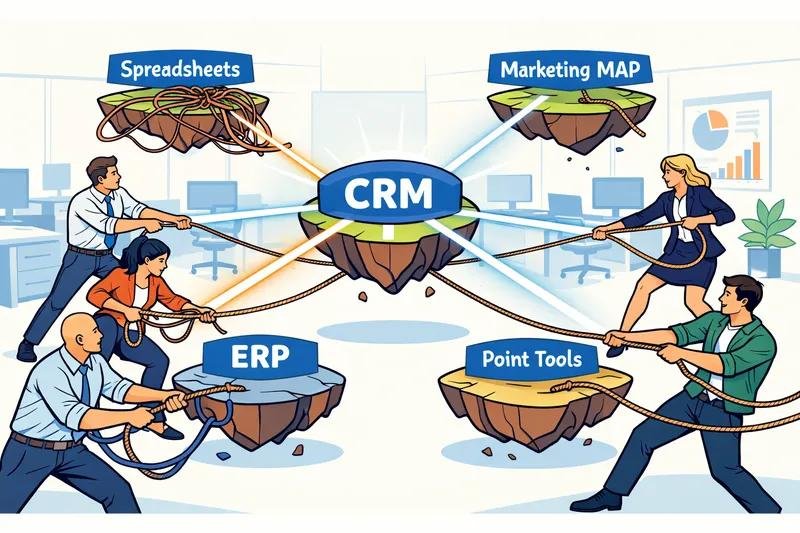
Like technical debt, integration debt often develops when organisations prioritise immediate requirements over long-term architecture. A department introduces a new application to solve an urgent problem, another team establishes a separate connection, and IT creates additional workflows to move information between systems. Over time, these individual decisions create dependencies that become increasingly difficult to manage.
For example, a marketing platform may exchange contact information with a CRM, which also connects to sales engagement software, customer support tools, and reporting dashboards. If each connection uses different data formats, authentication methods, or error-handling rules, even a minor change can require significant troubleshooting.
The problem is not necessarily the number of applications a business uses. It is whether those applications work together reliably and whether their connections have clear ownership, documentation, and monitoring.
Common signs of integration debt include:
- Duplicate customer records and inconsistent business information.
- Repeated manual data entry across multiple applications.
- Integrations that fail after software updates.
- Limited visibility into dependencies between systems.
- Increasing maintenance costs and lengthy troubleshooting.
- Unclear ownership of workflows and data connections.
Recognising these warning signs early allows businesses to address integration problems before they become major operational constraints. Businesses that fail to manage Integration Debt may face increasing maintenance costs, unreliable data transfers, and more complicated workflows as they grow.
7 Ways Integration Debt Slows Business Operations
1. Inconsistent Data Creates Multiple Versions of the Truth
One of the most immediate consequences of integration debt is inconsistent information across business applications. When data synchronisation is unreliable, different departments may work with different versions of the same customer, transaction, or business activity.
Consider a sales team that updates a customer’s contact details in its CRM. If the change does not reach the marketing platform or customer support system, employees may continue using outdated information. A sales opportunity marked as closed might also remain active in an analytics dashboard, creating discrepancies in management reports.
These inconsistencies affect more than reporting accuracy. Employees may contact the wrong person, repeat questions, overlook important updates, or make decisions using incomplete information.
To compensate, teams often export records, maintain separate spreadsheets, and manually reconcile differences. Although these workarounds may resolve immediate problems, they introduce additional copies of data and make consistency harder to maintain.
Businesses can reduce this risk by establishing clear data ownership, defining authoritative sources for important records, and implementing validation and monitoring for critical data flows.
Practical steps include:
- Define which system owns each important data field.
- Standardise data formats and validation rules.
- Monitor failed or delayed synchronisation.
- Establish procedures for identifying and resolving conflicting records.
Reliable data exchange is essential for trustworthy reporting and effective collaboration across departments. Unmanaged Integration Debt can make it difficult for businesses to maintain accurate customer records and consistent information across departments.
2. Employees Spend More Time Switching Between Systems
Technology should help employees complete tasks efficiently. However, disconnected applications can introduce additional steps that interrupt workflows and reduce productivity.
A sales representative, for example, might research an account in one application, review customer history in another, update an opportunity in the CRM, and then prepare a follow-up through a separate communication tool. If information cannot move automatically between these systems, the employee must repeatedly copy, verify, and re-enter details.
Similar challenges occur in HR, finance, marketing, procurement, and customer service. Employees may spend significant portions of their working day navigating applications instead of concentrating on the work that creates business value.
The impact becomes more noticeable when these tasks are repeated across large teams. Even small amounts of unnecessary effort can accumulate into substantial administrative overhead.
Organisations should therefore evaluate integrations based on complete business workflows rather than individual software features.
Useful improvements include:
- Identify tasks that require repeated data entry.
- Connect applications around common business processes.
- Eliminate unnecessary handoffs between departments.
- Gather employee feedback about repetitive administrative work.
- Prioritise integrations that reduce measurable workflow friction.
The objective is not simply to connect applications. It is to make everyday work easier to complete. Reducing Integration Debt allows employees to spend less time switching between applications and more time completing meaningful business tasks.
3. Fragile Integrations Undermine Automation
Business process automation depends on reliable data movement, consistent rules, and predictable system behaviour. When these foundations are weak, automation can introduce new problems instead of reducing manual effort.
For example, an automated lead-assignment workflow may depend on information flowing from a marketing platform into a CRM. If a required field changes or the connection stops working, a lead may never reach the appropriate salesperson.
Similar failures can affect invoice processing, customer notifications, employee onboarding, and management reporting. Some errors generate immediate alerts, while others remain unnoticed until a customer experiences a delay or a team discovers missing information.
Troubleshooting becomes particularly difficult when a failure occurs several steps away from where its consequences appear. IT teams may need to inspect application logs, authentication settings, API responses, and workflow dependencies before identifying the cause.
To make automation more dependable, businesses should implement:
- Centralised monitoring for critical integration workflows.
- Alerts for failed transactions and unexpected delays.
- Retry mechanisms and appropriate error-handling procedures.
- Testing before changes are introduced into production.
- Documented recovery procedures and clear incident ownership.
Automation delivers sustainable value when failures are visible, recoverable, and less likely to disrupt business operations. Addressing Integration Debt also improves automation reliability by making system dependencies easier to monitor, troubleshoot, and maintain.
4. Hidden Integration Costs Increase IT Spending
Integration debt rarely appears as a single expense. Its financial impact is distributed across software subscriptions, implementation projects, technical support, maintenance, and employee time.
A business might purchase an affordable application only to discover that connecting it to existing systems requires specialist development, additional middleware, or ongoing consultancy. Later, changes to either application may require further modifications and testing.
The indirect costs can be equally significant. IT teams spend time investigating recurring failures, employees reconcile data manually, and business initiatives take longer because new systems cannot be connected easily to existing infrastructure.
These expenses become particularly relevant when organisations expand into new markets, acquire other businesses, or introduce additional services.
A realistic assessment should consider the total cost of ownership rather than software subscription fees alone.
Businesses should evaluate:
- Initial integration and implementation costs.
- Ongoing maintenance and monitoring requirements.
- Time spent resolving integration incidents.
- Employee effort associated with manual workarounds.
- The cost and effort of future upgrades or system replacements.
Understanding these factors helps decision-makers compare technology options more accurately and avoid introducing connections that create disproportionate long-term costs.
5. Poorly Managed Connections Create Security Risks
Every integration establishes a pathway through which information can move between systems. These pathways need appropriate permissions, secure authentication, monitoring, and clearly defined ownership.
If an integration has excessive access privileges, it may expose information that the receiving application does not need. If credentials remain active after an employee leaves, an unnecessary access route may continue to exist. Temporary integrations can also become security concerns when they are forgotten and continue operating after their original purpose has disappeared.
The risk grows when organisations connect cloud applications, third-party services, data platforms, and AI-powered tools without maintaining an accurate view of information flows.
Reviewing applications individually may not reveal risks introduced by the connections between them. Effective integration management must therefore form part of the broader enterprise security strategy.
Important safeguards include:
- Apply least-privilege access to integration accounts.
- Store and rotate credentials securely.
- Review permissions and active connections regularly.
- Remove obsolete integrations and unused credentials.
- Maintain audit trails for important data transfers.
- Assess third-party access and relevant compliance obligations.
A well-managed integration environment improves operational reliability while helping organisations maintain control over sensitive business information.
6. Fragmented Systems Limit the Value of AI
AI assistants and automation platforms can help employees retrieve information from multiple business applications, summarise customer interactions, and recommend next steps. However, their usefulness depends partly on the quality and reliability of the underlying data.
Imagine an AI assistant preparing a customer account summary. The CRM contains one set of contact details, the support platform records a different account status, and the reporting system displays outdated sales figures. The assistant may present a polished summary without resolving the underlying inconsistencies.
This creates a subtle problem: a clear-looking answer can conceal fragmented or conflicting information.
AI-powered workflows may also fail when connections cannot retrieve relevant records, permissions prevent access to necessary information, or synchronisation delays leave the system working with outdated data.
Before expanding AI adoption, businesses should strengthen the data and integration foundations that support these tools.
Practical priorities include:
- Establish authoritative sources for important business information.
- Improve data quality and synchronisation reliability.
- Define access permissions for AI-enabled workflows.
- Monitor automated actions and provide appropriate human oversight.
- Test AI workflows against incomplete or conflicting records.
AI can make interconnected systems more useful, but it cannot automatically compensate for every weakness in their underlying architecture.
7. Complex Dependencies Slow Future Technology Changes
Integration debt also makes organisations less adaptable. When applications depend on numerous undocumented connections, changing one component can affect several downstream processes.
Replacing a CRM, upgrading an ERP system, or introducing a new analytics platform may require changes to multiple integrations. Without an accurate dependency map, teams may struggle to identify which workflows will be affected and how much testing is required.
This complexity can delay technology modernisation and increase the risk associated with system changes.
Businesses should maintain an up-to-date view of critical applications, their dependencies, and the business processes they support. Standardised integration patterns, documented interfaces, and clearly defined ownership can make future changes easier to plan and execute.
The goal is to preserve flexibility as the organisation grows rather than allowing historical technology decisions to dictate every future investment.
How to Reduce Integration Debt in an Enterprise Environment
Audit Existing Applications and Integrations
The first step is to understand the current environment. Businesses may know their major software platforms but lack visibility into every connection created by IT teams, individual departments, vendors, or external consultants.
An integration audit should identify important applications, data flows, dependencies, and ownership arrangements.
For each critical connection, document:
- The applications or services involved.
- The business purpose and information transferred.
- The technical and business owners.
- The authentication method and permissions.
- Monitoring arrangements and known failure points.
- The downstream workflows that depend on it.
This inventory helps organisations identify outdated connections, duplicate workflows, unnecessary access permissions, and systems that no longer serve a clear purpose.
Prioritise Integrations by Business Impact
Not every integration requires the same level of attention. A connection supporting financial transactions or customer service may be more critical than one used for a low-priority internal report.
Organisations should assess integrations according to business importance, reliability, maintenance effort, security exposure, and the consequences of failure.
A practical prioritisation approach is to classify connections into three groups:
- Critical: Supports essential business operations and requires strong monitoring, recovery procedures, and clear ownership.
- Improvement required: Delivers business value but creates recurring failures, manual work, or excessive maintenance.
- Retire or consolidate: Duplicates functionality, supports an obsolete process, or no longer has a clear business purpose.
This approach helps teams focus resources where improvements are most likely to reduce operational risk and unnecessary effort.
Standardise Integration Design and Governance
Consistent integration standards make the technology environment easier to maintain. Without them, different teams may create connections using incompatible data formats, authentication approaches, error-handling mechanisms, and documentation practices.
Organisations should establish guidelines for API usage, data validation, credential management, monitoring, testing, and ownership.
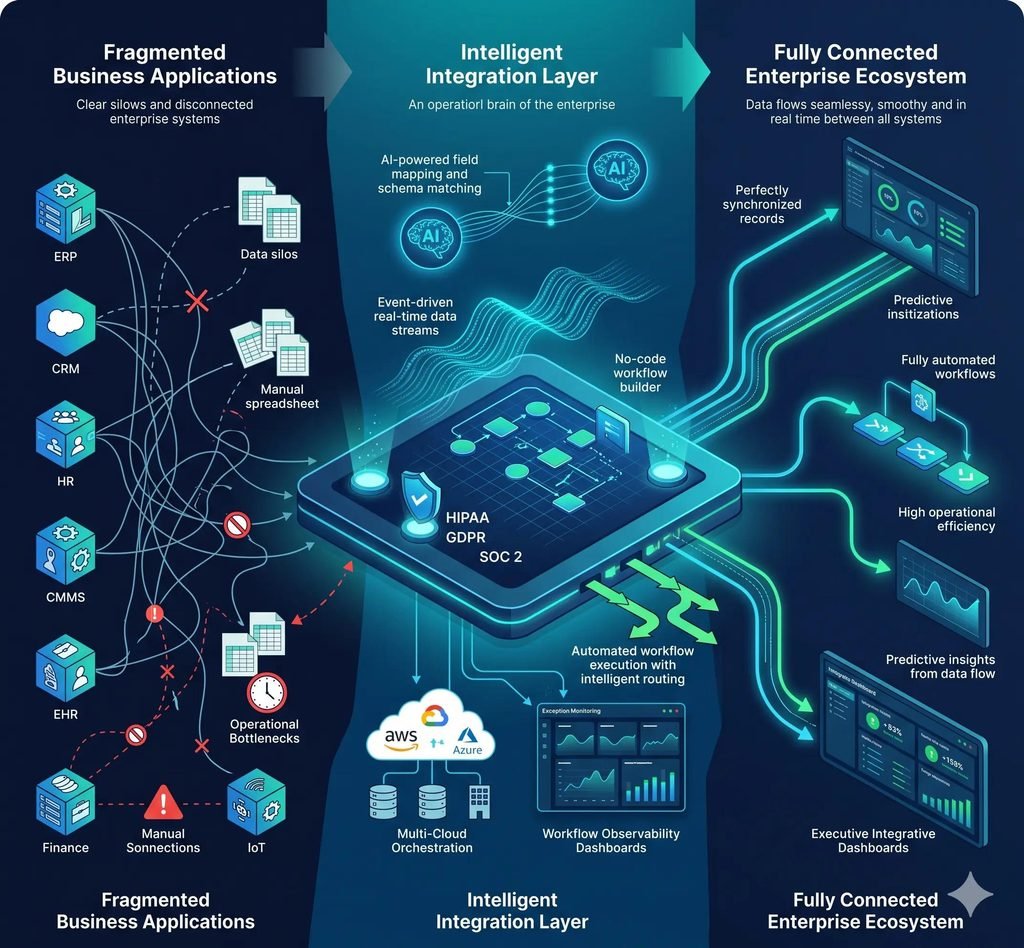
Where appropriate, an integration platform or middleware layer can help coordinate data flows and reduce the need for numerous independent point-to-point connections. However, adding a central platform is not automatically the right solution for every business.
The architecture should reflect actual requirements, the capabilities of existing systems, operational constraints, and the skills available to maintain it.
Good governance should make integration work more consistent without creating unnecessary approval processes or slowing legitimate business innovation. A clear integration strategy helps organisations control Integration Debt by establishing consistent standards, assigning ownership, and monitoring system connections.
Involve Employees in Workflow Improvements
Technical monitoring reveals whether a connection is operating correctly, but it does not always show whether the integration improves the employee experience.
Employees can identify repetitive data entry, unnecessary application switching, missing notifications, and manual reporting steps that are difficult to detect through technical logs alone.
Cross-functional discussions help organisations understand how information moves across departments and whether an improvement in one area creates additional work elsewhere.
For example, automatically transferring customer information into a marketing platform may save time for marketing employees but create problems for sales if ownership rules and consent preferences are not handled correctly.
Involving business users early helps ensure that integrations support complete workflows rather than merely moving information between applications.
How to Measure the Impact of Integration Improvements
Reducing integration debt should produce observable business benefits. Simply removing applications or reducing the number of connections does not guarantee better performance.
Organisations should establish a baseline and monitor whether integration changes improve reliability, data quality, employee productivity, and operating costs.
Useful measures include:
- Integration failure rate: How frequently critical connections fail or require intervention.
- Incident resolution time: How long teams need to diagnose and resolve integration problems.
- Data consistency: How often important records match across connected systems.
- Manual effort: How much employee time is spent copying, correcting, or reconciling information.
- Workflow completion time: How long important cross-system business processes take.
- Maintenance effort: How much IT time is required to support and modify integrations.
- Change readiness: How easily new applications can be introduced or existing systems upgraded.
These indicators should be selected according to the organisation’s priorities. A company focused on customer operations may place greater emphasis on data accuracy and workflow completion, while a finance team may prioritise transaction reliability and processing delays.
Regular reviews help leaders determine whether integration improvements are delivering practical value and where additional investment is justified.
Conclusion
Integration debt is a reminder that the value of business technology depends not only on what individual applications can do, but also on how reliably they work together. Disconnected systems can create inconsistent data, duplicate effort, fragile automation, higher maintenance costs, and security risks that become more difficult to manage as organisations grow. Reducing Integration Debt helps businesses build a more reliable technology environment for future automation, analytics, and AI initiatives.
Addressing these challenges requires more than purchasing another platform or connecting every application to every other system. Businesses need visibility into existing dependencies, clear data ownership, consistent integration standards, appropriate security controls, and ongoing performance measurement.
By auditing their technology environment, prioritising critical workflows, involving employees, and simplifying unnecessary connections, organisations can create a more dependable foundation for digital transformation.
As enterprise AI and automation continue to expand, managing integration complexity will become increasingly important. Businesses that treat integration as a long-term architectural and operational responsibility will be better positioned to use their technology effectively, adapt to change, and reduce the friction that prevents teams from doing their best work.
Frequently Asked Questions
What is integration debt in business technology?
Integration debt is the accumulated complexity, maintenance effort, and operational cost associated with poorly managed connections between business applications. It often develops when systems are connected without consistent standards, adequate documentation, or clear ownership.
How does integration debt affect business productivity?
It can increase manual data entry, create duplicate records, interrupt automated workflows, and force employees to switch repeatedly between applications. These inefficiencies consume time that could otherwise be spent on customer service, analysis, and business operations.
What causes integration debt?
Common causes include rapid software adoption, disconnected departmental systems, duplicated integrations, inconsistent data formats, undocumented workflows, and insufficient long-term maintenance planning.
What is the difference between integration debt and technical debt?
Technical debt generally refers to the future cost of shortcuts or compromises in software design and implementation. Integration debt focuses on the complexity and ongoing burden created by connections and dependencies between applications. The two can overlap.
How can businesses identify integration debt?
Businesses can conduct an integration audit, map application dependencies, review recurring failures, investigate manual workarounds, and assess maintenance effort. Employee feedback and monitoring data can reveal problems that are not immediately visible in system architecture diagrams.
Can an integration platform eliminate integration debt?
An integration platform can simplify data movement, improve visibility, and standardise certain integration processes. However, it cannot automatically resolve poor data quality, unclear ownership, unnecessary workflows, or weak governance. Its value depends on how well it addresses the organisation’s actual requirements.
How does integration debt affect AI adoption?
AI systems depend on accessible, reliable, and appropriately governed information. Fragmented data and unreliable integrations can lead to incomplete context, conflicting answers, and failed automated actions. Improving data quality and integration reliability helps create a stronger foundation for AI adoption.
How can organisations measure integration debt reduction?
They can track integration failures, incident resolution times, data consistency, manual data entry, workflow completion times, and maintenance effort. Comparing these measures before and after improvements helps determine whether the changes are producing meaningful operational benefits.