

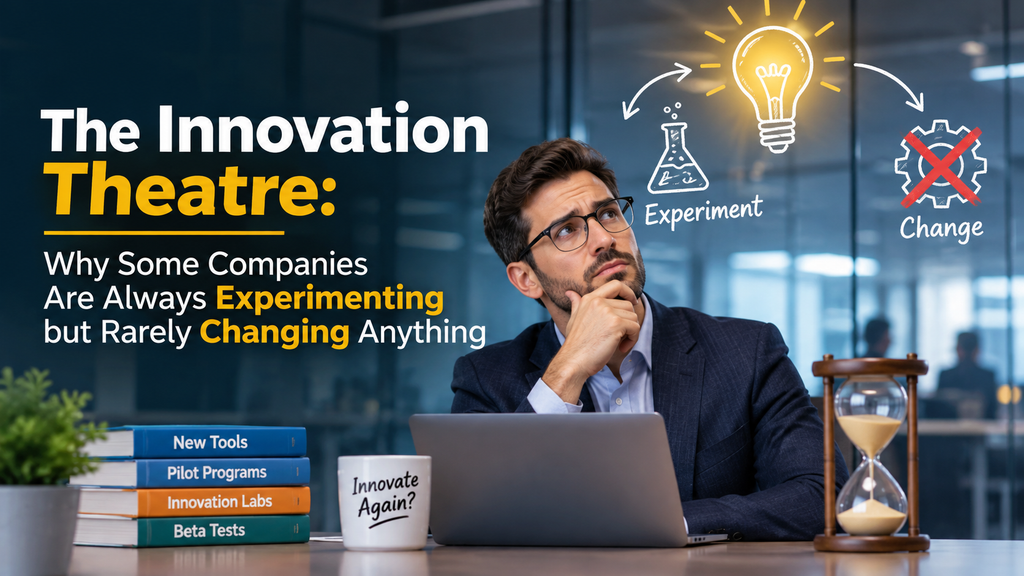
Innovation theatre has become a growing challenge for organizations that continuously experiment with new technologies and ideas but struggle to translate those initiatives into meaningful business improvements. Companies regularly announce innovation programmes, introduce emerging technologies, organize brainstorming sessions, launch pilot projects, and encourage employees to challenge traditional ways of working. From artificial intelligence experiments to enterprise-wide digital transformation programmes, businesses are constantly searching for opportunities to demonstrate progress.
Yet an interesting contradiction exists within modern organizations: despite all this innovation activity, very little fundamentally changes. New ideas are discussed, tested, presented, and sometimes celebrated, but they rarely influence how the business actually operates. An organization may conduct multiple innovation workshops without improving its decision-making processes, introduce new software without increasing productivity, or experiment with automation without addressing the inefficient workflows responsible for unnecessary work.
This creates what can be described as innovation theatre: the appearance of continuous improvement without the organizational commitment required to produce meaningful transformation. The problem is not necessarily a lack of ideas. In many cases, businesses have more ideas than they can execute. The real challenge is that experimentation has become an activity in itself rather than a pathway towards measurable business outcomes.
What Is Innovation Theatre and Why Does It Matter?
Innovation theatre occurs when organizations invest considerable time, resources, and attention in activities that appear innovative but fail to create lasting operational or strategic improvements. These activities often involve workshops, technology demonstrations, pilot programmes, internal innovation competitions, and experimental projects that generate enthusiasm without producing meaningful changes.
The distinction between genuine innovation and innovation theatre lies in what happens after an idea is introduced. Genuine innovation moves beyond exploration and becomes part of the organization’s everyday operations. Innovation theatre, on the other hand, frequently stops at presentations, prototypes, and temporary demonstrations.
For example, an enterprise might introduce an artificial intelligence pilot to automate customer support activities. The project may successfully demonstrate that AI can respond to common customer queries. However, if the organization never integrates the solution into its existing customer service workflows, trains employees, or establishes a deployment strategy, the experiment produces limited business value.
The same pattern appears across different enterprise functions:
- Information Technology: Organizations test new infrastructure management platforms but continue relying on disconnected legacy processes.
- Human Resources: HR teams experiment with recruitment automation but retain manual candidate screening and administrative workflows.
- Marketing: Marketing departments introduce AI-powered content tools without improving campaign planning, reporting, or performance measurement.
- Operations: Teams test workflow automation but continue using fragmented systems that require unnecessary manual intervention.
- Customer Experience: Businesses conduct customer feedback experiments without addressing the internal processes responsible for recurring customer complaints.
Innovation becomes meaningful when experimentation leads to decisions, implementation, and measurable improvements.
1. Experimentation Is Easier to Announce Than Implementation
One of the biggest reasons innovation theatre has become common is that experimenting with new ideas is often easier to communicate than implementing them.
A pilot project creates an opportunity to demonstrate progress, present findings, and generate excitement without requiring the organization to make difficult structural changes. Leaders can announce that a department is testing artificial intelligence, employees can participate in innovation sessions, and teams can showcase prototypes that demonstrate what might be possible.
However, moving from experimentation to implementation requires a different level of commitment.
It may involve changing established processes, reallocating budgets, redesigning responsibilities, training employees, and challenging decisions that have been accepted for years. These activities can create resistance because they affect how people work and how authority is distributed across the organization.
Consider an enterprise that successfully tests an automated invoice processing solution. During the pilot, the technology demonstrates its ability to extract information, validate records, and reduce repetitive data entry. However, implementing the solution across the organization may require changes to finance workflows, approval structures, enterprise resource planning systems, and employee responsibilities.
The technology may be ready, but the organization may not be prepared to change.
This creates a familiar cycle in which:
- A new idea generates interest and receives management approval.
- A pilot project demonstrates technical feasibility.
- Initial results are presented to stakeholders.
- Implementation requires additional investment and organizational changes.
- The initiative loses momentum and eventually gets replaced by another experiment.
The pilot remains a pilot, the presentation becomes the final achievement, and the business moves on without addressing why the previous initiative never progressed.
The practical lesson: Organizations should evaluate innovation initiatives not only by their ability to demonstrate potential but also by their readiness for operational implementation.
2. Measuring Innovation Activity Instead of Business Outcomes
Another major contributor to innovation theatre is the tendency to measure the number of experiments conducted rather than the business value they create.
Organizations frequently use activity-based indicators to evaluate innovation programmes. These may include the number of ideas generated, workshops completed, prototypes developed, technologies tested, and employees participating in innovation initiatives.
Although these indicators can help measure engagement, they do not necessarily reveal whether the business has become more effective.
For example, a company might test several AI-powered tools across different departments but fail to determine which solutions meaningfully reduce manual work, improve decision-making, or enhance customer experiences.
Another organization may conduct multiple customer experience experiments without changing the internal processes responsible for customer dissatisfaction.
When innovation is evaluated through activity rather than outcomes, teams naturally focus on producing visible evidence of experimentation.
Businesses should distinguish between learning something interesting and changing something important.
A more meaningful approach is to evaluate innovation through measurable business outcomes, such as:
- Operational efficiency: Has the initiative reduced unnecessary manual work or simplified existing workflows?
- Employee productivity: Are employees spending less time on repetitive administrative activities?
- Customer experience: Has the initiative improved service quality, responsiveness, or customer interactions?
- Decision-making: Can teams access relevant information and make informed decisions more efficiently?
- Cost optimization: Has the solution reduced operational expenses or eliminated unnecessary technology investments?
- Scalability: Can the initiative be implemented across multiple departments without creating additional complexity?
For example, instead of measuring the success of an AI automation pilot through the number of workflows tested, an enterprise should examine whether the selected workflow has become faster, more reliable, and easier to manage.
The objective should not be to conduct more experiments. It should be to identify which experiments deserve to become permanent improvements.
3. Organizational Culture Often Prevents Innovation from Moving Forward
Corporate culture plays an important role in determining whether new ideas become meaningful business improvements.
Many organizations communicate that innovation is everyone’s responsibility. Employees are encouraged to identify inefficiencies, recommend improvements, challenge existing practices, and think creatively.
However, the decision-making structures required to support innovation may remain highly centralized.
Employees may identify practical opportunities for improvement but lack the authority, resources, or management support required to implement them. Their proposals may need approval from multiple levels of management before anything can happen.
By the time an idea receives attention, the original enthusiasm may have disappeared or business priorities may have changed.
Fear of failure can create another obstacle. In some organizations, unsuccessful experiments are treated as personal failures rather than opportunities to learn. This discourages employees from questioning established processes or proposing alternative approaches.
A genuine innovation culture requires more than encouraging employees to share ideas. It requires creating an environment where those ideas can be evaluated, tested, and implemented.
Organizations can strengthen this environment by:
- Giving teams clear ownership of improvement initiatives.
- Reducing unnecessary approval processes for low-risk experiments.
- Encouraging employees to challenge inefficient established practices.
- Treating unsuccessful experiments as opportunities for structured learning.
- Providing the budget, time, and technical resources required to implement promising ideas.
- Ensuring senior leadership actively supports initiatives beyond their initial launch.
Innovation should not remain an additional responsibility that employees are expected to manage alongside their existing workload without sufficient support.
It must become part of how the organization makes decisions and improves its operations.
4. Technology Adoption Without Process Transformation Creates Limited Value
The growing availability of artificial intelligence, cloud platforms, automation solutions, and enterprise software has made experimentation easier than ever.
Businesses can now explore technologies for workflow automation, content generation, predictive analytics, customer intelligence, reporting, and infrastructure management without making the same level of initial investment that these initiatives once required.
While this accessibility creates opportunities, it also makes it easier for organizations to accumulate disconnected experiments.
Different departments may independently test similar technologies, purchase overlapping subscriptions, or develop separate solutions to problems that could be addressed through a shared enterprise platform.
For example, a marketing team may automate reporting, a sales team may experiment with lead analysis, and an operations team may introduce workflow automation.
Each initiative may deliver some departmental benefit, but none may be connected to a broader business strategy.
The organization becomes technologically active without becoming operationally smarter.
This is particularly important when implementing artificial intelligence. Introducing an AI tool does not automatically improve productivity if employees continue following the same inefficient processes.
Consider a business that introduces an AI-powered document processing solution. If employees still need to manually transfer extracted information between disconnected applications, verify duplicate records, and obtain approvals through email, the organization has automated only one part of the problem.
The technology may work as expected, but the overall workflow remains inefficient.
To avoid this situation, businesses should consider three important questions before adopting new technologies:
- What business problem are we solving? Identify the operational challenge before selecting a technology.
- How will the solution change existing workflows? Understand the process changes required to generate meaningful value.
- How will the improvement be measured? Establish clear performance indicators that demonstrate whether the initiative is working.
Technology should support business transformation rather than become a substitute for it.
5. The Gap Between Successful Pilots and Enterprise-Wide Implementation
A successful pilot does not automatically guarantee successful enterprise implementation.
This is one of the most overlooked challenges in enterprise innovation. A solution that performs effectively within a small, controlled environment may encounter different challenges when introduced across multiple departments, locations, or business units.
During a pilot, teams often work with limited datasets, a smaller number of users, simplified workflows, and dedicated technical support.
Enterprise-wide deployment introduces additional considerations, such as system integration, data governance, cybersecurity, employee training, regulatory requirements, scalability, and ongoing maintenance.
For instance, an organization may successfully test an automated employee onboarding process within its HR department. However, implementing the same solution across multiple business units may require integration with identity management platforms, payroll systems, compliance processes, and existing HR information systems.
Without addressing these requirements, the pilot may remain an isolated success.
A structured implementation approach can help organizations bridge this gap.
Build a clear transition from pilot to implementation
A practical approach should include:
- Technical validation: Confirm that the solution performs reliably under realistic business conditions.
- Business validation: Determine whether the solution addresses the original operational problem.
- Integration planning: Identify dependencies involving existing enterprise applications, databases, and infrastructure.
- Change management: Prepare employees and stakeholders for changes in their responsibilities and workflows.
- Scalability assessment: Evaluate whether the solution can support additional users, departments, and business requirements.
- Performance monitoring: Establish a process for measuring outcomes after implementation.
The transition from pilot to production should be treated as an essential part of innovation planning, not as a separate decision that can be postponed indefinitely.
6. Leadership Must Take Responsibility for Turning Ideas into Change
Innovation initiatives frequently receive attention during their initial stages because they offer an opportunity to demonstrate strategic thinking and organizational ambition.
However, sustained innovation requires leadership involvement beyond approving budgets or announcing new programmes.
Business leaders must ensure that promising initiatives receive the resources, ownership, and organizational support required to move forward.
This includes making difficult decisions about which projects deserve investment, which existing processes need to change, and which initiatives should be discontinued.
Without clear leadership accountability, innovation programmes can become disconnected from business priorities.
For example, an enterprise may launch several digital transformation initiatives across different departments. Each team may have its own objectives, technology preferences, and implementation timelines.
Without coordinated leadership, these initiatives can create overlapping investments, inconsistent technology adoption, and fragmented operational processes.
Leaders can address this challenge by establishing a more disciplined approach to innovation management.
Important leadership responsibilities include:
- Connecting innovation initiatives with measurable business objectives.
- Assigning accountable owners to promising projects.
- Providing realistic implementation budgets and timelines.
- Removing organizational barriers that delay execution.
- Reviewing outcomes rather than focusing exclusively on project activity.
- Discontinuing initiatives that no longer demonstrate meaningful value.
Most importantly, leadership must demonstrate that innovation is not simply about introducing something new. It is about improving something that matters to the business.
7. Building an Innovation Strategy That Produces Measurable Business Change
Moving beyond innovation theatre requires organizations to become more selective about what they experiment with and more disciplined about what they implement.
Every initiative should begin with a clearly defined business problem rather than an attractive technology or fashionable idea.
Teams should understand what is currently not working, why the issue matters, what improvement would look like, and how the results will be evaluated.
A practical innovation strategy should connect experimentation, decision-making, implementation, and continuous improvement.
Start with business problems, not technology trends
Organizations should identify operational challenges before evaluating potential solutions.
For example, instead of deciding to introduce AI because it is becoming increasingly popular, a business might identify that its employees spend considerable time manually preparing reports.
This creates a clearer opportunity to evaluate reporting automation, data integration, and AI-assisted analysis.
Establish clear ownership and accountability
Every innovation initiative should have an accountable owner who understands the business objective, coordinates stakeholders, and ensures that the project progresses beyond experimentation.
Without ownership, promising initiatives can remain dependent on temporary enthusiasm.
Define success before launching experiments
Teams should establish measurable objectives before starting a pilot.
These objectives might include reducing manual processing, improving response times, simplifying workflows, or increasing the reliability of business information.
Defining success early makes it easier to determine whether an initiative deserves further investment.
Create a structured implementation pathway
Successful experiments should have a defined route towards operational adoption.
This includes identifying technical requirements, integration dependencies, employee training needs, implementation budgets, and ongoing responsibilities.
Review, scale, or discontinue initiatives
Not every experiment needs to become a permanent solution.
Some initiatives will reveal that an approach is technically unsuitable, financially impractical, or misaligned with business priorities.
That learning is valuable when it informs future decisions.
Organizations should establish clear decisions for every experiment:
- Scale: The initiative demonstrates meaningful value and is ready for broader implementation.
- Improve: The concept is promising but requires additional refinement or validation.
- Stop: The initiative does not justify further investment.
- Revisit: The idea may become valuable when business requirements or technology capabilities change.
This approach helps businesses avoid accumulating disconnected pilot projects and encourages more disciplined investment in innovation.
Conclusion: Real Innovation Begins When Something Actually Changes
Ultimately, the success of innovation should not be determined by how many new ideas a company discusses or how frequently it experiments with emerging technologies. It should be determined by what becomes different because those ideas were introduced.
Did the organization make decisions faster? Did employees spend less time on repetitive activities? Did customers receive a better experience? Did a process become simpler, more reliable, or less expensive?
These are the questions that reveal whether innovation has moved beyond presentations and entered everyday business operations.
Innovation theatre continues when businesses prioritize visibility over implementation, experimentation over outcomes, and technology adoption over meaningful process improvement.
Moving beyond it requires a different mindset. Organizations need the discipline to identify meaningful opportunities, the courage to challenge established practices, and the commitment to turn successful experiments into lasting improvements.
For enterprise leaders, the challenge is not simply to encourage more innovation. It is to create the conditions in which good ideas can move from experimentation to execution and eventually become part of the organization’s operating model.
The most innovative organization is not necessarily the one with the most ideas, the largest number of pilot projects, or the newest technology. It is the one that consistently turns useful ideas into real business change.