

Enterprise AI ROI is becoming a critical consideration for organizations investing in artificial intelligence to improve productivity, streamline operations, enhance customer experiences, and support better business decisions. As companies move beyond experimentation and begin integrating AI into everyday workflows, measuring its financial and operational impact is essential for determining whether these investments deliver meaningful business value.
However, evaluating the return on AI investments is not as straightforward as measuring the cost savings from a traditional software implementation. AI initiatives can influence multiple business functions simultaneously, from employee productivity and customer support to software development, risk management, and revenue generation. Some benefits are immediately measurable, while others emerge gradually as teams adopt new workflows and organizations refine their AI capabilities.
For enterprise leaders, the objective is not simply to determine whether an AI tool works. It is to understand whether the technology solves a meaningful business problem, produces measurable outcomes, and justifies the resources required to implement and maintain it. A structured approach to Enterprise AI ROI helps organizations connect technology investments with business priorities and make more informed decisions about future AI initiatives.
What Is Enterprise AI ROI?
Enterprise AI ROI refers to the measurable business value an organization generates from its investments in artificial intelligence compared with the total cost of implementing, operating, and managing those solutions.
Unlike traditional IT investments, AI projects often involve ongoing experimentation, model usage costs, data preparation, human oversight, and changes to existing business processes. These factors make it important to evaluate both the initial implementation costs and the long-term resources required to sustain the solution.
For example, an organization might deploy an AI-powered customer support assistant to help service representatives resolve routine inquiries more efficiently. The investment may include software licensing, system integration, employee training, security controls, and ongoing monitoring. Its value could come from reduced handling time, increased support capacity, improved service consistency, or fewer escalations.
The actual return depends on whether these improvements translate into measurable business outcomes.
Why Measuring AI Business Value Matters
Without a clear measurement framework, organizations may confuse AI adoption with business success. A team might use an AI assistant regularly without achieving meaningful productivity gains, or an automation project might reduce task completion time without lowering costs or increasing business output.
Measuring Enterprise AI ROI helps businesses:
- Justify technology spending: Establish whether AI investments support defined business objectives.
- Prioritize high-value use cases: Direct resources toward applications with meaningful and achievable outcomes.
- Identify implementation gaps: Understand why an AI solution may not be delivering its expected benefits.
- Improve accountability: Give business, finance, and technology teams shared performance indicators.
- Support scalable adoption: Determine which successful pilots are ready for broader deployment.
The central principle is simple: AI performance matters, but business outcomes determine the value of the investment.
7 Powerful Ways to Measure Enterprise AI ROI
Measuring AI business value requires more than tracking usage statistics or technical accuracy. Organizations should evaluate financial performance, operational improvements, employee effectiveness, customer outcomes, and risk management in relation to the purpose of each AI initiative.
1. Measure Cost Savings and Operational Efficiency
Cost savings are among the most direct ways to evaluate the financial impact of enterprise AI. AI-powered automation can help organizations reduce repetitive manual work, accelerate document processing, streamline administrative activities, and improve resource utilization.
However, a reduction in task completion time does not automatically translate into equivalent financial savings. The organization must determine whether the improvement reduces actual expenditure, avoids planned hiring, increases productive capacity, or enables employees to focus on higher-value work.
Consider an enterprise finance department that introduces AI-assisted invoice processing. The system extracts invoice details, identifies potential discrepancies, and prepares information for human review. To measure its impact, the organization can compare processing costs, error rates, review time, and exception-handling effort before and after implementation.
Useful metrics include:
- Cost per transaction or completed task.
- Average processing time.
- Manual hours required per workflow.
- Error correction and rework costs.
- Overtime expenditure or external service costs.
Practical insight: Establish a baseline before implementation and compare it with results after deployment. Include ongoing software, infrastructure, integration, and oversight costs to understand the net financial impact.
2. Track Employee Productivity and Capacity Gains
AI tools can help employees draft documents, analyze information, generate code, summarize meetings, prepare reports, and retrieve organizational knowledge. These capabilities may reduce the time required for individual tasks and improve the amount of useful work teams can complete.
Nevertheless, productivity should not be measured solely by how quickly an employee finishes a task. Output quality, review effort, rework, and the usefulness of the completed work also matter.
For example, a software engineering team might use AI coding assistants to generate test cases and explain unfamiliar code. Although the tools may accelerate initial development, the organization should also evaluate code quality, security findings, defect rates, and the time required for testing and review.
Relevant productivity indicators include:
- Time required to complete defined tasks.
- Completed work per employee or team.
- Review and rework effort.
- Delivery cycle time.
- Quality-adjusted output.
The business value of productivity improvements becomes clearer when organizations determine how the additional capacity is used. Employees may support more customers, accelerate project delivery, improve service quality, or reduce backlogs without increasing headcount.
Practical insight: Measure the entire workflow rather than the AI-assisted activity in isolation. A faster first draft offers limited value if the final deliverable requires substantially more correction.
3. Evaluate Revenue Growth and Business Opportunities
Enterprise AI ROI is not limited to reducing costs. AI can also support revenue generation by helping sales teams identify promising accounts, personalize customer engagement, improve forecasting, and respond to buyer requirements more effectively.
In B2B organizations, AI-enabled sales intelligence may help representatives prioritize leads, summarize account histories, identify potential customer needs, and prepare relevant proposals. These capabilities can improve sales effectiveness when integrated into established sales processes.
For example, a B2B software provider might use AI to analyze its customer relationship management data and identify accounts that may benefit from an additional product or service. Sales representatives can then investigate these opportunities and engage relevant decision-makers.
Possible metrics include:
- Qualified leads generated.
- Lead-to-opportunity conversion rate.
- Opportunity-to-win conversion rate.
- Sales cycle duration.
- Revenue or gross profit attributable to the initiative.
- Customer acquisition cost.
Revenue attribution requires particular care. Changes in sales performance may also result from pricing, market conditions, sales incentives, product improvements, or changes in the sales team. Organizations should avoid attributing every improvement to AI.
Practical insight: Use controlled pilots, comparison groups, or carefully defined before-and-after measurements where practical. Evaluate whether AI contributes to incremental business results rather than merely coinciding with them.
4. Assess Customer Experience and Service Quality
Customer experience is another important dimension of AI business value, particularly for organizations operating large customer support, service delivery, and account management functions.
AI-powered chatbots, agent-assist tools, intelligent knowledge retrieval, and automated ticket classification can help teams respond to customer requests more consistently. These applications may improve response times and service availability while helping human representatives focus on complex issues.
However, faster responses do not necessarily indicate better customer experiences. An AI system that provides inaccurate answers or repeatedly transfers customers between channels can increase frustration even when response times appear favorable.
Organizations should evaluate both operational efficiency and customer outcomes.
Useful indicators include:
- First-contact resolution rate.
- Average response and resolution time.
- Customer satisfaction scores.
- Customer effort and escalation rates.
- Repeat contact frequency.
- Service quality and answer accuracy.
For example, a B2B IT services company may introduce an AI assistant to help customers troubleshoot common technical issues. Its success should be evaluated by determining whether customers resolve problems more effectively, whether escalation patterns improve, and whether support teams maintain appropriate service quality.
Practical insight: Pair efficiency metrics with customer feedback and quality assessments. This helps ensure that AI improves the overall service experience instead of simply reducing the time spent on individual interactions.
5. Calculate the Total Cost of AI Implementation
An accurate Enterprise AI ROI calculation must account for the full cost of ownership. Focusing only on subscription fees or initial development expenditure can make an AI initiative appear more profitable than it actually is.
Enterprise AI projects may require substantial preparation before the first business benefit appears. Existing systems may need integration, data may require cleaning, employees may need training, and security teams may need to establish access controls and monitoring processes.
The cost structure also varies by implementation model. A managed AI service, an internally developed application, and a solution using self-hosted models can have very different operating requirements.
A comprehensive cost assessment should consider:
- Software subscriptions, model usage, and API charges.
- Cloud infrastructure, storage, and computing resources.
- Data preparation, integration, and migration.
- Development, testing, and deployment.
- Employee training and workflow redesign.
- Human review, monitoring, and maintenance.
- Security, compliance, and governance.
- Ongoing support and vendor management.
For example, an organization may deploy an AI knowledge assistant using an existing enterprise platform. While the initial rollout may be relatively straightforward, the long-term cost could include maintaining data connectors, updating permissions, evaluating answer quality, and managing usage growth.
Practical insight: Calculate costs over a defined evaluation period and include both implementation expenditure and recurring operating costs. Compare alternatives using consistent assumptions rather than evaluating each solution against a different cost baseline.
6. Measure Risk Reduction, Accuracy, and Governance
Not all AI benefits appear directly as revenue or cost savings. In some enterprise settings, AI can help identify suspicious transactions, detect anomalies, improve document review, or strengthen compliance monitoring.
These applications may reduce exposure to errors, operational disruption, or avoidable losses. However, organizations should distinguish between risks identified, risks successfully mitigated, and financial losses demonstrably avoided.
For example, an AI-assisted compliance workflow might flag unusual transactions for review. The value of the system depends on the relevance of those alerts, the ability of employees to investigate them, and the effectiveness of the resulting decisions.
Important measures include:
- False-positive and false-negative rates.
- Accuracy of AI-generated classifications.
- Human override and escalation frequency.
- Time required to investigate flagged cases.
- Compliance exceptions and remediation effort.
- Documented losses avoided, where they can be reasonably established.
Governance is also essential. Enterprise AI systems need appropriate access controls, data protection, auditability, human oversight, and processes for handling incorrect or unsafe outputs.
Practical insight: Treat governance and risk controls as part of the business case. A solution that appears efficient but creates unacceptable legal, security, or operational exposure may not deliver positive overall value.
7. Evaluate Long-Term Business Impact and Scalability
An AI pilot can deliver encouraging results in a controlled environment but encounter challenges when deployed across multiple departments, business units, or geographic regions.
Scaling introduces additional requirements, including infrastructure capacity, integration with different systems, employee adoption, support processes, data consistency, and ongoing governance. These factors can materially affect the economics of an AI initiative.
Organizations should therefore assess not only the initial return but also whether the solution can continue delivering value as usage grows.
Consider an enterprise that successfully introduces AI-assisted document processing in one department. Before expanding the solution across the organization, leaders should determine whether other departments have compatible workflows, suitable data, appropriate controls, and enough operational support.
Useful long-term measures include:
- Cost per additional user or transaction.
- Adoption and sustained usage rates.
- Performance across different departments.
- Ongoing maintenance requirements.
- Reliability and service availability.
- Incremental benefits from wider deployment.
Practical insight: Scale in stages. Validate the business case in a limited deployment, address operational weaknesses, and expand only when performance, governance, and financial assumptions remain credible.
How to Calculate Enterprise AI ROI
A consistent calculation helps business leaders compare AI initiatives and communicate results to finance and executive stakeholders.
The standard ROI formula is:
ROI (%) = [(Total Benefits − Total Costs) ÷ Total Costs] × 100
For AI investments, the challenge is defining which benefits are genuinely attributable to the solution and ensuring that all relevant costs are included.
A Practical Enterprise AI ROI Example
Suppose a company introduces an AI-assisted workflow for processing business documents. The following figures are illustrative assumptions for a one-year evaluation period, not industry benchmarks.
| Financial measure | Illustrative annual amount |
|---|---|
| Labor capacity and processing benefits | ₹12,00,000 |
| Reduced rework and related operating costs | ₹3,00,000 |
| Total quantified benefits | ₹15,00,000 |
| Software and model usage | ₹3,00,000 |
| Implementation and integration | ₹4,00,000 |
| Training, monitoring, and support | ₹2,00,000 |
| Total costs | ₹9,00,000 |
| Net quantified benefit | ₹6,00,000 |
Using these assumptions:
ROI = [(₹15,00,000 − ₹9,00,000) ÷ ₹9,00,000] × 100
Illustrative annual ROI = 66.7%.
This example assumes that the stated benefits are measurable, attributable to the initiative, and not double-counted. It also assumes that the implementation cost falls within the evaluation period.
There is an important distinction between labor capacity and realized cash savings. If the AI solution frees employee time but does not reduce expenditure or produce additional valuable output, the organization should not automatically treat the entire capacity benefit as cash savings.
For a more complete financial assessment, leaders can also evaluate payback period, net present value, and the expected costs and benefits over multiple years.
ROI, Payback Period, and Total Cost of Ownership
These measures answer different questions:
- ROI: How much quantified benefit is generated relative to the investment?
- Payback period: How long does it take for cumulative benefits to recover the initial investment?
- Total cost of ownership: What does the solution cost to implement, operate, and maintain over its useful life?
- Net present value: What is the present value of expected future cash flows after accounting for the time value of money?
Using several measures provides a more complete view than relying on a single ROI percentage.
Common Mistakes Businesses Make When Measuring AI ROI
Even organizations with strong technology capabilities can struggle to evaluate AI investments when their measurement methods do not reflect real business conditions.
Common mistakes include:
- Measuring activity instead of outcomes: Tracking prompts, logins, or AI-generated content without connecting them to business results.
- Ignoring hidden costs: Excluding data preparation, human review, training, maintenance, or security requirements.
- Overestimating productivity savings: Assuming that every minute saved becomes a financial saving.
- Ignoring quality and risk: Measuring speed without assessing accuracy, customer impact, or compliance.
- Using weak baselines: Comparing results against assumptions instead of reliable pre-implementation data.
- Attributing every improvement to AI: Overlooking other changes that may have influenced performance.
- Scaling too early: Expanding a pilot before validating its operating costs and business outcomes.
A strong measurement framework addresses these issues from the beginning. Business, finance, IT, and operational stakeholders should agree on the success criteria before implementation rather than selecting favorable metrics after the results are available.
Building an Enterprise AI ROI Measurement Framework
Organizations do not need a complicated measurement system to get started. They need a repeatable process that connects each AI initiative to a defined business objective.
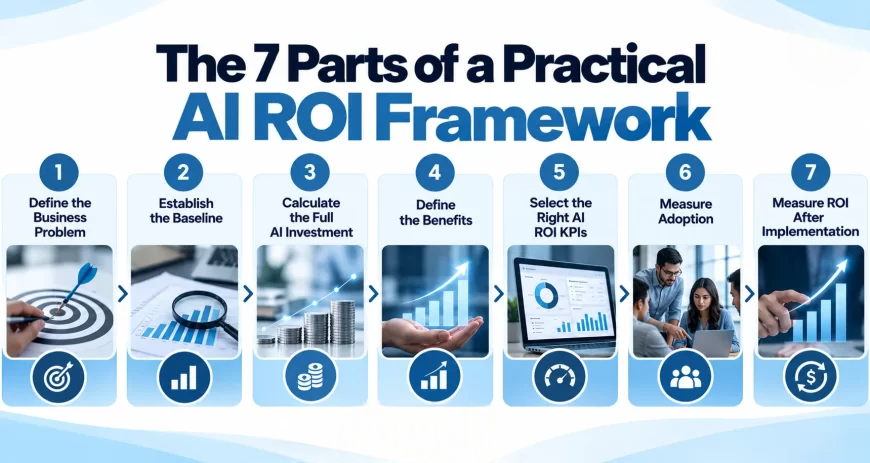
Step 1: Define the Business Problem
Start with a specific operational or commercial challenge. Examples include reducing document processing time, improving customer support resolution, accelerating software testing, or increasing the quality of sales forecasting.
A clearly defined problem makes it easier to identify relevant metrics and evaluate whether AI is an appropriate solution.
Step 2: Establish Baseline Performance
Record current performance before deploying the AI solution. Depending on the use case, this could include processing costs, completion time, error rates, customer satisfaction, or employee workload.
Ensure that the baseline reflects representative operating conditions and that the post-implementation measurements use consistent definitions.
Step 3: Select Business and Technical Metrics
Combine business indicators with technical measures where appropriate. A customer support application, for example, might track resolution time, customer satisfaction, answer accuracy, and escalation rates.
Technical performance is useful when it helps explain business results, but it should not replace business outcome measurement.
Step 4: Track Costs and Realized Benefits
Record implementation costs, ongoing operating expenditure, and measurable benefits. Separate cash savings from capacity gains and potential future benefits.
Document assumptions so that stakeholders can understand how the reported ROI was calculated.
Step 5: Review Results and Improve Continuously
Evaluate performance at regular intervals. Identify differences between expected and actual outcomes, investigate the reasons, and adjust workflows or technology where necessary.
Continue monitoring after deployment because usage patterns, model costs, business requirements, and operational performance can change over time.
The Future of Enterprise AI ROI
As AI becomes more deeply integrated into enterprise software and business operations, measuring its value will require a broader view of technology performance and organizational change.
AI agents, automated workflows, enterprise knowledge systems, and AI-assisted decision-making may influence several departments simultaneously. This makes it increasingly important to measure outcomes across complete business processes rather than isolated tasks.
Organizations will also need to distinguish between the value of the AI model itself and the value created by the surrounding business system. High-quality data, reliable integrations, clear accountability, employee adoption, and well-designed workflows can be just as important as model capabilities.
For enterprise leaders, the priority should be to establish credible measurement practices early, test assumptions against real operating conditions, and invest in solutions that demonstrate sustainable business value.
The organizations best positioned to benefit from AI will not necessarily be those that deploy the most tools. They will be those that consistently connect AI capabilities with meaningful business objectives and use evidence to guide investment decisions.
Conclusion
Enterprise AI ROI is ultimately a measure of whether artificial intelligence creates meaningful, sustainable business value. While AI can help organizations improve productivity, reduce operating costs, enhance customer experiences, and support better decisions, these benefits must be evaluated against the full cost and complexity of implementation.
The most effective approach combines financial analysis with operational performance, customer outcomes, risk management, and long-term scalability. By establishing reliable baselines, selecting relevant KPIs, tracking realized benefits, and accounting for ongoing costs, organizations can develop a more accurate understanding of their AI investments.
For B2B technology leaders, the next step is to move beyond measuring AI adoption and focus on measurable business outcomes. A disciplined approach to Enterprise AI ROI helps organizations identify valuable use cases, make informed investment decisions, and build an AI strategy grounded in evidence rather than expectations.