

In today’s competitive digital landscape, creating high-quality content requires significant time, effort, and budget. However, many B2B companies still treat content as a one-time asset—publishing a blog post, sharing it once on social media, and moving on. In 2026, that approach leaves substantial value untapped.
Content Repurposing Strategy helps businesses maximize the value of existing content by transforming it into multiple formats across different channels. This approach improves content ROI, expands audience reach, and enables brands to maintain consistent engagement without increasing content creation costs.
What Content Repurposing Really Means –
A successful Content Repurposing Strategy allows businesses to transform valuable content into multiple assets while maintaining consistency across different marketing channels.With a strong Content Repurposing Strategy, companies can reduce content creation costs, improve audience engagement, and generate higher returns from existing marketing investments.
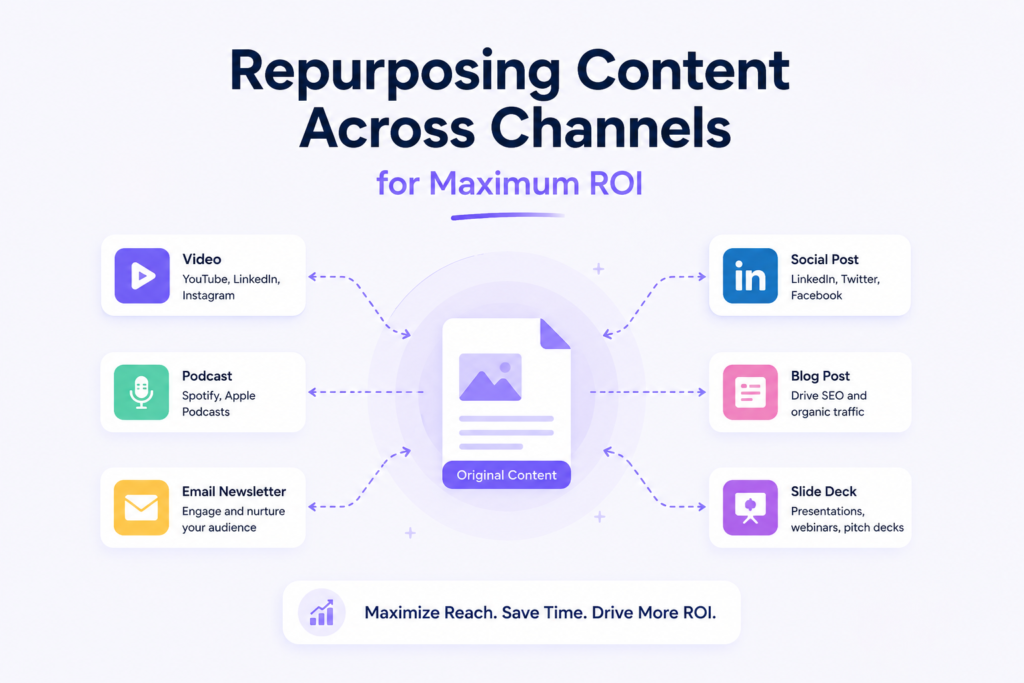
For example, a detailed whitepaper can become a blog series, a LinkedIn carousel, a webinar topic, short-form videos, email snippets, and even podcast discussions. Each version serves a different purpose while reinforcing the same central message.
Building a Content Repurposing Strategy around pillar content helps marketers create a continuous flow of valuable content for different audience segments.
Why Repurposing Drives Higher ROI –
A successful B2B content marketing strategy allows organizations to maximize existing assets, improve visibility, and create sustainable growth through effective content reuse.
Key benefits include:
- Increased content lifespan
- Expanded audience reach
- Improved brand consistency
- Better SEO performance
- Higher engagement across multiple channels
- More touchpoints in the customer journey
When prospects encounter your message in different formats, it strengthens recall and builds trust over time.
Start with High-Value Core Content –
The most effective repurposing strategy begins with foundational or “pillar” content. This could be a comprehensive guide, research report, webinar, podcast episode, or case study.
From this core asset, you can derive multiple pieces of micro-content tailored to specific platforms. A well-structured pillar blog post, for instance, can be broken into:
- Short LinkedIn posts highlighting key insights
- Infographic summaries for visual platforms
- Email newsletter segments
- Short educational videos
- Slide decks for presentations
- Quoted insights for social graphics
By starting with depth, you create a reservoir of ideas that can be distributed in numerous ways.
Aligning Formats with Platform Behavior –
Each digital channel has unique audience behavior patterns. Repurposing content effectively requires adapting it to match platform expectations.
For example:
- LinkedIn favors professional insights, thought leadership, and carousel posts.
- Instagram and TikTok prioritize short, engaging video snippets.
- Email newsletters perform best with concise, value-driven summaries.
- YouTube supports in-depth educational videos.
- Blogs enhance SEO and long-form authority.
Rather than posting identical content everywhere, adjust tone, length, and presentation style while keeping the core message intact. This ensures relevance without redundancy.
Repurposing for the Entire Buyer Journey –
Different stages of the buyer journey require different content formats. A single topic can support awareness, consideration, and decision stages when adapted strategically.
For example, a research-based article could become:
- A short awareness-stage social media post introducing the problem
- A webinar exploring solutions in detail
- A case study demonstrating practical results
- A comparison guide for decision-making support
This layered approach keeps prospects engaged throughout their journey while reinforcing your authority.
Leveraging Data to Optimize Repurposed Content –
In 2026, data-driven decision-making plays a crucial role in content strategy. Analytics reveal which formats, platforms, and messages resonate most with your audience.
Instead of guessing what to repurpose, marketers analyze:
- High-performing blog posts
- Frequently shared social posts
- Top webinar attendance topics
- Most downloaded resources
High-engagement content signals demand. Repurposing those assets multiplies their impact and ensures marketing efforts align with proven audience interests.
Automation and AI in Content Repurposing –
Artificial intelligence tools now assist marketers in transforming long-form content into shorter variations efficiently. Transcription tools convert webinars into blog drafts. AI-driven platforms generate summary posts, captions, or email versions based on core material.
While automation accelerates repurposing, human oversight remains essential. Strategic adjustments, brand voice consistency, and contextual alignment ensure repurposed content maintains quality and authenticity.
The combination of technology and creativity significantly improves productivity while preserving strategic intent.
Maintaining Brand Consistency Across Channels –
As content spreads across multiple platforms, maintaining a consistent brand voice and messaging becomes critical. Repurposing should strengthen brand identity rather than dilute it.
Consistency includes:
- Unified tone and messaging
- Consistent visual branding
- Clear positioning statements
- Reinforcement of key value propositions
When prospects encounter similar core messages in different formats, it builds familiarity and credibility.
Common Mistakes to Avoid –
Although repurposing offers immense benefits, certain mistakes can reduce effectiveness.
Avoid:
- Posting identical content without format adaptation
- Ignoring platform-specific audience expectations
- Over-recycling outdated content
- Failing to track performance metrics
- Neglecting quality control
A thoughtful strategy ensures repurposed content feels intentional rather than repetitive.
Measuring ROI from Repurposed Content –
To evaluate the success of your repurposing strategy, focus on both engagement and revenue-related metrics.
Track indicators such as:
- Website traffic growth
- Social engagement rates
- Lead generation volume
- Conversion rates
- Cost per lead reduction
- Content production cost savings
When executed effectively, repurposing reduces overall marketing spend while increasing reach and conversion opportunities.
Conclusion –
Repurposing content across channels is one of the most efficient ways to maximize marketing ROI in 2026. Instead of constantly creating new material, smart B2B marketers extract greater value from existing assets by adapting them into multiple formats tailored to diverse platforms and buyer stages.
This strategy not only extends content lifespan but also enhances brand visibility, reinforces messaging, and drives consistent engagement. By combining strategic planning, data insights, platform adaptation, and automation tools, businesses can transform one powerful idea into a multi-channel growth engine.
In a digital environment where attention is fragmented and competition is intense, content repurposing ensures that your message reaches the right audience, in the right format, at the right time—again and again.