

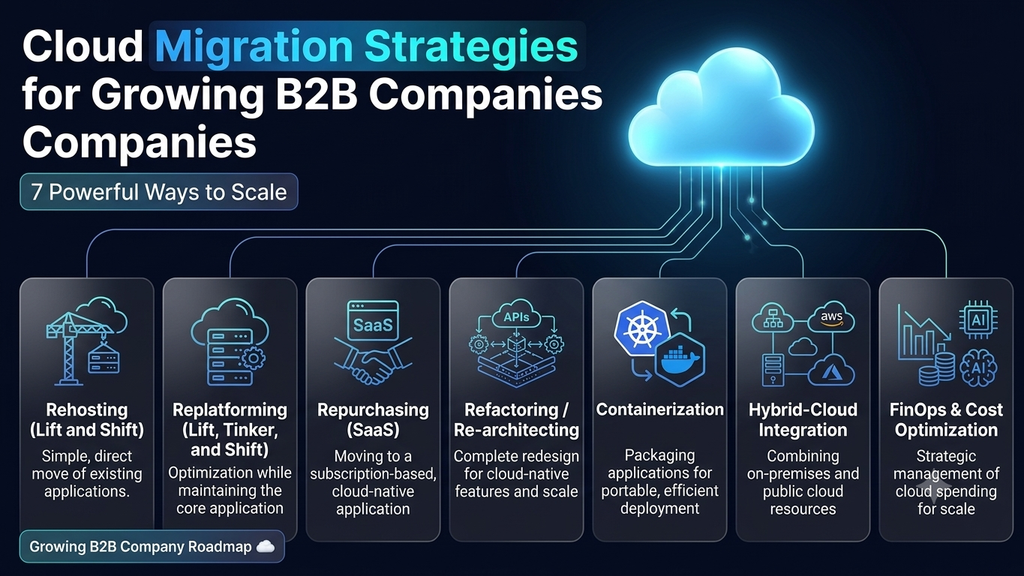
Cloud Migration Strategies for Growing B2B Companies: 7 Powerful Ways to Scale
Cloud migration strategies for growing B2B companies play an important role in building scalable, secure, and cost-efficient technology infrastructure. As businesses expand their customer base, introduce new digital services, and manage increasingly complex operations, traditional IT infrastructure can become difficult to maintain. Moving applications, data, and workloads to the cloud can help businesses address these challenges while creating opportunities for long-term growth.
However, cloud migration involves more than transferring files and applications from on-premises servers to a cloud platform. A successful migration requires careful planning, workload assessment, security controls, financial analysis, and coordination between technology and business teams. Without a clear strategy, organizations may experience unexpected costs, application disruptions, performance issues, or difficulties managing their new environments.
For B2B organizations, the goal should be to align cloud adoption with measurable business outcomes. Whether a company operates a SaaS platform, provides IT services, manages enterprise applications, or supports a distributed workforce, the right cloud migration approach can improve operational flexibility and prepare its technology environment for future demands. This guide explores seven practical strategies to help growing B2B companies plan and execute cloud migration effectively.
Why Cloud Migration Matters for Growing B2B Companies
As B2B companies grow, their technology requirements often become more demanding. More customers generate additional transactions and data, new markets introduce different operational requirements, and expanding teams need reliable access to business applications. Infrastructure that once supported a small organization may struggle to meet these changing demands.
Cloud computing provides an alternative to relying exclusively on company-owned infrastructure. Businesses can provision computing resources, storage, databases, and networking capabilities according to their needs. Depending on the architecture and services selected, they can also improve deployment flexibility, automate infrastructure management, and support geographically distributed operations.
For example, a B2B SaaS provider experiencing increased customer adoption may need additional application capacity without purchasing and installing new physical servers. A cloud-based architecture can help the provider scale resources as demand changes, provided that the application is designed and configured to support that flexibility.
Key business benefits of cloud migration can include:
- Scalability: Adjust computing and storage resources as workloads and customer demand change.
- Operational flexibility: Provision infrastructure and deploy applications without relying exclusively on physical hardware procurement.
- Business continuity: Use appropriate backup, replication, and disaster recovery capabilities to support recovery objectives.
- Security management: Apply centralized identity controls, monitoring, encryption, and other cloud security capabilities.
- Cost visibility: Track resource consumption and allocate infrastructure spending to teams, projects, or business units.
- Faster innovation: Give development teams access to modern platforms, managed services, and automated deployment workflows.
These benefits are not automatic. They depend on the selected cloud architecture, implementation quality, operational processes, and ongoing governance.
7 Cloud Migration Strategies for Growing B2B Companies
Choosing the right approach requires understanding the organization’s existing infrastructure, application dependencies, security requirements, and growth plans. The following cloud migration strategies for growing B2B companies provide a practical framework for making those decisions.
1. Assess Existing Infrastructure Before Migration
A detailed infrastructure assessment is the foundation of a successful cloud migration. Before selecting a cloud provider or moving applications, businesses need to understand what they currently operate, how their systems interact, and which workloads are suitable for migration.
This assessment should cover applications, databases, servers, storage systems, network dependencies, integrations, licensing arrangements, and security requirements. It should also identify applications that are no longer needed or that would benefit from modernization before migration.
For B2B organizations, this step is especially important when business applications support customer portals, enterprise resource planning systems, customer relationship management platforms, financial operations, or service delivery workflows. Effective cloud migration strategies begin with a clear understanding of existing IT infrastructure, application dependencies, and business priorities. This assessment helps B2B companies identify potential risks, allocate resources efficiently, and create a migration roadmap that supports future business growth.
How to conduct a cloud readiness assessment
Start by creating an inventory of existing IT assets and classifying each workload according to business importance, technical complexity, and migration readiness. Identify dependencies between applications so that moving one system does not unintentionally disrupt another.
A practical assessment should answer questions such as:
- Which applications are essential to daily business operations?
- What are the current infrastructure costs and performance limitations?
- Which systems contain sensitive or regulated information?
- Which applications can move with minimal changes, and which require redesign?
- What availability and recovery requirements apply to each workload?
For example, a growing B2B services company might find that its internal reporting application is relatively easy to migrate, while its customer-facing platform depends on several interconnected databases and third-party integrations. Treating these workloads differently can reduce migration risk and improve planning accuracy.
The outcome should be a documented inventory, dependency map, workload classification, and prioritized migration roadmap.
2. Choose the Right Cloud Migration Approach for Each Workload
Not every application needs the same migration method. Some systems can move to cloud infrastructure with minimal changes, while others may require architectural improvements or complete redevelopment. The right cloud migration strategies depend on application complexity, security requirements, budget, and future scalability needs. Evaluating these factors helps businesses choose a migration approach that balances implementation speed, operational efficiency, and long-term technology goals.
Selecting the appropriate approach helps organizations balance migration speed, technical complexity, business continuity, and long-term modernization goals.
Common cloud migration approaches
Rehosting (lift and shift) involves moving applications to cloud infrastructure with limited architectural changes. It can be useful when a business needs to exit a data center quickly or move relatively stable workloads.
Replatforming introduces selected optimizations during migration without completely redesigning the application. For example, a company might move an application to cloud infrastructure while adopting a managed database service.
Refactoring or re-architecting changes an application’s design to take advantage of cloud-native capabilities, such as managed services, container orchestration, or event-driven processing. This can offer long-term flexibility but typically requires more engineering effort.
Repurchasing replaces an existing application with a cloud-based software product, such as a SaaS solution, when the replacement better fits business requirements.
Retiring or retaining involves decommissioning unnecessary systems or keeping certain workloads in their existing environments when migration is not currently justified.
The right choice depends on the application’s business value, technical condition, cost, and future requirements.
For example, a B2B software company may rehost a legacy reporting application to reduce infrastructure management work while refactoring its core customer platform to support changing transaction volumes. A single migration strategy across every workload would be less appropriate than a workload-by-workload plan.
3. Prioritize Security and Compliance From the Beginning
Security should be built into cloud migration planning rather than treated as a final implementation step. Security-focused cloud migration strategies help B2B organizations protect sensitive business information during infrastructure changes. Implementing access controls, encryption, continuous monitoring, and compliance checks before migration can help reduce avoidable security risks.Moving workloads into a cloud environment changes how infrastructure is provisioned, how access is managed, and how systems are monitored.
B2B organizations may handle customer records, commercial agreements, financial information, intellectual property, and confidential operational data. Weak security controls can expose these assets and undermine customer trust.
Cloud providers supply a range of security capabilities, but customers remain responsible for configuring and using many of those capabilities correctly. The exact division of responsibility depends on the cloud service model and provider.
Essential cloud security practices
- Identity and access management: Apply least-privilege access and multifactor authentication where appropriate.
- Data encryption: Protect sensitive information in transit and at rest using suitable encryption controls.
- Network segmentation: Restrict communication between systems according to business and security requirements.
- Continuous monitoring: Collect logs, monitor suspicious activity, and establish appropriate incident response procedures.
- Backup protection: Secure backups against accidental deletion, unauthorized access, and ransomware-related risks.
- Compliance mapping: Identify applicable contractual, industry, and legal requirements before choosing storage locations and services.
Consider a B2B SaaS company that stores customer information across multiple environments. Before migration, the company should map where the data resides, determine which employees and services require access, and establish controls for data movement and retention.
Security validation should continue after migration through access reviews, vulnerability assessments, configuration checks, and periodic testing. This makes security an ongoing operational responsibility rather than a one-time migration milestone.
4. Build a Cloud Cost Optimization Plan
Cloud migration can change the way IT spending is managed, but moving workloads to the cloud does not automatically reduce costs. Poorly sized resources, unused environments, unnecessary data transfers, excessive storage retention, and inefficient application architectures can increase expenditure.
Growing B2B companies should therefore evaluate both migration costs and ongoing operating expenses before committing to a cloud design.
How to manage cloud migration costs
Begin by estimating the total cost of ownership for the proposed environment. Include infrastructure consumption, migration tools, software licenses, networking, security services, backup storage, support, staff training, and ongoing operations.
Next, establish financial governance practices that help teams understand and control consumption.
- Right-size resources: Match compute, memory, and storage capacity to actual workload requirements.
- Use autoscaling carefully: Adjust capacity according to demand where the workload supports it.
- Remove unused resources: Identify abandoned development environments, unattached storage, and unnecessary services.
- Set budgets and alerts: Monitor spending and notify teams when consumption approaches defined thresholds.
- Apply tagging and allocation: Assign resources to business units, products, customers, or projects.
- Review pricing commitments: Evaluate suitable reserved-capacity or savings plans against actual usage patterns and contractual flexibility.
For example, a B2B analytics platform may run intensive workloads during business hours but experience lower demand overnight. Scheduling nonproduction resources and using demand-based scaling where appropriate can help control spending.
Cloud financial management should continue after migration. Regular reviews help businesses understand whether infrastructure expenditure supports customer growth, product development, and operational efficiency.
5. Develop a Phased Migration Roadmap
Migrating every application at once can increase operational risk, particularly when systems support customer transactions or time-sensitive business processes. Well-planned cloud migration strategies allow growing B2B companies to move applications in manageable stages. This approach gives technical teams time to test workloads, resolve issues, validate security controls, and improve migration procedures before moving business-critical systems.A phased migration allows teams to validate assumptions, learn from early workloads, and refine procedures before moving more complex systems.
The roadmap should reflect business priorities, technical dependencies, application criticality, and available resources.
A practical phased migration model
Phase 1: Discovery and planning
Document applications, dependencies, security requirements, cost baselines, and desired business outcomes. Select initial workloads that are manageable and provide meaningful learning opportunities.
Phase 2: Pilot migration
Move a limited workload into the target environment. Validate performance, connectivity, access controls, backup procedures, monitoring, and cost assumptions.
Phase 3: Migration of priority workloads
Use the lessons from the pilot to migrate additional applications in planned groups. Coordinate application owners, infrastructure teams, security specialists, and business stakeholders.
Phase 4: Production validation
Confirm that migrated systems meet their functional, security, performance, and availability requirements. Test business workflows rather than relying only on infrastructure health checks.
Phase 5: Optimization and modernization
Remove redundant infrastructure, improve resource allocation, refine monitoring, and identify applications that would benefit from further modernization.
For example, a B2B manufacturing company could begin by migrating internal development environments, then move selected reporting systems, and finally address business-critical production applications after dependencies and recovery procedures have been validated.
Every phase should include defined acceptance criteria and a documented rollback or recovery plan. This helps the organization manage disruption without making unnecessary compromises to business continuity.
6. Strengthen Data Migration and Business Continuity Planning
Data migration is often one of the most sensitive parts of a cloud project. Business applications may rely on large databases, scheduled data exchanges, external integrations, and strict consistency requirements. Moving the infrastructure without planning how data will be transferred and validated can lead to service interruptions or inaccurate records.
A sound data migration strategy considers data volume, transfer methods, downtime limits, integrity checks, access controls, and the relationships between dependent systems.
Best practices for migrating business data
- Classify data: Identify sensitive, business-critical, archival, and redundant information.
- Select a transfer method: Choose online transfer, offline transfer, replication, or a combination based on data volume and downtime constraints.
- Validate data integrity: Reconcile record counts, checksums where appropriate, application-level results, and critical business transactions.
- Plan the cutover: Define the migration window, responsibilities, communication process, and criteria for switching production traffic.
- Test recovery procedures: Verify that backups can be restored and that recovery processes meet the organization’s objectives.
- Retain a rollback option: Establish a controlled process for returning to the previous environment when migration acceptance criteria are not met.
For example, a B2B e-commerce business migrating its order management system may need to coordinate customer accounts, inventory records, payment integrations, and order history. A staged transfer and carefully controlled cutover can help reduce the risk of inconsistent records or interrupted order processing.
Business continuity planning should also establish recovery time objectives (RTOs) and recovery point objectives (RPOs). RTO defines the target time to restore a service, while RPO defines the acceptable amount of data loss measured in time.
These objectives should be based on business impact rather than assumptions about what a cloud platform can deliver by default.
7. Prepare Teams for Cloud Operations and Continuous Improvement
Cloud migration changes more than infrastructure. It also affects how technology teams provision resources, deploy applications, monitor systems, manage incidents, and control spending.
Organizations that move to the cloud without updating their operational practices may carry old inefficiencies into a new environment. Clear ownership, relevant skills, automation, and governance are therefore essential for long-term success.
Build an effective cloud operating model
First, define responsibility for infrastructure management, security, application performance, cost control, and incident response. Teams should understand which tasks are handled by the cloud provider and which remain their responsibility.
Next, establish repeatable operating practices.
- Infrastructure as code: Use version-controlled configuration to deploy and manage infrastructure consistently.
- CI/CD automation: Standardize application testing and deployment to reduce manual errors.
- Observability: Combine logs, metrics, traces, and alerts to investigate system behavior.
- Cloud governance: Define approved configurations, resource policies, tagging standards, and access rules.
- Team enablement: Train developers, administrators, and security teams in the tools and responsibilities relevant to their roles.
- Continuous optimization: Review performance, reliability, security, and spending on a regular schedule.
For example, a B2B software development company can use automated deployment pipelines and infrastructure templates to create consistent environments for development, testing, and production. This reduces configuration differences and helps teams deliver changes more predictably.
The organization should also track business and technical outcomes after migration. Useful measures include service availability, deployment frequency, recovery performance, infrastructure cost per workload, and application response time.
Cloud migration should be treated as the beginning of an improvement cycle rather than the end of a project.
Common Cloud Migration Challenges B2B Companies Should Avoid
Even with a clear strategy, cloud migration can encounter technical, financial, and organizational obstacles. Identifying these challenges early makes it easier to plan realistic timelines and allocate appropriate resources.
Migrating without a clear business objective
Moving infrastructure simply because cloud adoption is a priority can lead to unnecessary expenditure and limited business value. Define the intended outcomes first, such as improving scalability, reducing data center dependency, supporting faster deployments, or strengthening recovery capabilities.
Underestimating application dependencies
Applications often depend on databases, authentication services, network configurations, scheduled jobs, and external systems. Incomplete dependency mapping can cause failures when components are migrated in the wrong order.
Treating security as a post-migration task
Cloud environments require deliberate configuration and ongoing monitoring. Establish access controls, data protection requirements, logging, and security validation before workloads enter production.
Ignoring ongoing cloud costs
Cloud spending can grow when resources are provisioned without ownership, capacity is poorly matched to demand, or data movement is overlooked. Introduce budgets, tagging, and recurring cost reviews early.
Overlooking employee readiness
New cloud tools and operating models may require different skills and responsibilities. Provide training and document operational procedures before retiring the systems and processes that teams currently depend on.
Failing to test recovery plans
A backup is useful only if it can be restored within acceptable business limits. Test restoration, application dependencies, and recovery workflows before relying on them in production.
How to Measure the Success of a Cloud Migration Strategy
A successful cloud migration should be evaluated against the business outcomes established during planning. Completing the technical transfer is not enough if the new environment remains expensive, unreliable, difficult to manage, or poorly aligned with customer requirements.
B2B companies should establish baseline measurements before migration and compare them with results after the new environment has stabilized.
| Performance area | Example measurement | Why it matters |
|---|---|---|
| Cost efficiency | Infrastructure cost per application or transaction | Shows how spending relates to business activity |
| Performance | Application response time and throughput | Helps validate user experience and workload suitability |
| Reliability | Availability and incident frequency | Measures operational stability |
| Recovery | Actual RTO and RPO test results | Evaluates business continuity readiness |
| Delivery speed | Time required to deploy a change | Shows whether teams can deliver improvements efficiently |
| Security | Access review results and unresolved critical findings | Helps assess security control effectiveness |
| Scalability | Performance under changing workload demand | Indicates whether the architecture supports growth |
The appropriate targets will vary by business, workload, and service requirements. A customer-facing SaaS platform may prioritize availability and response time, while an internal analytics system may place greater emphasis on data processing costs and reporting speed.
Regular reviews help organizations identify where further optimization or modernization is justified.
Conclusion
Cloud migration strategies help growing B2B companies build scalable, secure, and cost-efficient technology infrastructure. A successful approach combines infrastructure assessment, workload prioritization, security planning, cost optimization, and continuous monitoring to support long-term business objectives.
A phased roadmap allows businesses to validate their assumptions and reduce risk while building the skills and operating processes needed to manage cloud infrastructure effectively. Once workloads have migrated, ongoing optimization, performance monitoring, governance, and recovery testing help ensure that the new environment continues to meet business needs.
For B2B organizations planning their next stage of growth, cloud migration is an opportunity to modernize the technology foundation supporting customers, employees, and business operations. By focusing on measurable outcomes instead of migration alone, companies can build a more adaptable infrastructure that supports sustainable growth and future innovation.