


Artificial intelligence is transforming how businesses operate, but its adoption is not always happening in a coordinated way. AI Governance is becoming an essential business priority as employees and departments independently discover, purchase, and implement AI-powered tools to improve their daily workflows. Marketing teams are generating content and analysing customer behaviour, sales departments are automating prospect research, HR teams are experimenting with recruitment assistants, and finance professionals are using AI to simplify reporting. Although these initiatives can deliver meaningful productivity improvements, they also introduce a larger organisational challenge: how can a company ensure that individual AI initiatives support the same business objectives?
The challenge is not necessarily that employees are using too much artificial intelligence. It is that businesses may not have a clear understanding of which tools are being used, what information they access, how their outputs are evaluated, or whether different departments are working with compatible systems. Without an effective AI governance framework, independent experimentation can result in duplicated technology investments, fragmented information, security vulnerabilities, and inconsistent decision-making.
For enterprise leaders, the next stage of AI adoption is therefore about more than introducing additional tools. It requires connecting departmental innovation with organisational priorities, establishing clear accountability, and creating an environment where employees can use AI responsibly. The companies that approach AI governance strategically will be better positioned to turn individual productivity improvements into sustainable business value.
1. Why Independent Departmental AI Adoption Creates Business Challenges
AI adoption often begins with individual employees identifying opportunities to simplify their work. Someone discovers a platform that summarises lengthy reports, another finds an assistant that generates marketing content, and someone else starts using an AI-powered application to organise customer information.
These experiments are understandable. Employees naturally look for solutions that help them complete repetitive tasks, reduce administrative work, and improve productivity. Many AI tools are also relatively accessible, allowing teams to experiment without waiting for a large technology implementation project. An effective AI Governance strategy helps businesses identify these gaps early and establish consistent standards for technology adoption across departments.
However, individual productivity does not automatically translate into organisational efficiency.
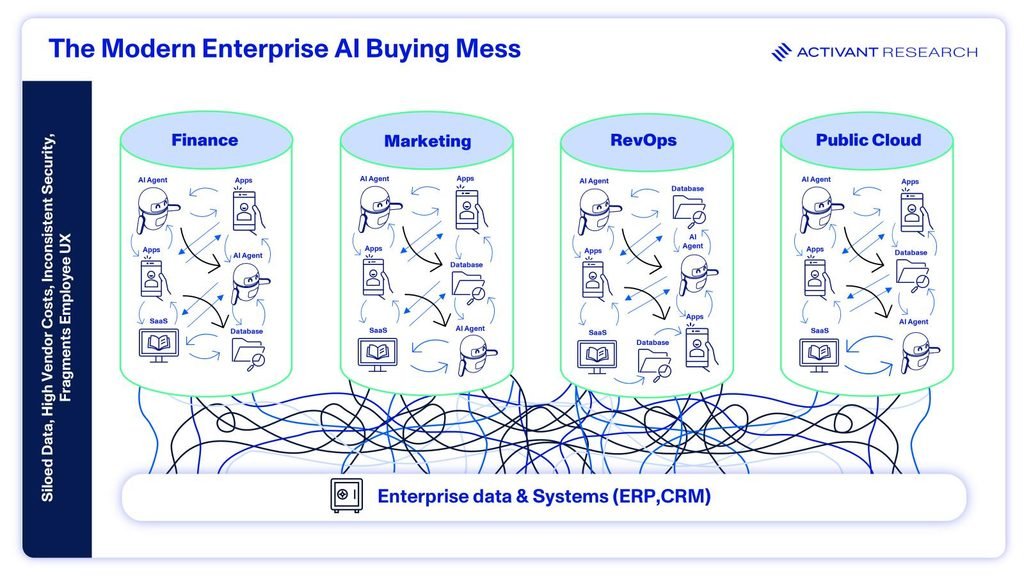
When departments independently select their own AI solutions, businesses can gradually develop disconnected technology environments. Different teams may use separate platforms, maintain independent datasets, follow inconsistent workflows, and purchase overlapping subscriptions.
This creates several challenges:
- Technology fragmentation: Departments operate different AI platforms that may not communicate effectively.
- Duplicated investments: Multiple teams purchase tools that provide similar capabilities.
- Information silos: Important business insights remain isolated within individual departments.
- Inconsistent processes: Employees follow different methods for generating, reviewing, and using AI outputs.
- Limited visibility: Management struggles to understand which AI applications are being used across the organisation.
This is where AI governance becomes important. Rather than restricting every department to identical technology, organisations need a framework that connects independent experimentation with shared business standards.
The objective is to ensure that departmental innovation contributes to enterprise-wide productivity instead of creating another layer of operational complexity.
2. How Disconnected AI Tools Affect Collaboration Between Departments
One of the biggest risks associated with independent AI adoption is the possibility that departments develop different understandings of the same business information.
Consider a company where marketing and sales teams use separate AI platforms to analyse customer behaviour.
The marketing department might use an AI application to identify audience interests, evaluate campaign engagement, and generate personalised content. Meanwhile, the sales team could rely on another platform to research prospects, prepare outreach messages, and summarise customer conversations.
Both teams may become more productive individually. However, their understanding of customers might be based on different information.
Marketing could identify a prospect as highly interested in a particular service because of their engagement with an article. Sales, however, may have discovered through direct conversations that the prospect has a completely different requirement.
Without effective information sharing, marketing may continue producing irrelevant content while sales spends additional time correcting misunderstandings.
This demonstrates an important limitation of disconnected AI adoption: technology can make individual processes faster without necessarily improving communication between them.
The impact on customer experience
When AI platforms operate independently, the customer journey can become fragmented.
For example:
- Marketing generates personalised campaigns using outdated customer engagement information.
- Sales prepares outreach messages without access to the latest marketing insights.
- Customer support uses a separate knowledge system that does not reflect recent product updates.
- Management receives different performance summaries from different departmental platforms.
These situations can create inconsistent customer interactions and make it difficult to maintain a unified understanding of business performance.
Effective AI governance should therefore encourage appropriate data sharing, system integration, and common information standards.
The goal is not to eliminate specialised departmental applications. It is to ensure that these applications operate within a connected enterprise environment.
3. The Hidden Cost of Multiple AI Platforms and Overlapping Investments
Another challenge emerges when several departments purchase AI applications that perform similar functions. Through AI Governance, organisations can evaluate existing subscriptions, identify overlapping capabilities, and make more informed technology investment decisions.
Marketing might subscribe to a platform that generates reports and analyses customer engagement. Sales may purchase another application with overlapping reporting capabilities, while management introduces a separate AI assistant to summarise business performance.
Meanwhile, the organisation’s existing CRM, ERP, business intelligence, or productivity software may already provide some of these capabilities.
Without central visibility, decision-makers may approve additional subscriptions without understanding what the company already owns.
The financial impact extends beyond licensing costs. Every additional platform can introduce administrative responsibilities, integration requirements, security assessments, employee training, and ongoing maintenance.
Businesses may also encounter difficulties when employees transfer information between applications manually.
Where duplicated AI investments create problems
- Subscription expenses: Multiple departments pay for similar capabilities.
- Integration costs: IT teams must connect applications that were purchased independently.
- Training requirements: Employees need to learn different interfaces and workflows.
- Administration overhead: Permissions, accounts, renewals, and access policies become harder to manage.
- Reporting inconsistencies: Different platforms may generate competing versions of business information.
A structured AI governance framework can help organisations establish an inventory of AI applications, review existing technology investments, and evaluate new purchases before approval.
This does not mean every department must use one universal AI platform. Specialised tools can still be valuable when they address specific business requirements.
The important consideration is whether a new application provides measurable benefits that justify its financial and operational costs.
4. Data Security and Confidentiality Must Be Part of AI Governance
As employees experiment with different AI applications, data security becomes an increasingly important enterprise concern.
Business users regularly work with information that should only be accessible through approved systems. This may include customer records, commercial proposals, financial reports, employee information, internal documents, and confidential business strategies. Strong AI Governance also ensures that employees understand their responsibilities when handling confidential information through third-party AI applications.
When employees use unapproved AI platforms, they may unintentionally expose information to services that have not undergone the organisation’s security and privacy assessments.
The risks depend on the particular application, its configuration, contractual terms, data-handling practices, retention policies, and access controls.
An application being popular or easy to use does not automatically make it suitable for processing confidential business information.
What organisations should establish
An effective AI governance policy should define:
- Approved AI applications: Maintain a list of tools that have undergone appropriate security and procurement reviews.
- Data classification: Clearly identify which information can be used with AI applications and which information requires additional protection.
- Access management: Ensure that employees only access information and AI capabilities appropriate to their responsibilities.
- Data retention policies: Understand how different platforms handle submitted information and generated outputs.
- Vendor assessments: Review security practices, contractual commitments, privacy terms, and relevant compliance requirements.
- Incident reporting: Establish a process for reporting suspected data exposure or inappropriate AI usage.
These guidelines should be practical enough to support everyday business activities.
An organisation that completely prohibits AI experimentation may encourage employees to use personal accounts or unapproved applications without informing IT. Conversely, unrestricted adoption can introduce risks that remain invisible until an incident occurs.
The better approach is to establish clear AI governance policies that protect business information while giving employees access to suitable technology.
5. AI-Generated Insights Need Verification and Clear Accountability
AI applications can generate market analysis, summarise customer feedback, recommend business strategies, and identify patterns in financial information.
However, the quality of these outputs depends on the available data, the assumptions used, the capabilities of the system, and the context of the task.
Different departments may use separate platforms that produce conflicting conclusions about the same business question.
For example, one AI platform might estimate market demand using historical customer information, while another generates a different estimate based on broader market assumptions.
If managers cannot identify the information sources or evaluation methods behind these results, they may struggle to determine which output deserves consideration.
The problem is not that AI systems are always inaccurate. It is that convincing, well-presented answers can sometimes appear more reliable than the evidence supporting them.
Why human oversight remains essential
Businesses should establish verification practices based on the importance and potential consequences of each AI-assisted task.
Consider the following examples:
- Marketing: Verify product claims, statistics, references, and campaign messaging before publication.
- Sales: Confirm prospect information and review AI-generated communications before sending them to customers.
- Finance: Validate calculations, assumptions, and financial conclusions against reliable source data.
- Human resources: Review AI-assisted recruitment recommendations for relevance, fairness, and potential bias.
- IT and security: Evaluate AI-generated technical recommendations before implementing changes to production systems.
AI governance should also establish who is responsible for approving important decisions.
Employees should understand that AI-generated outputs are recommendations or assistance, not automatic replacements for professional judgement.
When AI influences significant financial, operational, recruitment, or customer-related decisions, accountability must remain clearly assigned to appropriate human decision-makers.
6. Align Departmental AI Initiatives With Shared Business Objectives
Different departments naturally measure productivity in different ways.
Marketing teams may focus on campaign performance and content production. Sales departments prioritise prospecting efficiency and revenue generation. HR teams may measure recruitment efficiency, while finance departments concentrate on reporting accuracy and cost management.
These priorities are all legitimate, but they do not always align automatically.
For example, marketing might use AI to increase the volume of published content. However, sales may need fewer campaigns that attract more relevant prospects.
Similarly, HR could introduce AI-assisted candidate screening to reduce administrative work, while hiring managers may discover that the system does not adequately capture the experience or potential required for a particular role.
This is why enterprise AI adoption needs shared objectives.
Instead of measuring success through the number of AI applications deployed or tasks automated, businesses should evaluate whether AI improves outcomes that matter to the organisation.
Establish common performance indicators
Depending on the business function, useful evaluation areas may include:
| Business Function | AI Initiative | What to Measure |
|---|---|---|
| Marketing | AI-assisted content and campaign analysis | Engagement quality, campaign effectiveness, and content accuracy |
| Sales | Prospect research and communication assistance | Research efficiency, prospect relevance, and conversion performance |
| HR | Recruitment and employee training assistance | Administrative efficiency, process quality, and fairness |
| Finance | Financial reporting and analysis | Reporting accuracy, processing time, and consistency |
| IT | AI-assisted technical operations | Resolution efficiency, reliability, and security |
| Customer Support | AI-assisted customer service | Response quality, resolution rates, and customer satisfaction |
These indicators should reflect actual business requirements rather than encouraging departments to maximise AI usage for its own sake.
An effective AI governance framework connects departmental performance with wider organisational goals, making it easier for leadership to understand where technology is delivering meaningful value.
7. Build a Practical AI Governance Framework for Enterprise Adoption

AI governance does not require senior executives to understand every technical detail of every available platform.
It requires leadership to establish clear responsibilities, technology standards, risk management processes, and evaluation practices.
A practical framework should provide enough flexibility for departments to experiment while maintaining appropriate organisational oversight.
Step 1: Identify existing AI applications
Start by understanding which AI tools employees and departments are already using.
Create an inventory covering:
- Application and service names.
- Business owners and departments.
- Primary use cases.
- Types of information accessed.
- Integration requirements.
- Security and privacy considerations.
- Subscription and operational costs.
This provides management with a clearer understanding of the organisation’s existing AI environment.
Step 2: Establish clear usage policies
Develop practical rules that explain which applications employees can use, what information they can share, and which activities require additional approval.
Policies should reflect the organisation’s actual operational and regulatory requirements.
Step 3: Create an approval and evaluation process
Before introducing a new AI application, departments should assess whether it solves a genuine business problem.
Evaluation should consider functionality, security, privacy, integration compatibility, total cost, and potential overlap with existing applications.
Step 4: Encourage appropriate system integration
Where practical, AI applications should connect with approved business systems and information sources.
Integration can reduce manual data transfers, improve information consistency, and support better collaboration across departments.
Step 5: Define ownership and accountability
Every significant AI initiative should have an identifiable business owner.
IT, security, legal, compliance, and departmental stakeholders should have clearly defined responsibilities based on the application’s purpose and risk.
Step 6: Monitor performance and emerging risks
AI governance should not end when an application receives approval.
Organisations should periodically review performance, usage, costs, access permissions, security considerations, and whether the technology continues to meet business requirements.
Step 7: Improve employee awareness and training
Employees need practical guidance on using AI responsibly, identifying unreliable outputs, protecting confidential information, and understanding when human review is necessary.
Training should be relevant to actual departmental responsibilities rather than relying entirely on generic AI awareness sessions.
Together, these steps help businesses create an AI governance structure that supports innovation without sacrificing security, accountability, or operational consistency.
8. Employee Training and Responsible AI Adoption Go Hand in Hand
Providing employees with access to AI applications is only one part of successful enterprise adoption.
People also need to understand how these systems work, what their limitations are, and how their outputs should be evaluated.
An employee who can generate a report using AI may not necessarily know how to verify its conclusions. A salesperson who uses AI for prospect research may not recognise when the application has generated outdated or inaccurate information.
Similarly, marketing professionals need to review generated claims, finance employees must validate calculations, and HR teams should understand the limitations and fairness considerations associated with AI-assisted recruitment.
Organisations should develop training programmes that reflect the specific responsibilities of different teams.
Department-specific AI training should cover
- Marketing: Content verification, brand consistency, copyright considerations, and responsible use of customer information.
- Sales: Prospect research validation, communication accuracy, and responsible customer data handling.
- HR: Recruitment oversight, fairness, candidate privacy, and appropriate human decision-making.
- Finance: Data accuracy, calculation verification, confidentiality, and reporting controls.
- IT: Security assessments, access management, integration standards, and application monitoring.
Employee training also creates opportunities to share successful AI experiments across the organisation.
When one department discovers an effective solution, its experience can help other teams avoid unnecessary experimentation and duplicated investments.
This turns AI adoption into a shared organisational learning process rather than a collection of isolated departmental activities.
9. How Leadership Can Turn Departmental AI Experiments Into Enterprise Value
Ultimately, the success of AI adoption depends on how effectively organisations connect technology with their people, processes, and business objectives.
Leadership must move beyond evaluating individual applications and consider how the entire technology environment operates.
This requires collaboration between executive management, IT teams, security professionals, and departmental leaders.
A central AI governance structure can help coordinate these responsibilities without forcing every department to follow identical workflows.
For example, leadership might establish approved enterprise AI platforms for common activities while allowing specialised departments to request additional applications when justified by genuine operational requirements.
Regular reviews can then help management determine whether these initiatives are delivering measurable value, creating unnecessary complexity, or introducing risks that need attention.
What successful enterprise AI management should achieve
- Better visibility into departmental AI usage.
- Reduced duplication of technology investments.
- Improved information sharing across business functions.
- Stronger protection of confidential business data.
- Consistent standards for evaluating AI-generated outputs.
- Clear ownership of important AI-assisted decisions.
- Better alignment between technology investments and business priorities.
The purpose of AI governance is not to centralise every decision or prevent employees from experimenting.
It is to create the conditions in which useful experimentation can scale across the organisation without compromising operational control.
Businesses that achieve this balance can move from isolated productivity improvements towards more connected, intelligent, and efficient operating models.
Conclusion
Artificial intelligence is changing how individual departments work, but departmental productivity alone is not enough to create a successful enterprise-wide transformation. When marketing, sales, HR, finance, and IT independently adopt AI tools without a shared direction, organisations can experience fragmented information, duplicated investments, inconsistent processes, and increased security risks.
AI Governance provides the structure businesses need to manage these challenges while continuing to encourage innovation. By establishing clear usage policies, improving technology visibility, protecting confidential information, defining accountability, and aligning departmental initiatives with shared objectives, organisations can turn independent experimentation into coordinated business value.
The companies that benefit most from artificial intelligence will not necessarily be those that purchase the largest number of tools or automate the greatest number of tasks. They will be the organisations that understand how individual AI capabilities fit into a larger business ecosystem.
The future of enterprise AI is not simply about giving every employee a smarter assistant. It is about ensuring that all those assistants help the organisation work towards the same goals. Strong AI governance makes that possible.
Frequently Asked Questions
What is AI Governance?
AI governance refers to the policies, processes, responsibilities, and controls organisations establish to manage artificial intelligence responsibly. It helps businesses oversee AI usage, protect information, evaluate outputs, manage risks, and ensure that AI initiatives align with organisational objectives.
Why is AI Governance important for businesses?
AI governance is important because employees and departments may independently adopt different AI applications. Without appropriate oversight, this can create security vulnerabilities, duplicated investments, fragmented information, and inconsistent decision-making. Governance helps organisations manage these challenges while supporting innovation.
What is Shadow AI in an organisation?
Shadow AI refers to the use of AI applications by employees or departments without formal approval or adequate organisational oversight. It can introduce data security, privacy, compliance, and operational risks, particularly when confidential business information is shared with unapproved platforms.
How can companies manage departmental AI adoption?
Companies can manage departmental AI adoption by maintaining an inventory of existing tools, establishing approved usage policies, introducing application evaluation procedures, defining ownership, and conducting regular reviews. They should also encourage collaboration between IT and departmental leaders.
Does AI Governance mean every department must use the same AI tools?
No. Different departments have different operational requirements, and specialised applications may provide significant benefits. AI governance establishes shared standards for security, procurement, integration, accountability, and responsible usage without requiring every team to use identical technology.
How does AI Governance improve data security?
AI governance helps organisations define which information can be shared with AI applications, identify approved platforms, manage employee access, assess vendor security practices, and establish data retention and incident reporting policies. These controls reduce the risk of inappropriate information exposure.
Who should be responsible for AI Governance in an enterprise?
AI governance should be a shared organisational responsibility. Executive leadership provides strategic direction, IT and security teams oversee technical requirements, legal and compliance teams assess relevant obligations, and departmental leaders manage business-specific usage. Clear ownership should be established for individual AI initiatives.
How can organisations measure the success of AI adoption?
Businesses can evaluate AI adoption through relevant operational and business indicators, such as processing efficiency, reporting accuracy, customer experience, employee productivity, operating costs, and risk reduction. Measurements should reflect actual business outcomes rather than simply counting the number of AI tools deployed.
What is the difference between AI Governance and an AI strategy?
An AI strategy defines how an organisation plans to use artificial intelligence to achieve business objectives. AI governance establishes the rules, responsibilities, processes, and safeguards that guide how those AI initiatives are selected, implemented, monitored, and managed.
How can employees use AI responsibly at work?
Employees should use approved applications, follow organisational data protection policies, verify AI-generated information, avoid sharing confidential information without authorisation, and seek human review for important decisions. Role-specific training helps employees understand these responsibilities in their everyday work.