


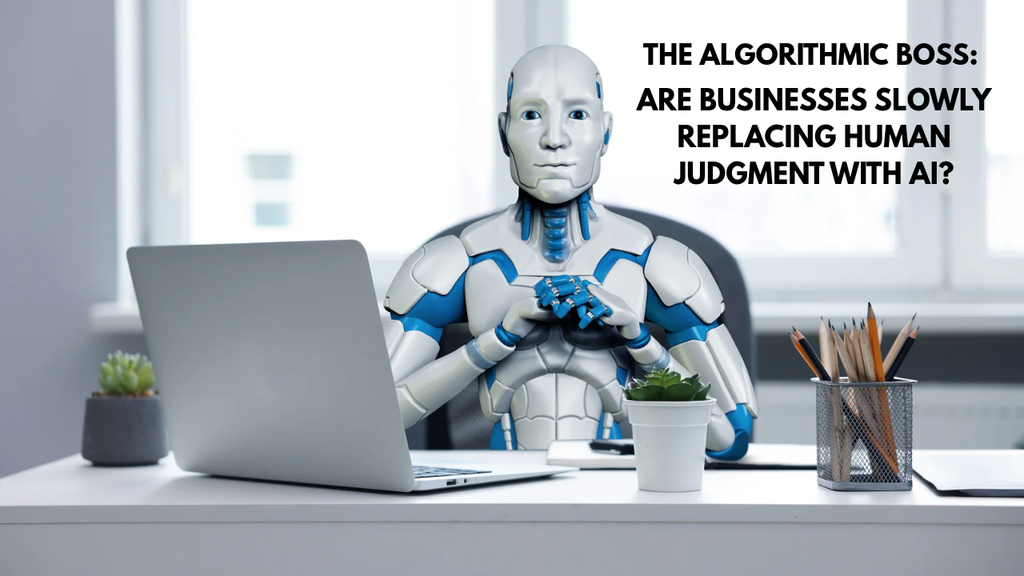
AI-driven decision-making is gradually transforming how modern businesses operate, influencing everything from recruitment and employee performance to customer relationships, sales strategies, and corporate leadership. Artificial intelligence is no longer just a technology that supports administrative tasks or automates repetitive processes. It is increasingly becoming an influential part of the decision-making process, often shaping business outcomes without employees or customers fully recognizing its involvement.
Organizations are adopting AI-powered systems because they promise faster analysis, greater consistency, improved efficiency, and the ability to identify patterns that traditional decision-making might overlook. From predicting customer behaviour to evaluating business opportunities, algorithms are helping leaders make decisions using increasingly sophisticated data insights. For businesses operating in competitive markets, these capabilities offer significant advantages.
However, beneath the growing enthusiasm for artificial intelligence lies a more important question: Are businesses becoming so dependent on algorithms that they are gradually losing their ability to exercise independent human judgment? The concern is not simply whether AI can make mistakes. It is whether organizations will continue questioning its recommendations, understanding its limitations, and accepting responsibility for the decisions made with its assistance.
The Rise of AI-Driven Decision-Making in Modern Businesses –
Business decision-making has traditionally depended on managerial experience, professional expertise, collaboration, and an understanding of organizational circumstances. Although these approaches are not always perfect, they allow decision-makers to consider factors that extend beyond numerical data.
AI is changing this approach by introducing systems capable of processing large volumes of information, identifying patterns, and generating recommendations within seconds. As a result, AI-driven decision-making is becoming increasingly relevant across enterprise operations, influencing both routine activities and strategic business decisions.
For example, organizations are using AI-powered tools to:
- Recruitment: Analyze applications, identify relevant qualifications, and support candidate shortlisting.
- Sales: Predict conversion opportunities, prioritize potential customers, and recommend sales strategies.
- Marketing: Analyze customer behaviour, personalize campaigns, and identify changing market preferences.
- Human resources: Support workforce planning, performance analysis, and employee engagement initiatives.
- Business strategy: Evaluate operational patterns, identify potential risks, and support resource allocation.
These applications demonstrate how artificial intelligence can improve the speed and accessibility of business intelligence.
However, the growing influence of AI also introduces a fundamental distinction between receiving a recommendation and making a responsible decision. An algorithm can identify patterns in historical data, but understanding whether those patterns should influence a particular business decision requires context, interpretation, and judgment.
The real challenge for organizations is therefore not simply adopting AI but determining how much authority they should give it.
Why Businesses Are Trusting Algorithms More Than Human Judgment –
The growing adoption of AI in business decision-making is understandable. Human decisions can be influenced by personal preferences, emotional reactions, incomplete information, organizational politics, and unconscious biases. Even experienced managers can struggle to evaluate complex situations when information is scattered across different systems.
Artificial intelligence offers an alternative approach by analyzing information systematically and applying defined criteria across large datasets.
For enterprises, this can create several operational advantages.
Faster and More Consistent Decisions –
AI systems can process information much faster than traditional manual workflows. This is particularly valuable for organizations handling thousands of customer interactions, applications, transactions, or operational records.
Data-Driven Business Insights –
Algorithms can identify relationships and patterns that may not be immediately visible to human decision-makers. These insights can help businesses understand customer preferences, recognize operational inefficiencies, and identify potential opportunities.
Reduced Dependence on Manual Analysis –
By automating repetitive analytical activities, AI allows employees to spend more time on complex responsibilities that require communication, creativity, and strategic thinking.
Nevertheless, consistency should never be confused with correctness.
An AI system may repeatedly recommend similar candidates, prioritize certain customer segments, or identify the same types of business opportunities because its underlying data reflects historical patterns. Those patterns may contain outdated assumptions or existing organizational biases.
A recommendation can appear objective simply because it comes from a machine. Yet the information used to train the system, the criteria selected by its developers, and the objectives established by the organization all influence its outputs.
The biggest mistake businesses can make is assuming that an algorithmic recommendation is automatically an unbiased or accurate decision.
The Accountability Problem: Who Is Responsible When AI Makes a Decision?
One of the most important concerns surrounding algorithmic decision-making is accountability.
When a manager makes a decision, the organization can generally ask why it was made, what information influenced it, and whether alternative approaches were considered. The decision-maker can explain the reasoning and accept responsibility for the outcome.
AI introduces additional complexity.
When a decision is influenced by an automated system, responsibility can become less clear. Managers may rely on AI-generated performance scores, recruitment teams may follow automated candidate rankings, and sales departments may prioritize opportunities based on predictive recommendations.
In these situations, employees may begin treating the algorithm as the final authority rather than a source of information.
This creates several organizational risks:
- Unclear ownership: Employees may struggle to identify who is responsible for decisions influenced by automated systems.
- Reduced transparency: Decision-makers may not fully understand how a recommendation was generated.
- Limited challenge: Employees may hesitate to question an AI recommendation because they assume the system has evaluated more information than they have.
- Weaker accountability: Managers may use technological explanations to avoid taking responsibility for difficult decisions.
For enterprise organizations, this is not merely a technology governance issue. It is a leadership challenge.
AI should strengthen accountability by giving decision-makers better information and clearer insights. However, without appropriate governance, organizations risk creating environments where responsibility becomes distributed across people, platforms, and automated processes.
Businesses must establish clear ownership of AI-assisted decisions and ensure that human decision-makers remain accountable for their consequences.
How Algorithmic Management Is Changing the Employee Experience –
AI-driven management is transforming not only how organizations make decisions but also how employees experience authority, performance evaluation, and workplace expectations.
Modern organizations increasingly use productivity dashboards, automated performance indicators, predictive analytics, and workforce management platforms to understand employee activity.
These systems can help managers identify operational challenges and improve workforce planning. However, problems emerge when organizations assume that measurable activity represents actual employee value.
Consider a salesperson who spends several days developing a relationship with a major enterprise customer. Their work may involve multiple discussions, internal coordination, technical consultations, and negotiations.
Another salesperson may generate a much higher number of customer interactions but contribute less to long-term business growth.
If an AI system evaluates performance primarily through activity-based indicators, it may favour the second employee despite the greater strategic contribution of the first.
The same challenge can appear across departments.
- An employee solving complex technical problems may generate fewer measurable outputs than someone performing repetitive tasks.
- A creative professional may require considerable time to develop an effective solution that cannot be evaluated through simple productivity metrics.
- A manager supporting employee development may contribute long-term organizational value that is difficult to capture in automated performance reports.
The Risk of Measuring Activity Instead of Contribution –
AI systems are only as useful as the information and objectives guiding them. If an organization prioritizes easily measurable indicators, automated evaluation may reinforce the belief that visible activity is more valuable than meaningful contribution.
Human managers can sometimes recognize important contextual factors that numerical indicators overlook, including creativity, collaboration, professional development, unexpected responsibilities, and the complexity of individual assignments.
This is why AI-driven employee management should support managerial understanding rather than replace it.
Organizations need to ensure that performance evaluations consider both measurable outcomes and the broader context of employee contributions.
Are Business Leaders Becoming Intellectually Dependent on AI?
Another emerging concern is the possibility that AI could gradually influence not only business decisions but also the way leaders think.
Consider a business executive who regularly uses an AI-powered platform to identify new markets, evaluate investment opportunities, prioritize customers, and assess organizational performance.
Initially, the system may function as a valuable decision-support tool. It provides additional information and helps the executive evaluate possibilities more efficiently.
However, repeated dependence on AI recommendations can gradually change the decision-making process.
Instead of independently evaluating a situation and using AI to validate assumptions, managers may begin waiting for algorithmic recommendations before forming their own opinions.
This creates a form of intellectual dependency.
The concern is particularly relevant for emerging leaders who develop their professional judgment in workplaces where AI-generated insights are readily available.
If managers become accustomed to accepting recommendations without understanding their underlying assumptions, they may become less confident when dealing with situations that require independent thinking.
Why Independent Thinking Still Matters –
Business environments frequently involve uncertainty, incomplete information, changing customer expectations, and unexpected market conditions.
Historical data can provide useful insights, but it cannot guarantee that previous patterns will continue.
Leaders must still be capable of:
- Questioning the assumptions behind AI-generated recommendations.
- Identifying missing or incomplete information.
- Recognizing situations where historical patterns may no longer apply.
- Considering ethical and organizational consequences.
- Making informed decisions when AI recommendations conflict with practical experience.
The most effective leaders will not necessarily be those who use AI for every decision. They will be those who understand how to combine algorithmic insights with independent reasoning.
The Hidden Risks of Treating AI Recommendations as Final Decisions –
AI systems can improve organizational efficiency, but their outputs should always be evaluated within the context of the decisions they influence.
A major concern is that organizations may gradually develop a culture where questioning AI becomes unusual.
When employees repeatedly see automated recommendations being accepted without discussion, they may begin assuming that the technology is more reliable than human interpretation.
This can create several risks.
Historical Bias Can Influence Future Decisions –
AI systems trained on historical organizational data may reproduce patterns that reflect earlier biases or outdated business practices.
For example, a recruitment system using historical hiring information could favour candidate profiles similar to those previously selected, potentially limiting the diversity of future applicants.
Incomplete Data Can Produce Misleading Recommendations –
An algorithm cannot automatically account for information that is missing from its inputs.
A customer classified as unlikely to purchase may actually be preparing for a significant enterprise contract that has not yet been reflected in the available data.
Changing Business Conditions Can Reduce Relevance –
Markets, customer expectations, technologies, and competitive environments change. A recommendation based on previous patterns may become less relevant when business conditions shift.
Ethical Considerations Cannot Be Reduced to Performance Scores –
A decision may improve operational efficiency while creating negative consequences for employees, customers, or other stakeholders.
Organizations must consider these broader implications rather than evaluating decisions exclusively through numerical outcomes.
The lesson is clear: AI recommendations should be treated as informed inputs, not unquestionable instructions.
Building a Responsible AI Strategy Without Losing Human Judgment –
Businesses do not need to choose between artificial intelligence and human decision-making. The more effective approach is to establish a framework in which technology improves decision quality while people retain appropriate oversight and accountability.
Responsible AI adoption requires more than purchasing software or integrating intelligent systems into existing workflows. It requires clear policies, employee awareness, leadership involvement, and ongoing evaluation.
Organizations should consider the following practices.
Establish Clear Boundaries for AI Decision-Making –
Not every business decision requires the same level of human involvement.
Routine and repetitive activities, such as data classification, scheduling, and basic information processing, may benefit from substantial automation.
However, decisions involving employee welfare, recruitment outcomes, customer relationships, strategic investments, and significant ethical considerations require appropriate human review.
Maintain Human Oversight for High-Impact Decisions –
Businesses should identify decisions where automated recommendations could have substantial consequences.
Human decision-makers should have the authority and relevant information to review, question, and override AI-generated recommendations when necessary.
Improve AI Literacy Across the Organization –
Employees should understand more than how to operate AI tools.
Training should also explain how AI systems generate recommendations, where their limitations may exist, and why outputs require contextual interpretation.
This helps employees become informed users rather than passive followers of automated systems.
Monitor Performance and Identify Potential Biases –
AI systems should be evaluated regularly to determine whether they continue producing useful and appropriate outcomes.
Organizations should examine whether their systems rely on relevant data, whether their recommendations align with business objectives, and whether unintended patterns are influencing decisions.
Create a Culture Where Questioning AI Is Encouraged –
Employees should feel comfortable challenging recommendations without being perceived as resistant to technological change.
Constructive questioning can help organizations identify inaccurate assumptions, missing information, and opportunities to improve their AI systems.
Ultimately, responsible AI adoption is not about limiting innovation. It is about ensuring that innovation strengthens organizational capabilities without weakening human responsibility.
The Future of Business Leadership: Human Intelligence and AI Must Work Together –
The future of business leadership will not be determined by whether organizations adopt artificial intelligence. AI is already becoming an important part of enterprise operations, and its influence on business processes is likely to continue expanding.
The more important question is how leaders choose to integrate it into their organizations.
Businesses that rely exclusively on traditional decision-making may struggle to benefit from the speed, analytical capabilities, and operational opportunities offered by AI. On the other hand, organizations that blindly follow algorithmic recommendations risk losing the human understanding required to navigate complex situations.
The strongest approach combines computational intelligence with human reasoning.
AI can help leaders identify patterns, evaluate alternatives, process information, and recognize potential risks. Human decision-makers bring contextual understanding, professional experience, ethical reasoning, creativity, and responsibility.
Conclusion –
AI-driven decision-making is reshaping the relationship between technology, leadership, and organizational responsibility. Artificial intelligence is helping businesses process information faster, identify opportunities, improve operational efficiency, and make more informed decisions. However, these advantages should not come at the expense of independent thinking and human accountability.
The growing influence of algorithms creates important questions about who makes business decisions, who takes responsibility for their outcomes, and whether organizations are becoming overly dependent on automated recommendations. When AI outputs are treated as unquestionable answers, businesses risk overlooking context, reinforcing historical biases, and weakening the judgment that effective leadership requires.
The solution is not to resist artificial intelligence but to adopt it responsibly. Businesses must establish clear governance structures, maintain human oversight for important decisions, educate employees about AI limitations, and encourage a workplace culture where technological recommendations can be questioned.
Frequently Asked Questions
AI-driven decision-making refers to using artificial intelligence technologies to analyze business information, identify patterns, generate predictions, and recommend actions. Organizations use it across recruitment, sales, marketing, customer management, financial planning, and operational activities.
AI is increasingly influencing decisions traditionally made by managers and employees. However, it does not automatically replace the contextual understanding, ethical reasoning, experience, and accountability required for effective human judgment. The extent of its influence depends on how organizations implement and govern these systems.
Major risks include algorithmic bias, incomplete information, limited transparency, unclear accountability, excessive dependence on automated recommendations, and decisions that overlook important human or organizational circumstances.
Algorithmic management uses AI and automated systems to monitor, evaluate, and support workforce decisions. While it can improve operational visibility, excessive reliance on automated performance indicators may overlook creativity, collaboration, complex problem-solving, and other valuable employee contributions.
AI cannot automatically guarantee unbiased decisions. Its outputs can reflect limitations, biases, or outdated patterns within its training data and decision-making processes. Organizations need appropriate testing, monitoring, transparency, and human oversight to identify potential problems.