

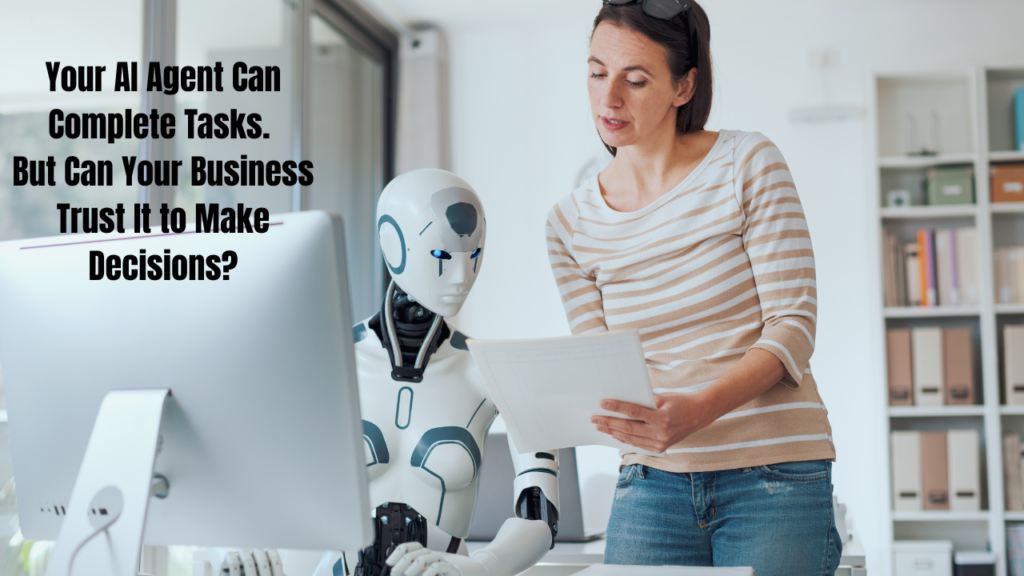
AI agents in business are moving beyond answering questions and generating recommendations to executing tasks, interacting with enterprise software, and making decisions that influence real business outcomes. From customer service and sales operations to finance, procurement, and IT management, these systems are creating new opportunities to automate complex workflows, improve operational efficiency, and support faster decision-making. However, as AI agents gain greater independence, organizations face an important challenge: ensuring that their actions are not only efficient but also reliable, secure, and aligned with business objectives.
The appeal of agentic AI is easy to understand. An AI agent can retrieve information from multiple systems, interpret instructions, coordinate a sequence of activities, and complete work that previously required substantial human involvement. For enterprises managing complex processes and growing volumes of data, this capability can reduce repetitive effort, accelerate workflows, and help employees focus on higher-value responsibilities. Yet the ability to execute a task successfully does not automatically mean an AI agent can make a sound business decision.For organizations implementing AI agents in business, building trust requires evaluating decision accuracy, operational risks, and the level of autonomy appropriate for each workflow.
For organizations adopting AI agents in business, the priority is to balance automation efficiency with reliable decision-making and appropriate human oversight.
For business leaders, the real question is no longer whether AI can perform work independently. It is whether the organization can trust the system to act within appropriate boundaries, recognize uncertainty, protect sensitive information, and escalate decisions when human judgment is necessary. Building that trust requires more than choosing a capable AI model. It demands a thoughtful combination of data quality, governance, security, human oversight, performance measurement, and controlled implementation.By establishing these safeguards, businesses can use AI agents in business to improve operational efficiency while maintaining control over critical decisions and outcomes.
Artificial intelligence is moving beyond tools that answer questions, summarize documents, generate content, or recommend the next step. A new generation of AI agents is being designed to carry out sequences of tasks, interact with software systems, retrieve information from multiple sources, and take actions with varying degrees of independence. In a business environment, an AI agent might review incoming customer requests, gather information from a CRM, prepare a response, update records, identify a potential sales opportunity, or help coordinate a complicated workflow that previously required several employees and multiple applications.
The attraction is understandable: if AI can do more than produce recommendations and can also complete the work associated with those recommendations, organizations may be able to reduce repetitive effort, accelerate processes, and free employees to focus on more valuable responsibilities. However, the ability to execute a task is not the same as the ability to make a sound business decision. An agent may successfully complete every step in a workflow while acting on incomplete information, misunderstanding a customer’s circumstances, overlooking an important exception, or making a choice that conflicts with the organization’s broader priorities.
This creates a crucial question for businesses adopting agentic AI: how much independence should an intelligent system receive when its actions can affect customers, revenue, operations, security, or reputation? The answer cannot depend solely on how impressive the technology appears during a demonstration. It must depend on the consequences of its decisions, the reliability of its information, the controls surrounding its actions, and the organization’s ability to understand and correct what happens.
AI Agents in Business: Balancing Task Automation and Decision-Making
The difference between task automation and decision-making becomes clearer when AI agents are introduced into everyday business operations. Consider a customer support agent that can read incoming requests, retrieve account information, identify a relevant policy, and draft a response. If the request concerns a routine question with a clearly documented answer, the agent may be able to handle the process with minimal intervention. For enterprises adopting AI agents in business, the key is to distinguish between routine tasks that can be automated and complex decisions that require human judgment.
However, if the customer disputes an invoice, requests an exception to a contract, or raises a complaint involving sensitive circumstances, the same workflow becomes more complicated. The agent must understand not only the words in the request but also the relevant policy, the customer’s history, the limits of its authority, and the possible consequences of its response. A technically correct answer may still be commercially inappropriate if it ignores an earlier commitment or creates an expectation the business cannot fulfil. Similar challenges appear in sales, finance, human resources, procurement, and IT, where seemingly straightforward actions can carry implications that are not obvious from the immediate task.
An agent that updates a customer record may affect future sales decisions; one that approves a routine expense may need to recognize unusual circumstances; and one that changes a system configuration may create a security or availability risk. The more an AI system moves from producing information to taking action, the more important it becomes to define what the system is permitted to do, which decisions require additional evidence, and when a human must become involved.
One of the most common mistakes organizations can make is assuming that a high level of accuracy on a narrow task automatically makes an AI agent suitable for independent operation. A system might perform well when tested on familiar examples but behave differently when faced with incomplete records, conflicting instructions, unusual customer requests, or a process that has changed since its training or configuration.
Real business environments are rarely as predictable as controlled demonstrations. Information may be spread across disconnected applications, employees may use inconsistent terminology, and important decisions may depend on exceptions that exist only in internal documents or experienced employees’ knowledge. An agent can retrieve several pieces of information and still fail to recognize that one source is outdated or that two records refer to different situations. It may also interpret an instruction too broadly, continue a process when it should stop, or confidently present an assumption as though it were a verified fact. These risks do not mean AI agents have no place in business operations.
They mean that reliability must be assessed under realistic conditions rather than inferred from a few successful examples. Before granting an agent greater autonomy, organizations should test how it responds to ambiguous requests, conflicting information, unusual scenarios, and situations in which the correct action is to ask for clarification or decline to proceed. The ability to recognize uncertainty and stop safely can be just as important as the ability to complete a task quickly.
Data Quality and Governance for AI Agents in Business
The quality of the information available to an AI agent is another major factor in determining whether its decisions can be trusted. Businesses often operate with a patchwork of CRM platforms, enterprise resource planning systems, spreadsheets, communication tools, shared drives, customer databases, and specialist applications. Each system may contain a different part of the information required to make a decision, and those records may not always agree.
A sales platform might show that an opportunity is active while a finance system indicates that the customer’s account is overdue. A product database might contain updated specifications while an older document still describes a discontinued feature. An employee might have received an approval through email that has not yet been recorded in the official workflow. When an AI agent works across these systems, it needs more than access to information; it needs a clear understanding of which sources are authoritative, how recent the information is, and how conflicting records should be handled.
Without those rules, automation can increase the speed at which incorrect assumptions move through the organization. Businesses should therefore establish dependable data sources, define ownership for important records, maintain appropriate access controls, and create clear procedures for handling missing or inconsistent information. They should also distinguish between information an agent can safely use to prepare a recommendation and information it is authorized to use when making a consequential decision. A sophisticated agent cannot compensate reliably for a business environment in which critical information is inaccurate, inaccessible, or poorly governed.
Trust also depends on giving AI agents clearly defined boundaries rather than unrestricted access to every system they might theoretically need. In practical terms, an agent designed to summarize sales conversations does not necessarily need permission to alter contract terms, issue refunds, export an entire customer database, or approve financial transactions. For AI agents in business to operate securely, access should be limited to the specific information and actions required for the assigned workflow.
Effective governance ensures that these systems operate within clearly defined permissions while protecting sensitive information and reducing operational risks. In practical terms, an agent designed to summarize sales conversations does not necessarily need permission to alter contract terms, issue refunds, export an entire customer database, or approve financial transactions. Access should be limited to the specific information and actions required for the assigned workflow.
Where possible, organizations can separate the ability to read information from the ability to change it, require additional approval for high-impact actions, and impose limits on transaction values, frequency, or scope. Sensitive actions should be recorded so that the organization can determine what happened, which information the agent used, and which rules governed the decision. These controls become particularly important when agents interact with external systems, because an error can move beyond an internal recommendation and directly affect a customer, supplier, employee, or business partner. Security teams must also consider the possibility that an agent may encounter misleading instructions embedded in documents, emails, websites, or other content it processes.
Such material should be treated as information to evaluate, not as authority to override the agent’s approved instructions or access restrictions. Strong governance is therefore not an obstacle added after automation has been implemented. It is part of the design that allows an organization to benefit from autonomous systems without granting them more power than the business can responsibly supervise.
Human oversight is frequently discussed as a safeguard for AI, but the phrase can mean very different things in practice. Asking an employee to approve every action may reduce certain risks, yet it can also create a bottleneck that undermines the efficiency the agent was supposed to deliver. At the other extreme, allowing an agent to operate independently without meaningful review can make errors difficult to detect until they have caused damage.
The more useful approach is to design oversight according to the level of risk. Routine, reversible, and clearly defined actions may be suitable for automated execution when the system has demonstrated consistent performance. Actions involving significant financial commitments, sensitive personal information, legal obligations, employee decisions, or substantial customer impact may require explicit human authorization or specialist review. There should also be a clear escalation path for situations in which the agent encounters conflicting evidence, exceeds its confidence threshold, reaches the limits of its permissions, or identifies a case outside the approved workflow.
Employees responsible for oversight need enough context to evaluate the proposed action rather than simply clicking an approval button. They should be able to see the relevant evidence, understand the reason for the recommendation, and reject or modify the action when necessary. Most importantly, the organization must establish who is accountable for the outcome. Delegating execution to an AI agent does not remove management responsibility for the processes, policies, and decisions that the organization chooses to automate.
Measuring the value of AI agents requires the same level of care as evaluating their risks. Businesses can be tempted to judge success by the number of tasks completed, the speed of execution, or the percentage of interactions handled without human involvement. These measures may be useful operational indicators, but they do not necessarily reveal whether the business is performing better.When evaluating AI agents in business, organizations should measure improvements in productivity, decision quality, customer outcomes, and risk management rather than task completion alone.
An agent that resolves customer requests quickly but increases the number of repeat complaints may be creating additional work rather than reducing it. A system that processes more sales enquiries but generates inaccurate records may leave the sales team with a larger administrative burden. An automated procurement workflow might shorten processing times while overlooking opportunities to negotiate better terms. In each case, the system appears productive when measured by activity, but the business outcome tells a different story.
Organizations should establish a baseline before implementation and evaluate the agent against outcomes that matter to the specific process. These might include resolution quality, error rates, cost per completed task, customer satisfaction, compliance, time saved, revenue impact, or the number of cases requiring rework. They should also monitor how performance changes as workflows become more complex or business conditions evolve. The goal is not to maximize autonomy for its own sake. It is to determine whether granting the agent a particular level of independence produces a measurable improvement without creating unacceptable risks or hidden costs.
AI Agents in Business: A Practical Guide to Controlled Implementation
A practical way to build confidence in AI agents is to introduce them gradually rather than moving directly from a successful pilot to unrestricted deployment. Initially, an agent can operate in an observation or recommendation mode, examining information and proposing actions without executing them. Employees can compare its recommendations with their own decisions, document discrepancies, and identify the circumstances in which the system performs well or requires additional context.
Once the organization has evidence that the workflow is reliable, it can permit the agent to execute a limited set of low-risk actions while maintaining monitoring and clear rollback procedures. The next stage may involve expanding its responsibilities to additional scenarios, provided that each expansion is supported by testing, performance data, and appropriate controls. This process should include realistic edge cases rather than only routine examples, because unusual situations often reveal weaknesses that are invisible during normal operation.
Businesses should also decide in advance what would trigger a pause, a return to human review, or a rollback to an earlier configuration. Changes to the underlying model, connected applications, permissions, or business rules may affect performance and should be evaluated accordingly. By treating deployment as a controlled progression rather than a one-time launch, organizations can learn where autonomy creates genuine value, correct weaknesses early, and expand the agent’s responsibilities based on evidence instead of enthusiasm.
The people working alongside these systems will also need to adapt. As AI agents take over more routine execution, employees may spend less time entering information, preparing initial drafts, or coordinating repetitive administrative steps. However, their responsibilities may increasingly involve defining objectives, checking assumptions, managing exceptions, interpreting results, and making decisions that require contextual understanding.
This shift calls for more than technical training on how to use an AI tool. Employees need to understand the limits of automated recommendations, recognize when information may be incomplete, identify actions that require escalation, and know how to challenge a result that does not make sense. Managers, meanwhile, need to redesign workflows so that employees are not simply placed at the end of an automated process to approve decisions without sufficient time or information.
Businesses should communicate clearly about which responsibilities are changing, how performance will be evaluated, and where human expertise remains essential. They should also involve the people who perform the work when designing automated processes, because these employees often understand the exceptions, dependencies, and practical constraints that are difficult to capture in formal documentation. The strongest results are likely to come from organizations that treat AI agents as part of a broader operating model, combining machine speed and consistency with human judgment, accountability, and an understanding of business context.
The successful adoption of AI agents in business depends on combining intelligent automation with trustworthy data, effective governance, and clear human accountability.
Ultimately, the question businesses should ask is not whether an AI agent can complete a task without human assistance. It is whether the agent can complete that task reliably, within defined boundaries, using appropriate information, while producing an outcome that the organization is willing to stand behind. More capable AI systems create opportunities to rethink how work is organized, how decisions are supported, and how employees spend their time.
But greater capability also increases the importance of governance, security, testing, and accountability. Organizations that focus only on the number of tasks they can automate may overlook the consequences of giving intelligent systems authority over increasingly important business processes. Those that establish clear rules, measure meaningful outcomes, and expand autonomy carefully can make more informed decisions about where AI belongs and where human involvement remains necessary.
The objective is not to prevent AI from making decisions, nor is it to hand over every decision simply because the technology can act independently. It is to create a thoughtful balance between automation and oversight, allowing AI agents to handle work they can perform reliably while ensuring that consequential choices remain appropriately controlled. The real competitive advantage will not come from giving AI agents the freedom to do everything. It will come from knowing exactly what they should be trusted to do, what they should never do alone, and how to tell the difference.