


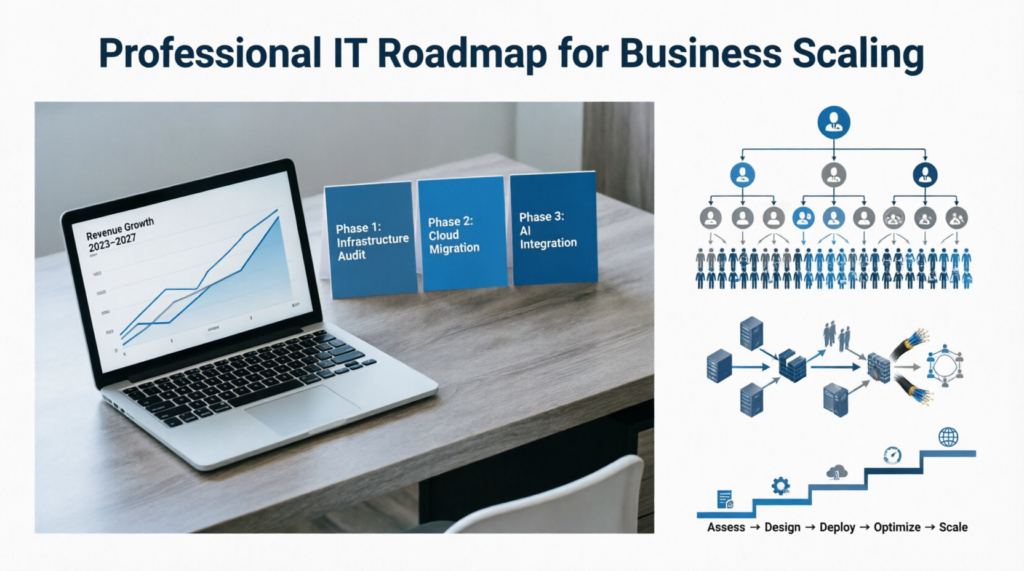
Scaling a B2B company from 10 to 100 employees is a major transition where informal systems stop working and structured IT becomes essential. At this stage, growth depends not only on hiring but also on how well technology supports communication, operations, and decision-making. A weak IT foundation can slow down expansion, while a well-planned roadmap enables smooth, controlled scaling.
Stage 1: 10–25 Employees (Foundation Stage)
At the earliest stage, companies should focus on building a simple but reliable IT base. Most teams operate with basic communication tools, shared drives, and simple workflows. However, this is also the best time to introduce cloud-based systems so the business can scale without rebuilding everything later. Using modern infrastructure like Cloud Computing ensures flexibility, remote access, and easy scaling. Even basic security measures such as authentication and access control should be introduced early.
Key Points:
- Set up basic communication and collaboration tools
- Use cloud-based storage and systems
- Introduce basic security practices
- Avoid overcomplicating tools at this stage
Stage 2: 25–50 Employees (Structure Stage)
As the team grows, informal processes begin to break. This is the stage where businesses need structured systems, especially for managing customers and sales. Implementing a CRM becomes critical for tracking leads, managing customer relationships, and improving visibility. Tools like Salesforce help bring structure to growing sales pipelines. Alongside this, companies should define clear workflows for sales, onboarding, and customer support to ensure consistency.
Key Points:
- Implement CRM system for sales and customer tracking
- Standardize internal business processes
- Improve team coordination and accountability
- Reduce dependency on manual tracking
Stage 3: 50–75 Employees (Integration Stage)
At this stage, multiple tools and teams start operating in parallel, which creates complexity. The main focus should be integration and automation. Systems like CRM, marketing tools, and support platforms must be connected to avoid data silos. Automation should be introduced for repetitive tasks such as lead assignment and reporting. At the same time, cybersecurity becomes more important as data exposure increases and threats like Ransomware become a real risk for growing companies.
Key Points:
- Integrate all business tools and platforms
- Automate repetitive workflows
- Strengthen cybersecurity systems
- Improve data flow between departments
Stage 4: 75–100 Employees (Scaling Stage)
In the final stage of this growth phase, the focus shifts from building systems to optimizing them. Businesses need more advanced infrastructure, better analytics, and stronger IT governance. Data becomes a key driver of decisions, and dashboards help leadership track performance in real time. At this stage, having a dedicated IT team is essential to manage systems, security, and scaling challenges effectively.
Key Points:
- Upgrade IT infrastructure for performance and scale
- Use analytics for decision-making
- Build a dedicated IT and security team
- Focus on system optimization, not just setup
IT Scaling Roadmap Summary
| Stage | Employee Size | Focus Area | Key IT Action |
|---|---|---|---|
| Foundation | 10–25 | Setup & Stability | Cloud tools, basic security |
| Structure | 25–50 | Organization | CRM, process standardization |
| Integration | 50–75 | Efficiency | Automation, system integration |
| Scaling | 75–100 | Optimization | Analytics, IT team expansion |
Conclusion
Scaling from 10 to 100 employees is not just operational growth—it is a shift in how a business functions at its core. Companies that invest early in structured systems, cloud infrastructure, automation, and security are able to scale smoothly without losing efficiency. A clear IT roadmap ensures that growth is controlled, predictable, and sustainable rather than chaotic.